Contract Signed but Not Stamped or Registered: Is It Still Valid?
Read More
MoU vs Agreement vs Contract: When Should Founders Use Each? (2026 Guide)
By the SolvLegal Team
Published on: Jan. 19, 2026, 2:03 p.m.
Quick Answer: What This Guide Helps You Decide
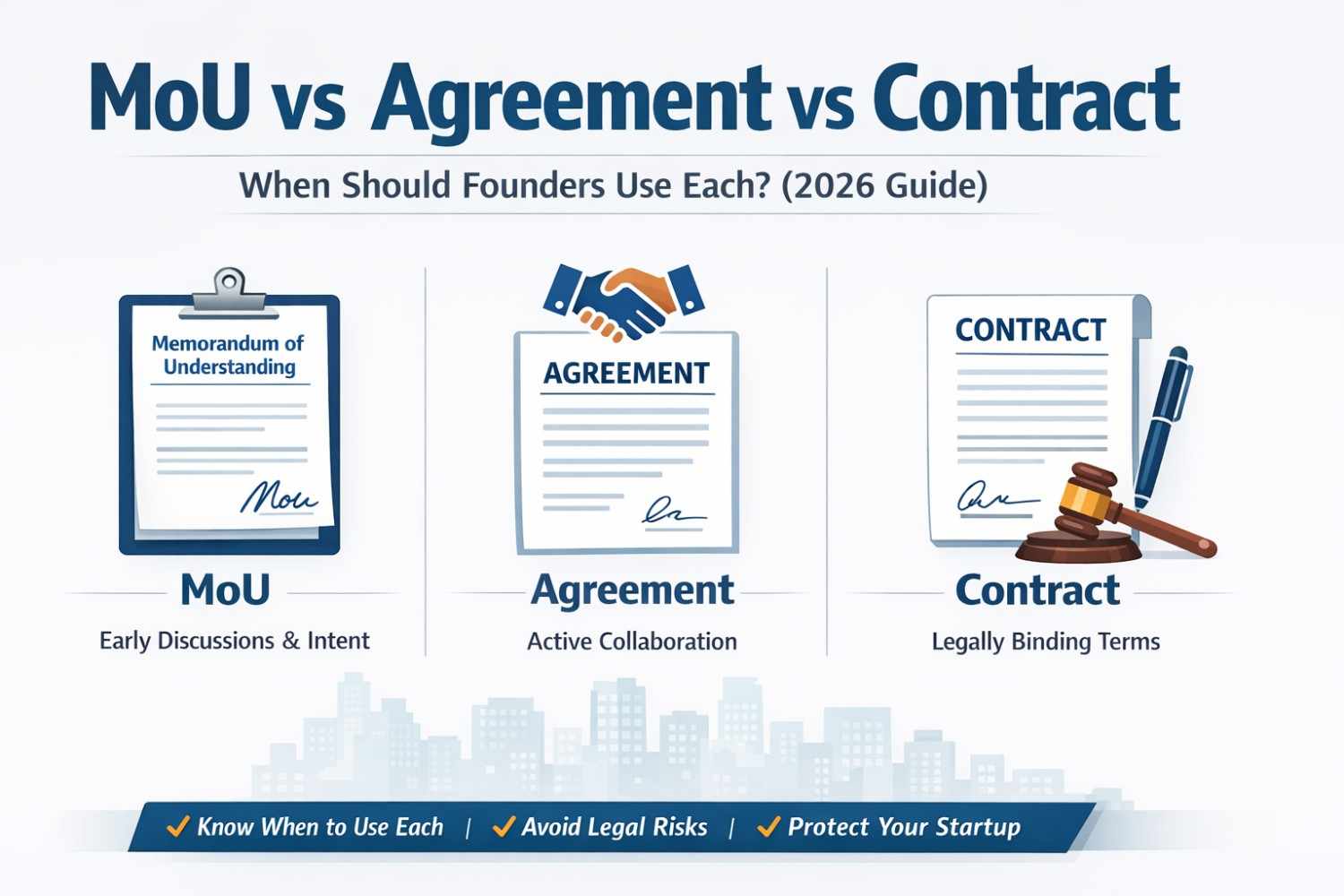
Founders often use the terms MoU, agreement, and contract interchangeably, assuming they mean the same thing. They don’t. Choosing the wrong document at the wrong stage can quietly weaken your legal position, delay deals, or create disputes you never intended.
This guide explains, in plain language, what each document is meant for, when founders should use an MoU instead of an agreement, when an agreement should be upgraded into a contract, and why simply naming a document does not decide whether it is legally binding. It focuses on real business situations, not textbook definitions.
By the end of this article, you should be able to confidently assess which document fits your situation, understand the risks of using the wrong one, and structure business discussions without overcomplicating or under-protecting yourself.
Why Founders Get Confused Between MoUs, Agreements, and Contracts
The confusion usually starts with language. In everyday business conversations, people use MoU, agreement, and contract as if they are interchangeable. Emails say “let’s sign an MoU,” founders say “we already have an agreement,” and someone else assumes that means a legally enforceable contract exists. In reality, the label used is often the least important part of the document.
Another reason for confusion is that founders are usually focused on speed and relationships, not legal structure. Early-stage discussions move fast. There is excitement, trust, and momentum. In that environment, documents are often seen as formalities rather than tools that allocate risk. An MoU feels lighter and less intimidating, so it is used even when the relationship has already crossed into commercial territory.
There is also a widespread misconception that MoUs are always non-binding and contracts are always binding. That is not how the law works. Courts look at the content of the document, the obligations created, and the intention of the parties, not just the heading on the first page. This is why founders are often surprised to learn that a casually drafted MoU can sometimes be enforced, while a poorly drafted “agreement” may not offer meaningful protection.
Templates add another layer of confusion. Founders frequently download documents from the internet or reuse old formats without understanding why certain clauses exist. The document may look professional, but it may not match the stage of the relationship or the commercial reality of the deal. Over time, this mismatch creates gaps that only become visible when something goes wrong.
Understanding this confusion is important because it shows why choosing between an MoU, an agreement, and a contract is not about terminology. It is about intent, risk, and timing. The next section breaks this down by explaining what an MoU is actually meant to do, and where founders often misuse it.
What an MoU Actually Is (and What It Is Not)
A Memorandum of Understanding, or MoU, is meant to capture intent, not conclude a deal. In business practice, it is used when parties want to record a shared understanding before committing to binding obligations. Founders often reach for an MoU when discussions are serious but still evolving, and when both sides want clarity without locking themselves into a full contractual framework.
An MoU is commonly used at the exploratory or alignment stage. It helps parties confirm that they are broadly on the same page about the nature of the collaboration, the roles they may play, and the direction the relationship could take. At this stage, flexibility matters more than enforceability. The MoU acts as a reference point for further negotiations rather than a tool for enforcement.
What an MoU is not meant to be is a substitute for a commercial contract. It is not designed to manage payments, detailed deliverables, liability, or long-term risk. Problems arise when founders start including commercial commitments in an MoU while still assuming it is “only a formality.” That assumption is often incorrect.
Founders usually use an MoU in situations such as:
· early-stage collaborations or pilot discussions,
· preliminary talks with partners or vendors,
· outlining intent before due diligence or detailed negotiations begin.
The key mistake is treating an MoU as harmless simply because it sounds informal. The law does not protect documents based on their name. If an MoU goes beyond intent and creates clear obligations, it can enter legally risky territory.
When an MoU Can Become Legally Binding
One of the biggest misconceptions founders have is that an MoU is always non-binding. In reality, courts do not care much about what you call a document. They care about what the document actually does. An MoU can become legally binding if its language and structure show that the parties intended to create enforceable obligations.
The first factor courts look at is intention. If the wording of the MoU shows that both sides intended to be bound by certain terms, the document may be enforced, even if it is titled “Memorandum of Understanding.” Phrases that sound casual to founders can still signal legal commitment when read in context.
The second factor is the nature of obligations included. An MoU that merely records intent and future discussion is usually safe. Problems arise when it starts including:
· fixed payment terms,
· specific deliverables or timelines,
· exclusivity clauses,
· confidentiality or non-compete obligations,
· penalties or consequences for non-performance.
Once these appear, the document begins to look less like a discussion note and more like a contract.
Another important factor is conduct after signing. If both parties act as though the MoU is binding, by performing obligations, making payments, or relying on it commercially, courts may treat it as enforceable regardless of the heading.
This is where founders often get caught off guard. An MoU signed to “move things forward” later becomes the basis of a dispute because one side assumed flexibility while the other assumed commitment. The mismatch is rarely intentional, but the consequences are real.
The takeaway is simple: if you want flexibility, your MoU must be drafted for flexibility. And if you are already committing to commercial terms, an MoU is probably the wrong document.
What an Agreement Is and Why Most Business Documents Fall Here
In practical business terms, most relationships do not jump straight from discussion to a full contract. They sit in the middle, and that middle ground is usually an agreement. An agreement is broader and more flexible than people assume, and this is why founders end up using it most often, sometimes without realising it.
An agreement records mutual promises and expectations between parties. Unlike an MoU, it is usually intended to govern how parties will actually work together, even if the arrangement is limited in scope or duration. It may not look as heavy as a formal contract, but it is no longer just about intent. It starts to regulate conduct.
Agreements are commonly used where:
· services are being provided on a defined basis,
· vendors or freelancers are being engaged,
· collaborations have moved beyond exploration but are not long-term,
· payments, timelines, or responsibilities need clarity.
This is why NDAs, service agreements, consultancy agreements, and partnership agreements are all, at their core, agreements.
What founders often miss is that many agreements are legally enforceable even if they are not labelled “contracts.” If there is clarity on obligations, consideration (something of value exchanged), and intention to be bound, an agreement can carry legal force. The difference is not the name, but the structure and seriousness of commitments.
At the same time, agreements are often drafted lighter than contracts. They may have fewer remedies, simpler termination clauses, or limited liability terms. This makes them suitable for relationships that are real but still evolving.
The risk arises when founders treat agreements casually, assuming they are “not fully legal yet.” That assumption can leave gaps around liability, IP ownership, dispute resolution, or exit terms. When money or business continuity is involved, those gaps matter.
What Makes a Contract Different (and Why It Carries More Weight)
A contract is not just a more formal version of an agreement. It is a document that is clearly intended to be legally enforceable, with defined consequences if things go wrong. This intention to create binding legal obligations is what remember, not the title printed on the first page.
What distinguishes a contract is the degree of certainty. Contracts usually deal with matters where ambiguity is costly: payments, deliverables, intellectual property, liability, termination, and dispute resolution. They are used when the relationship has moved beyond trust and discussion into reliance. At this stage, one party is making decisions, spending money, or committing resources based on the expectation that the other party will perform.
Unlike MoUs or lighter agreements, contracts are drafted with enforcement in mind. They anticipate disputes rather than assuming goodwill will always prevail. This does not mean parties expect conflict; it means they are realistic about risk. Clear remedies, jurisdiction clauses, indemnities, and limitation of liability provisions are not signs of mistrust. They are signs that the relationship has real commercial value.
For founders, contracts become essential when revenue is involved, when intellectual property is being created or transferred, or when long-term obligations are being undertaken. Investors, partners, and regulators all expect contracts at this stage because they provide predictability. An arrangement that affects ownership, money, or control without a proper contract is a red flag in due diligence.
The mistake many founders make is not using contracts too early, but using them too late. They allow a relationship to operate on informal agreements until something valuable is at stake, and then scramble to formalise it under pressure. By then, negotiating fair terms becomes harder.
Understanding when an agreement should mature into a contract is less about legal theory and more about recognising when your business can no longer afford uncertainty. The next section translates this into practical scenarios founders actually face.
Which One Should Founders Use - Practical Business Scenarios
The easiest way to decide between an MoU, an agreement, and a contract is to stop thinking in legal labels and start thinking in business stages. Each document fits a different level of commitment, risk, and reliance.
When you are still exploring a relationship, such as discussing a potential partnership, collaboration, or pilot project, an MoU usually makes sense. At this stage, neither side should be building dependencies. The goal is alignment, not enforcement. An MoU helps capture shared intent while keeping the door open to walk away if things don’t progress.
Once the relationship moves into actual performance, even on a limited scale, an agreement is more appropriate. This is where services are being rendered, work is being delivered, or payments are being made, but the engagement may still be short-term or flexible. Agreements work well for freelancers, vendors, early partnerships, or trial arrangements where clarity is needed, but the relationship is not yet core to the business.
A contract becomes necessary when your business starts relying on the other party in a meaningful way. This could involve revenue generation, ownership of intellectual property, long-term obligations, exclusivity, or significant financial exposure. At this point, uncertainty is no longer acceptable. You need enforceable rights, defined remedies, and clear exit mechanisms. This is also the stage where investors, auditors, and partners expect to see proper contracts in place.
Founders often get into trouble when they let a relationship outgrow the document governing it. An MoU used long after discussions have turned into execution, or a light agreement used for a relationship that now affects revenue or IP, creates silent legal risk. The document no longer matches reality.
The practical rule is simple: as the cost of failure increases, the strength of the document should increase with it. The next section looks at the common mistakes founders make when they ignore this progression.
Common Mistakes Founders Make While Using These Documents
· Using an MoU to avoid commitment instead of managing it
Founders often rely on MoUs even after discussions have turned commercial. While this feels flexible, it creates risk when payments, deliverables, or timelines are already in motion. The document no longer reflects the reality of the relationship.
· Assuming the title of the document decides its legal effect
Many founders feel protected because the document is labelled “MoU” or “Agreement.” In law, the heading matters far less than the content. If obligations are clearly written, the document may still be enforceable.
· Letting conduct override what the document says
Even loosely drafted documents gain legal weight when both parties act on them. Making payments, delivering work, or publicly relying on the arrangement can signal binding intent, regardless of what the document was meant to be.
· Using templates without understanding the transaction
Generic or copied templates often miss critical issues like IP ownership, termination, liability, or dispute resolution. These gaps stay invisible until something goes wrong, and by then, they are expensive to fix.
· Delaying formalisation out of fear of damaging relationships
Founders often avoid upgrading to proper agreements or contracts to keep things “friendly.” In practice, unclear arrangements strain relationships far more than clear, well-drafted documents.
How SolvLegal Helps Founders Choose the Right Document
SolvLegal helps founders decide which document fits the stage of the relationship, instead of defaulting to an MoU, agreement, or contract out of habit. The focus is on understanding the commercial reality first, whether discussions are exploratory, whether money or IP is involved, and how much risk the founder is actually taking on.
Based on this, SolvLegal drafts clear, proportionate documents that protect key interests without overcomplicating deals or creating unintended obligations. The aim is simple: make sure the paperwork matches the business, not the other way around.
Conclusion
Founders often see documentation as something that slows deals down. In reality, the wrong document is what slows you down later. MoUs, agreements, and contracts are not about adding friction; they are about making sure everyone involved is moving forward with the same understanding of risk, responsibility, and commitment.
The real issue is not whether a document is binding or non-binding, but whether it matches the stage and substance of the relationship. When intent is still forming, an MoU keeps discussions flexible. When work and payments begin, an agreement brings structure. When the business starts relying on the relationship for revenue, IP, or continuity, a contract becomes essential. Problems arise when founders let relationships evolve but leave the paperwork behind.
Good documentation does not kill trust. It protects it. Clear terms reduce assumptions, prevent silent disagreements, and allow relationships to grow without constant renegotiation. Investors, partners, and customers also read your documents as signals of how seriously you run your business.
For founders, choosing the right document is not a legal exercise. It is a business judgment call. Making that call deliberately, rather than by habit or convenience, is one of the simplest ways to reduce risk while preserving momentum.
FAQs
Is an MoU legally binding?
An MoU can be legally binding if it shows clear intention to create obligations. Courts look at the language used, the nature of commitments, and how parties act after signing. Simply calling a document an MoU does not make it non-binding.
Is every agreement a contract?
Not necessarily. An agreement becomes a contract when it creates enforceable obligations with clear intent, consideration, and certainty. Many agreements are legally enforceable, but some are deliberately kept lighter depending on the stage of the relationship.
Can emails or WhatsApp messages be treated as contracts?
Yes, in some cases. If emails or messages clearly show offer, acceptance, and intent to be bound, courts may treat them as contracts. This is why casual confirmations of price, scope, or timelines can carry legal risk.
When should a founder move from an MoU to an agreement or contract?
You should upgrade the document once work starts, money changes hands, or the business begins relying on the relationship. The higher the commercial risk, the stronger and more formal the document should be.
Do agreements or contracts need to be registered to be valid?
Most business agreements and contracts do not need registration to be valid, but lack of registration can affect enforceability in certain cases. Registration and stamping should be assessed based on the nature of the transaction and jurisdiction.
What is the biggest risk of using the wrong document?
The biggest risk is mismatch. Either you think you are protected when you are not, or you accidentally bind yourself more than intended. Both situations create unnecessary legal and commercial exposure.
Related articles:
1. Term Sheets & Shareholders’ Agreements 2025: Legal Clauses Indian Founders Often Overlook
2. Outsourcing Software Development Abroad? Legal Clauses Every Business Must Know (2025 Global Guide)
About the author: Kunal Singh is a second-year B.Sc. LL.B. (Hons.) student at National Forensic Sciences University, Gandhinagar.
Reviewed by: Gaurav Saxena is the founder of SolvLegal, where he brings together dual expertise in engineering and law to guide clients through complex corporate and compliance matters. With a strong grounding in the law of contracts, corporate law, intellectual property, IT law and data privacy, he works with startups and established businesses alike to structure agreements, advise on governance and safeguard innovation.
Disclaimer
The information provided in this article is for general educational purposes and does not constitute a legal advice. Readers are encouraged to seek professional counsel before acting on any information herein. SolvLegal and the author disclaim any liability arising from reliance on this content

Related Articles
Leave a Comment