Online Dispute Resolution (ODR) Explained: How Businesses Can Resolve Disputes Faster Without Courts (2026 Global Guide)
Read More
How to Recover Payments from Clients in India: MSME Dispute Resolution, Samadhaan & ODR Explained
By the SolvLegal Team
Published on: Feb. 8, 2026, 12:52 p.m.
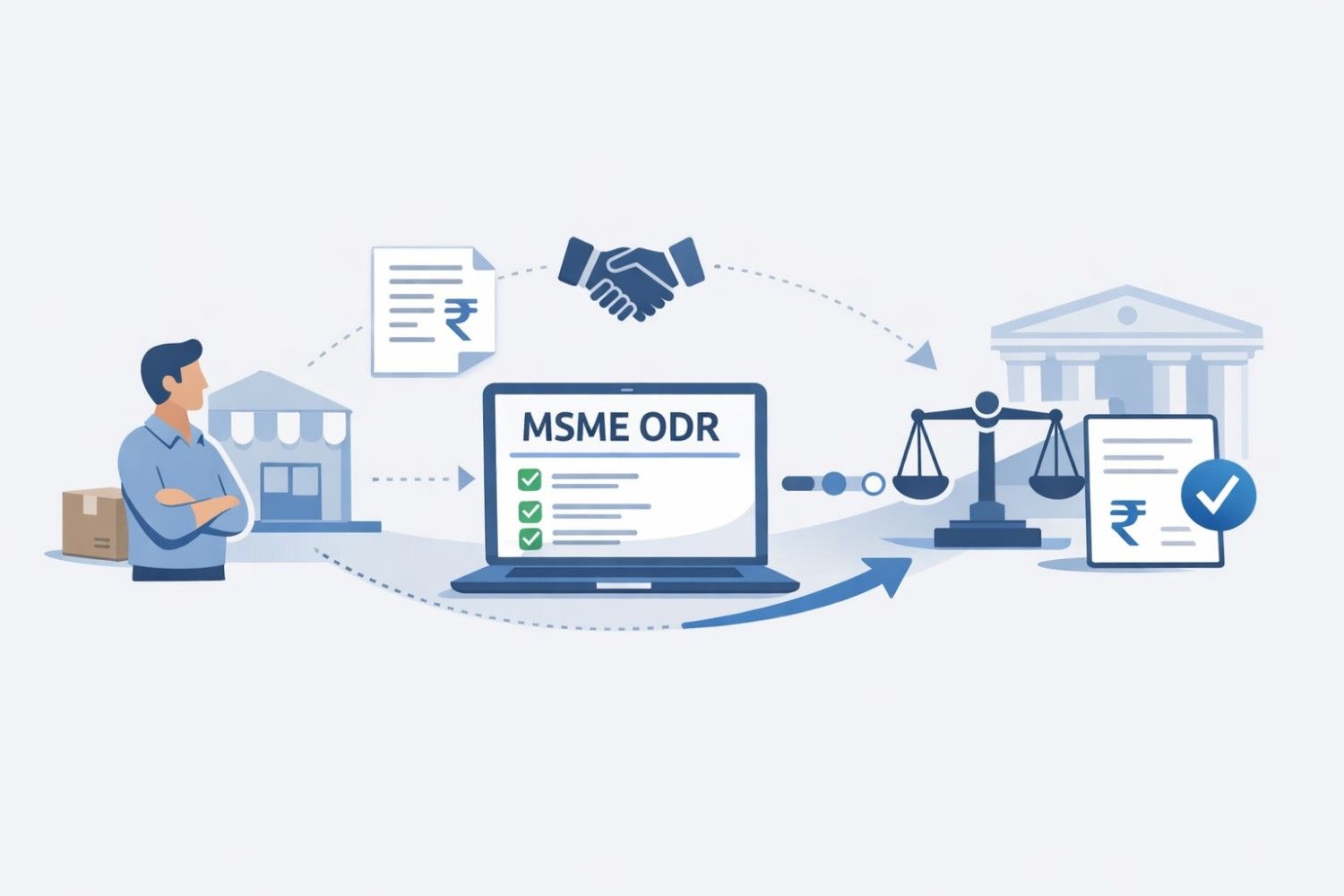
Quick Answers
Who can file? Any micro or small enterprise (with a valid Udyam registration before the disputed invoice date) can apply for delayed payment relief under the MSME Act.
How to file? As of 2025, all new delayed payment cases must be filed on the government’s MSME ODR portal. (Earlier filings use the Samadhaan portal). You’ll need your Udyam number and copies of purchase orders, invoices, and delivery proofs. The portal guides you step-by-step through a digital claim form.
Process after filing: The portal first tries an automated negotiation. If there is no settlement, the case goes to the state’s MSE Facilitation Council (MSEFC) for conciliation and, if needed, arbitration. The council must decide within 90 days.
Interest and award: The buyer automatically owes interest (triple the RBI bank rate) on any late payment. If the council rules in your favor, the order (with interest) is like a court decree and can be enforced by the District Collector.
Appeals: A buyer unhappy with the MSEFC award can appeal, but only after depositing 75% of the award amount with the court. This strict rule means appeals are rare unless really justified.
Bottom line: Keep good records of orders and invoices, register on the portal, and follow the guided steps. The law is designed to help you get paid fast while treating buyers firmly, but outcomes vary. For complex disputes, consider expert legal help.
Here we go
When payments are late, MSME owners often panic: “Will we ever get paid? What if we lose money and can’t pay wages? Is the legal process too slow or expensive?” These worries are real. But India’s MSME law (the MSMED Act, 2006) gives small businesses a clear remedy for payment delays. It forces buyers to pay within 45 days (unless another date is agreed) and to pay heavy interest if they don’t. It also provides an online process to resolve disputes without a full court battle.
Understanding your rights: Under the MSMED Act, a buyer must pay on or before the agreed date, and that date can never be more than 45 days after you delivered goods or services. If the buyer doesn’t pay, he must pay compound interest (with monthly compounding) three times the RBI bank rate until payment. In practice, that means your overdue payment will more than double every few years of nonpayment, giving the buyer a strong incentive to settle quickly.
The Act also tells each state to set up a Micro & Small Enterprises Facilitation Council (MSEFC). These are quasi-judicial bodies that hear delayed payment disputes. In theory, you could approach the MSEFC on paper. In practice, the government has provided web portals to make filing simpler.
Online Filing: MSME Samadhaan and the New ODR Portal
To file a complaint about late payment, use the official online system. Since 2017, the MSME Samadhaan Portal has existed for this purpose. In June 2025, a new MSME ODR (Online Dispute Resolution) portal was launched by the government. This ODR portal handles all new cases of delayed payments in a fully digital, user-friendly way. In fact, the Samadhaan site itself now tells users: “All new delayed payment applications will now be filed at the MSME ODR Portal”.
What you need to do: First, ensure your enterprise is registered under Udyam (the MSME registration) before the invoice date. As clarified by law and court rulings, you cannot file a claim unless your Udyam registration existed prior to the sale that is in dispute. If you need one, you can register for free on the Udyam portal.
Next, go to the ODR portal (or Samadhaan site) and create an account. You’ll use your Udyam number as the user ID. Follow the on-screen prompts to fill out a claim form. You will provide:
1) Supplier details: Your enterprise name, Udyam number, contact info.
2) Buyer details: Name, address, and identification (such as GSTIN) of the buyer who hasn’t paid.
3) Contract/Purchase Order: Upload a copy of the written contract or purchase order. (Note: A work order or contract is mandatory. If the order was made orally, you must upload a notarized affidavit saying so.)
4) Invoices: Upload PDFs of unpaid invoices. You can combine multiple invoices into one file. Make sure the invoices add up the total amount being claimed (including the accrued interest so far).
5) Delivery proof: Attach delivery challans or proof of service that show the buyer accepted the goods/ services.
The portal will ask you to recheck everything and submit it. You’ll get an acknowledgment with a reference number and contact details of the MSEFC where the case is filed. (Each state’s MSEFC office address is usually shown on the site).
Once submitted online, your application is forwarded automatically to the appropriate MSE Facilitation Council (the one in the buyer’s state or the seller’s state, as per rules). You can then track the status on the portal whether the council has converted it to a formal case or if there are any queries to clear up.
Quick Tip
The process is meant to be paperless. Avoid mailing physical copies unless specifically asked. Always note dates and keep personal copies of what you filed.
Step by Step MSME ODR Process: From Negotiation to Arbitration
A big change with the new ODR portal is how cases are handled entirely online. According to official guidelines, the dispute resolution has up to four stages.
1) Digital Guided Pathway
Once you file, the portal instantly notifies both you (the supplier) and the buyer. The system presents a guided pathway: informational guides, FAQs, and even an AI tool to estimate outcomes based on your claim. You have 3 days to fill out any claim form details. The AI tries to predict likely results just to help both sides see what might happen.
2) Un-manned E-Negotiation (UNP)
Next, there is an optional online negotiation meeting. The portal arranges a video conference (within about 6 days of filing) where you and the buyer can calmly discuss settlement, with your legal reps allowed. Either side can opt-out of this stage in advance. If neither side opts out, you attend virtually and try to reach an agreement. You might succeed; if so, a formal settlement agreement is sent to both of you electronically for signatures. The portal then tracks compliance with any agreed terms.
3) Mandatory Conciliation
If the negotiation phase is skipped or fails, the case moves to the formal MSEFC process. The MSEFC must attempt conciliation (mediation) first. That means the council (or an assigned mediator) tries to help you and the buyer resolve the issue. They may do this by themselves or refer it to an alternate dispute resolution Centre, but the law requires conciliation. This happens online, too.
4) Statutory Arbitration
If conciliation doesn’t yield a settlement within the allowed time, the MSEFC moves to arbitration. The council itself can act as an arbitrator, or it can send the case to a licensed arbitration Centre. Importantly, this arbitration is under the Arbitration & Conciliation Act (1996), meaning it follows the rules of arbitration law. The arbitration award given is final (subject to limited court review) and treated as a decree.
Throughout all stages, everything is done online; you never have to appear in person. The portal and council offer fair process: both sides can be heard, have representation, and get time to prepare. The council is bound by the rule to decide the case within 90 days from the date of reference. In practice, this means filing to final order is often within 2 to 3 months. For more reliable and safer option reach out to Solv legal team for personalized guidance.
Bottom line: The ODR portal encourages out-of-court settlement first. But if negotiations fail, the dispute is adjudicated (first by conciliation, then by arbitration) with strict deadlines. This process is much faster and cheaper than traditional courts, so even small claims of Rs. 50,000 can be worthwhile to pursue online.
To get more information on out of court settlement, visit Online Dispute Resolution (ODR) Explained by Solv Legal.
Recovery and Enforcement: Getting Paid
When (and if) the council rules in your favor, they will specify an award: the outstanding invoice amount plus applicable interest. This award is binding and final (barring appeal), and it has the power of a civil court decree. That means you can enforce it like any court judgment.
Under the law, an award by the MSEFC can be sent to the District Collector of the area, who will recover the amount as if it were land revenue. In practice, you can get a copy of the award and present it to the Collector (or the court) to attach the buyer’s assets/bank accounts if they still refuse to pay. Because the Act has a “non obstante” clause, it overrides other laws the MSME award takes priority over things like SARFAESI recovery (banks’ asset recovery law) and even Insolvency and Bankruptcy rules. Also important: because interest has accumulated since the due date, your award may be significantly higher than the original invoice. This gives buyers a big push to settle.
Appeals: Only the buyer can appeal against the MSEFC award (the supplier who filed cannot appeal “downwards” if we lost). However, Section 19 of the MSMED Act says no court will hear an appeal unless the buyer first deposits 75% of the award amount with the court. This rule is very strict: it prevents delaying tactics. For you as a supplier, it means any appeal is unlikely unless the buyer truly has a strong case and even then, he can’t access the money without payment.
In short, once you get an award (and interest), it’s as good as a civil court decree. Enforcement will be handled by officials, so you don’t have to sue again in a district court (unlike before). This streamlines recovery.
Practical Tips and Legal Strategy
If you’re unsure how to prepare your documents, calculate late payment interest, or respond to a legal notice from a buyer or if you're already stuck in the Samadhaan or ODR process, you don’t have to figure it all out alone.
1) Register and Document:
Before anything, ensure your business has a valid Udyam registration and that registration was done before the invoice date. Courts have repeatedly held that MSME status and benefits cannot be claimed retroactively. Without this, you can’t file at all.
2) Collect Evidence Early:
When you deliver goods or services, immediately note down the date, the contract terms, and get formal acceptance. Keep copies of every purchase order, work order, challan, delivery receipt, and invoice. Clear, written orders are crucial. If the order was only verbal, be prepared to file an affidavit to that effect.
3) Use the Portal’s Guidance:
The MSME ODR portal provides FAQs and tutorials. Read them. It also has a 24×7 legal help desk for procedural questions. Take advantage of that, especially if your case is unusual. They can tell you which documents to upload and how to avoid technical rejections.
4) Upload Documents Correctly:
Scan your documents clearly. Combine multiple invoices or proofs into single PDF files as instructed. Name files carefully. For example, "PO_No12345_Invoice.pdf". Check file size limits before uploading.
5) Be Prompt with the Process:
After you file, monitor the portal. If the council raises a “defect” or query, respond quickly. You often get a short time window to fix something (missing info, signature, etc.). Failing to respond could get your case struck off. Also, if asked to appear (online), mark the date and be online on time.
6) Negotiate if Possible:
Even though you’re within your rights, consider whether a partial or early settlement might save time. The first stage of ODR is a negotiation meeting (at no extra cost). Some suppliers successfully settle before going to arbitration. If you do settle, the portal will formalize it so you can still enforce the agreement.
7) Follow Up on Award:
When the council issues an award, the portal typically emails it to both parties. Don’t ignore it! If it favors you, the buyer legally should pay immediately, but many still drag feet. After a week or two, you may need to register it with the Collector or file for execution in a court (depending on local practice). The award itself is strong evidence, so enforcement is usually straightforward.
8) Seek Advice for Big Claims:
The online system is designed to be “DIY,” but if your claim is very large, or if you’re facing a well-known big buyer, you may want legal support. Solv legal team can be your helper, MSME cases can ensure your application is airtight (correct value calculation, interest). They can also represent you during conciliation or arbitration if needed. This is often worth it for high-value disputes.
9) Remember the Timeline:
The MSMED Act expects MSEFCs to finish in 90 days. In reality it might take a bit longer, but it should not drag on for years. If you feel the process is unduly delayed on the council’s side, write reminders or approach higher authorities in the state MSME department. Keep copies of all notices and emails exchanged.
10) No Guarantees, But Strong Remedies:
Finally, keep perspective. The MSME dispute system is faster and cheaper than courts, but it isn’t a 100% guarantee of payment. Sometimes buyers genuinely can’t pay or go into insolvency. In such cases, MSME recovery might still fail (especially if the buyer is bankrupt). Always have a plan B: for example, ensure you do credit checks before big orders, or ask for upfront payments when possible.
Conclusion
Dealing with unpaid invoices can be scary and stressful for any small business. The key is to act promptly and use the legal tools provided for MSMEs. Remember, under the MSME laws you are not powerless: the buyer can’t stall indefinitely. File online through the official portal, keep your paperwork in order, and follow the prescribed steps. The process is designed to be swift (within months) and mostly free or inexpensive.
If used correctly, this system can turn an unpaid debt into cash in hand plus interest. At worst, it forces the buyer to commit (since skipping payment after a legal order to risk forced recovery). As always, each case differs. We’ve explained the main steps and legal rules here, but complex situations may need deeper legal advice. When in doubt, reach out to an MSME support helpline or a lawyer who handles MSME disputes. Your business can’t afford prolonged delays. By understanding and following the MSME dispute resolution process (online filing, council hearing, enforcement), you give yourself the best shot at recovery.
Frequently Asked Questions
1) Can I file offline or by mail?
The MSMED Act allowed filing at the council office, but now the Samadhaan/ODR portal is the preferred method. Offline filing is generally discouraged. Only use it if the portal truly doesn’t work for you and even then, be prepared for it to be a slower, more cumbersome process.
2) What if the buyer is in another state or outside India?
The MSEFC of your state can handle disputes where the buyer is anywhere in India. If the buyer is a government department or PSU, the process is the same (they are treated like any buyer). For foreign buyers, the MSMED Act remedies may not apply, and you might need to sue in foreign courts or arbitration as per your contract.
3) Is there a minimum claim amount?
No. Even small claims (a few thousand rupees) can be filed. In fact, before this system, small MSMEs often avoided claims under ₹1 lakh because the process (and travel to state capital) was too costly. The online portal removes most fixed costs, so it’s worthwhile even for small amounts. Government has hinted it may reimburse ₹4,000 of the claim filing fee for MSMEs, to encourage use.
4) What if I close the case later?
The portal allows you to withdraw or close your application before it becomes a full case in the council. If you settle with the buyer on your own, notify the portal. If your case is already converted into a “case” (not just an application), closing it might be harder and may require approval.
5) Can a buyer counter-sue me in this forum?
No. The MSMED Act process is only for claims by suppliers against buyers for delayed payments. It is not a general litigation forum. If the buyer has some grievance against you, that’s a separate issue they must take to civil court or arbitration, not at the MSEFC.
6) Do I need a lawyer to file?
Technically, any MSME entrepreneur can file without a lawyer on the ODR portal. The system is meant to be accessible. However, if you are uncomfortable with legal forms or if the negotiation/arbitration stage seems daunting, we Solv legal are here to help you through that.
RELATED ARTICLES
1. MSME Registration Services: Business Registration and Legal Support
2. Startup Package: Trademark, Contracts, MSME Registration and More
ABOUT THE AUTHOR
This article is authored by Shridansh Tripathi, a second-year law student at the Department of Legal Studies and Research, Barkatullah University, Bhopal,
REVIEWED BY
This blog was reviewed by Yashvardhan Singh, a legal professional focusing on legal research, contract analysis, and regulatory compliance. He works closely with corporate and technology-driven legal frameworks, with particular exposure to data protection, commercial documentation, and legal process optimisation. His work supports businesses in strengthening compliance structures and ensuring legally sound operations.
Visit our Dispute Resolution Services:
https://solvlegal.com/legal-services/dispute-resolution-and-settlement/
Read more on ODR:
https://solvlegal.com/blogs/online-dispute-resolution-odr-explained-2026/
DISCLAIMER
The information provided in this article is for general educational purposes and does not constitute legal advice. Readers are encouraged to seek professional counsel before acting on any information herein. SolvLegal and the author disclaims any liability arising from reliance on this content.

Related Articles

Leave a Comment

.jpeg "How to Protect an App Idea: Copyright, Design and Patent Explained")