India-US Technology Contracts: Choosing Governing Law, Arbitration Seat and Enforcement Strategy
Read More
Online Dispute Resolution (ODR) Explained: How Businesses Can Resolve Disputes Faster Without Courts (2026 Global Guide)
By the SolvLegal Team
Published on: Jan. 23, 2026, 4:20 p.m.
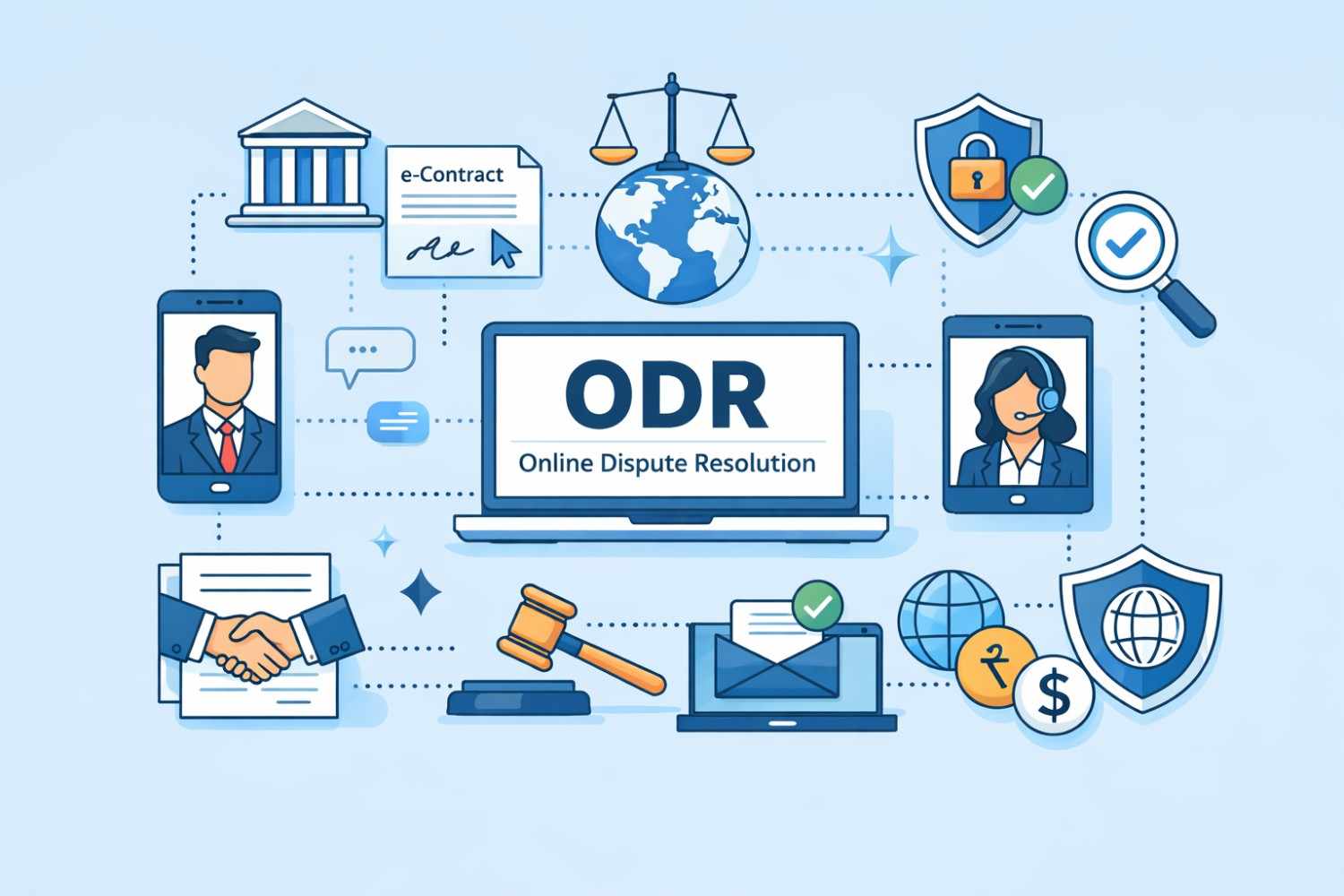
Online Dispute Resolution (ODR) Explained: How Businesses Can Resolve Disputes Faster Without Courts (2026 Global Guide)
Quick Answer
Online Dispute Resolution (ODR) allows businesses to resolve disputes digitally, without stepping into a courtroom. This guide explains what ODR is, why it matters in 2026, and how it is being legally recognised and used in India and globally. It breaks down the Indian legal position, compares ODR frameworks across key jurisdictions, and shows how businesses are already using ODR to resolve disputes faster and at lower cost.
You’ll also see where ODR actually works in practice, especially for MSMEs, e-commerce platforms, and fintech companies, along with its real advantages and limitations. The guide closes by explaining what needs to change for ODR to scale further, how businesses can approach it strategically, and how legal advisors like SolvLegal support businesses in structuring and navigating ODR effectively.
If you’re trying to understand whether ODR is legally sound, commercially viable, and practically usable for your business, this article walks you through it step by step.
India-Specific Legal Position on Online Dispute Resolution
India does not yet have a dedicated statute that exclusively governs Online Dispute Resolution. However, this does not mean that ODR operates in a legal vacuum. The Indian legal system already recognises dispute resolution outside traditional courts, and ODR functions as a technology-enabled extension of those recognised mechanisms. Its legality flows from existing laws on arbitration, mediation, electronic records, and evidence, rather than from a single standalone ODR law.
At the core of ODR’s legal validity in India is the Arbitration and Conciliation Act, 1996. The Act is designed to promote flexible, party-driven dispute resolution and does not mandate any particular physical format for proceedings. As long as parties consent to arbitration or conciliation and the principles of natural justice are followed, the law does not prohibit proceedings from being conducted online. This makes online arbitration and online conciliation legally permissible when supported by a valid arbitration agreement.
Judicial recognition of alternative dispute resolution further strengthens ODR’s footing. Section 89 of the Code of Civil Procedure, 1908, empowers courts to refer disputes to arbitration, mediation, conciliation, or Lok Adalats where settlement appears possible. While the provision does not explicitly mention online processes, Indian courts have increasingly embraced technology-assisted ADR, especially after the COVID-19 pandemic. Virtual mediation sessions and digitally conducted settlement processes have demonstrated that enforceability does not depend on physical presence.
The most significant statutory enabler of ODR in India is the Information Technology Act, 2000. ODR relies entirely on electronic communication, digital contracts, and online submissions. The IT Act grants legal recognition to electronic records and digital signatures, ensuring that agreements, pleadings, notices, and decisions exchanged online are legally valid. Without this recognition, ODR would face serious enforceability challenges. Instead, the Act provides the technological legitimacy required for end-to-end digital dispute resolution.
Evidentiary support for ODR has been further strengthened with the enactment of the Bharatiya Sakshya Adhiniyam, 2023, which replaces the Indian Evidence Act. Since ODR proceedings generate digital evidence, such as emails, electronic documents, and recordings of video-conferenced hearings, the admissibility of electronic records is crucial. The new evidence law explicitly recognises electronic records and digital recordings, ensuring that outcomes of online proceedings are not weakened at the enforcement stage.
Beyond legislation, India has also seen increasing institutional and regulatory support for ODR. Government initiatives aimed at digitising justice delivery, along with sector-specific regulatory frameworks in areas like consumer protection, digital payments, and securities markets, have actively incorporated online dispute resolution mechanisms. These developments signal that ODR is no longer experimental but is being integrated into mainstream dispute resolution infrastructure.
Taken together, India’s legal position on ODR can be described as functionally recognised but still evolving. ODR is legally valid, enforceable, and increasingly institutionalised, even though it is not governed by a single consolidated statute. Its strength lies in the adaptability of India’s existing legal framework, which allows technology to be layered onto traditional dispute resolution mechanisms without undermining legal certainty.
How Online Dispute Resolution Actually Works
Online Dispute Resolution follows the same core principles as traditional alternative dispute resolution, but replaces physical interaction with digital infrastructure. Instead of courtrooms, filings, and in-person hearings, the entire dispute lifecycle is conducted through secure online platforms. This includes initiation of claims, exchange of documents, communication between parties, facilitation by neutrals, and delivery of outcomes.
The ODR process typically begins when parties agree, either contractually or post-dispute, to resolve their dispute through an online mechanism. This agreement may already exist in the form of an ODR clause embedded in commercial contracts, platform terms of use, or consumer agreements. Once triggered, the platform provides a structured digital environment where parties can submit claims, upload documents, and track progress without procedural complexity.
Most ODR systems are designed in stages, allowing disputes to move from informal resolution to more structured processes if needed. The first stage often involves online negotiation, where parties communicate directly through chat interfaces, dashboards, or assisted negotiation tools. This stage prioritises speed and voluntary settlement, particularly for low-value or high-volume disputes.
If negotiation fails, disputes may be referred to online mediation, where a neutral third party facilitates discussion via video conferencing, asynchronous messaging, or secure portals. Online mediation mirrors traditional mediation in substance, but benefits from flexibility in scheduling, reduced costs, and the ability to involve parties across different locations without logistical barriers.
In more complex or high-stakes disputes, ODR platforms also support online arbitration. Here, a neutral arbitrator conducts proceedings digitally, reviews submissions electronically, and issues a binding decision. Online arbitration relies heavily on digital evidence, virtual hearings, and electronic awards, making it especially suitable for commercial and cross-border disputes where physical hearings are impractical.
Technology plays an active role in ODR, not merely a supportive one. Many platforms integrate automated workflows, document management systems, and case-tracking tools to streamline proceedings. In some models, technology functions as a “fourth party,” assisting human decision-makers by organising information, flagging issues, or enabling early settlement through structured processes.
Importantly, ODR is not limited to private platforms. Courts, regulators, and industry bodies increasingly use online systems to manage dispute resolution at scale. Court-linked ODR, consumer grievance portals, and sector-specific redressal mechanisms demonstrate that ODR can function both as an alternative to courts and as an extension of the formal justice system.
In essence, ODR works by combining legal process with digital efficiency. It retains the legitimacy of recognised dispute resolution methods while removing geographical, procedural, and cost-related barriers. This makes it particularly effective for modern businesses operating in digital, high-volume, or cross-border environments.
Institutional and Regulatory Adoption of ODR in India
Online Dispute Resolution in India has moved beyond academic discussion and pilot projects. It is increasingly being adopted by government bodies, regulators, and institutional platforms as a formal mechanism for resolving disputes at scale. This institutional backing is one of the strongest indicators that ODR is becoming part of India’s mainstream dispute resolution framework.
At the government level, ODR has been closely linked with broader digital justice initiatives. Programs aimed at reducing court backlog and improving access to justice have encouraged the use of technology-enabled dispute resolution. Court-linked online mediation and virtual ADR processes, especially after the pandemic, demonstrated that disputes could be resolved efficiently without physical hearings. These developments laid the groundwork for formal acceptance of ODR within public dispute resolution systems.
Regulatory adoption has played an even more decisive role. In sectors with high-volume, low-value disputes, regulators have actively mandated or structured ODR mechanisms to ensure speed and consumer protection. The most prominent examples include:
· Digital payments and fintech disputes, where structured ODR frameworks have been introduced to handle failed transactions, unauthorised payments, and service-related grievances efficiently.
· Securities market disputes, where investors and intermediaries are required to use online mechanisms for grievance redressal before approaching traditional forums.
· Consumer disputes, where digital portals and online grievance systems allow consumers and businesses to resolve complaints without formal litigation.
Alongside regulatory frameworks, private ODR platforms have emerged as important institutional actors. These platforms provide end-to-end digital infrastructure for negotiation, mediation, and arbitration, often working in collaboration with courts, regulators, or industry bodies. Their role has been particularly significant in commercial disputes, MSME conflicts, and platform-based consumer transactions.
What distinguishes institutional ODR from informal online resolution is standardisation and enforceability. Institutional systems operate under defined rules, trained neutrals, and clear procedural safeguards. This ensures that outcomes are not only quick but also legally defensible.
Overall, institutional and regulatory adoption has transformed ODR from a voluntary alternative into a structured dispute resolution pathway. For businesses, this means ODR is no longer an experimental option but an increasingly expected part of compliance and risk management, especially in digitally regulated sectors.
Global Comparison of ODR Frameworks (India, US, UK, UAE)
Online Dispute Resolution is not unique to India. Different jurisdictions have adopted ODR in ways that reflect their legal culture, court structure, and regulatory priorities. A comparison helps businesses understand where India stands globally and how mature its ODR ecosystem is relative to other major markets.
Comparative Table :

India
India’s ODR framework is functionally recognised but still evolving. Rather than being governed by a single ODR statute, India relies on existing ADR laws, electronic transaction recognition, and sector-specific regulatory mandates. The emphasis is on scalability, particularly for consumer, fintech, and MSME disputes. While court-linked ODR is increasing, much of India’s growth has been regulator-driven rather than judge-driven.
United States
The United States has one of the most mature ODR ecosystems globally. ODR is deeply embedded in court systems, consumer dispute platforms, and private arbitration frameworks. Many state courts mandate or strongly encourage online mediation or negotiation for small claims and consumer disputes. Private ODR platforms also play a significant role, especially in e-commerce and employment disputes.
United Kingdom
The UK has focused on integrating ODR into public justice delivery rather than leaving it entirely to private platforms. The HM Courts & Tribunals Service has actively developed digital dispute resolution systems, particularly for low-value civil claims. The UK approach emphasises early online resolution, mediation, and structured digital workflows before disputes escalate to full hearings.
United Arab Emirates (UAE)
The UAE represents a pro-ODR, arbitration-centric model, especially within its financial free zones. The DIFC and ADGM have established digital courts and technology-friendly dispute resolution frameworks designed to attract international commercial disputes. ODR in the UAE is closely linked with arbitration and is particularly suited for cross-border and high-value commercial conflicts.
Comparison Shows : While India may not yet have the institutional depth of the US or the court-led integration of the UK, it is moving rapidly through regulatory adoption and digital infrastructure. For businesses operating across jurisdictions, this comparison highlights that ODR is no longer experimental anywhere, it is simply implemented differently.
Business Use Cases Where ODR Is Most Effective
Online Dispute Resolution is not meant to replace courts for every kind of dispute. Its real value lies in specific business contexts where speed, cost-efficiency, and scalability matter more than prolonged litigation. Certain sectors benefit disproportionately from ODR because of the nature, volume, and value of disputes they face.
MSMEs and Commercial Contract Disputes
For MSMEs, traditional litigation is often impractical. Court disputes are expensive, slow, and resource-intensive. ODR offers a more proportionate solution, especially for payment disputes, supply chain disagreements, and service-related conflicts. Because ODR allows disputes to be resolved remotely and often within weeks, it aligns better with the operational realities of small and medium businesses that cannot afford prolonged legal uncertainty.
E-commerce and Consumer-Facing Platforms
E-commerce platforms deal with high volumes of low-value disputes, ranging from refunds and cancellations to service deficiencies. Resolving such disputes through courts is neither viable nor desirable. ODR allows platforms to handle complaints quickly while maintaining consumer trust. Structured online negotiation and mediation systems help prevent escalation and reduce regulatory exposure, making ODR an essential compliance tool rather than just a convenience.
Fintech and Digital Payments
Fintech companies and payment intermediaries operate in an environment where disputes arise frequently and require rapid resolution. Failed transactions, unauthorised debits, and service disruptions can quickly escalate into reputational and regulatory issues. ODR is particularly effective here because it can be integrated directly into digital workflows, allowing disputes to be resolved within prescribed timelines without court intervention.
Cross-Border and Platform-Based Disputes
ODR is also well-suited for disputes involving parties in different jurisdictions, especially where the amounts involved do not justify cross-border litigation. Online arbitration and mediation remove geographical barriers and reduce enforcement friction. For global platforms and SaaS businesses, ODR provides a predictable and neutral forum that supports international operations without excessive legal complexity.
Advantages of ODR Over Traditional Litigation
The strongest case for Online Dispute Resolution is not theoretical. It lies in how ODR addresses the structural weaknesses of court-based litigation, especially for modern businesses operating in digital and high-volume environments. ODR does not change the nature of disputes; it changes the cost, time, and accessibility dynamics around resolving them.
One of the most significant advantages of ODR is speed. Traditional litigation in India and many other jurisdictions can take years to reach final resolution. ODR, by contrast, is designed to function within defined timelines. Digital workflows, limited procedural formalities, and focused dispute scopes allow matters to be resolved in weeks rather than years. For businesses, this means quicker closure and reduced operational uncertainty.
Another key advantage is cost efficiency. Court litigation involves filing fees, repeated appearances, lawyer costs, and indirect expenses such as travel and lost management time. ODR substantially reduces these costs by eliminating physical hearings, compressing procedures, and automating administrative tasks. This makes dispute resolution economically viable even for low-value claims that would otherwise be written off.
ODR also improves access to justice, particularly for small businesses and consumers. Geographic location, mobility constraints, and resource limitations often prevent parties from pursuing legitimate claims through courts. By moving the process online, ODR removes these barriers. Parties can participate from anywhere, submit documents digitally, and engage in resolution without logistical hardship.
From a business perspective, scalability is a critical advantage. Platforms dealing with thousands of disputes cannot rely on one-to-one litigation. ODR systems are designed to handle high volumes efficiently, using structured processes and standardised resolution pathways. This is especially important for e-commerce platforms, fintech companies, and regulated entities dealing with mass grievances.
Finally, ODR offers greater flexibility and confidentiality. Parties have more control over procedure, scheduling, and outcomes compared to rigid court processes. Many ODR mechanisms, particularly mediation and arbitration, also ensure confidentiality, which is valuable for businesses seeking to protect commercial relationships and sensitive information.
Taken together, these advantages explain why ODR is increasingly viewed not as an alternative of last resort, but as a strategic dispute management tool. The next section addresses the other side of the picture, its practical and legal limitations, so the analysis remains balanced and credible.
Practical Challenges and Limitations of ODR
· Digital access and literacy gaps
ODR assumes that parties can comfortably use online platforms, upload documents, and participate in virtual hearings. In practice, uneven access to technology and limited digital literacy can prevent effective participation, particularly for small businesses and individuals outside major urban centres.
· Lack of awareness and institutional trust
Many businesses and consumers are still unfamiliar with ODR or uncertain about its legitimacy. Courts and legal practitioners often default to traditional litigation, which slows adoption and reinforces scepticism around online processes.
· Enforceability concerns in private ODR systems
While arbitral awards and mediated settlements are legally enforceable, parties sometimes hesitate to rely on ODR outcomes, especially in high-value or complex disputes. This hesitation is more pronounced in cross-border disputes, where enforcement mechanisms may vary by jurisdiction.
· Data protection and cybersecurity risks
ODR platforms process sensitive commercial and personal data. Any breach, system vulnerability, or misuse of information can undermine confidence in the platform. Strong data security standards and compliance with privacy laws are therefore essential.
· Limited suitability for certain types of disputes
ODR is not appropriate for every conflict. Disputes involving criminal liability, complex constitutional issues, or extensive witness examination often require traditional court processes and cannot be effectively handled online.
How SolvLegal Helps Businesses Use ODR Effectively
SolvLegal helps businesses identify when ODR is the right tool and when it is not. This begins with assessing the nature of the dispute, the regulatory environment, and the commercial objectives involved. Instead of treating ODR as a one-size-fits-all solution, SolvLegal focuses on aligning dispute resolution strategy with business risk and operational priorities.
For businesses adopting ODR, SolvLegal assists in structuring enforceable ODR clauses, reviewing platform terms, and ensuring compliance with applicable Indian and cross-border legal requirements. The goal is to help businesses use ODR confidently, without sacrificing enforceability or procedural fairness.
Conclusion: Why ODR Matters for Businesses in 2026
Online Dispute Resolution is no longer a niche or experimental concept. For businesses operating in digital, regulated, and high-volume environments, ODR has become a practical necessity rather than a theoretical alternative. The legal framework in India already supports ODR through existing ADR laws, electronic transaction statutes, and modern evidence rules, even as dedicated regulation continues to evolve.
What makes ODR particularly relevant in 2026 is not just speed or cost reduction, but predictability and scalability. Businesses today cannot afford disputes that linger for years, drain resources, or disrupt operations. ODR offers a way to resolve conflicts proportionately, especially where traditional litigation is economically or operationally inefficient.
At the same time, ODR is not a replacement for courts. Its value lies in being used strategically, where the nature of the dispute, the volume involved, and the commercial context make digital resolution sensible. Understanding its limits is as important as understanding its benefits.
For businesses willing to adopt it thoughtfully, ODR represents a shift in how disputes are managed: from reactive litigation to structured, technology-enabled resolution. As institutional adoption grows and legal clarity improves, ODR is likely to become a standard part of dispute resolution strategy rather than an exception.
FAQs
1. Is Online Dispute Resolution legally valid and enforceable in India?
Yes. ODR is legally valid in India, even though there is no single statute titled “ODR Act.” Its enforceability flows from existing laws governing arbitration, mediation, electronic records, and evidence. Online arbitration awards are enforceable under the Arbitration and Conciliation Act, 1996, and settlements reached through online mediation can be enforced like any other mediated settlement, depending on the forum used. The use of electronic records and digital signatures is recognised under the Information Technology Act, 2000, which removes procedural barriers to conducting dispute resolution entirely online.
2. Can businesses be forced to use ODR instead of courts?
In most cases, ODR is consensual, meaning parties must agree to use it, either through a contract clause or after a dispute arises. However, in certain regulated sectors, such as digital payments, securities markets, and consumer disputes, regulators have mandated structured ODR mechanisms before parties can approach courts or tribunals. In these contexts, ODR is not optional but forms part of the regulatory dispute resolution process.
3. Is ODR suitable for high-value or complex commercial disputes?
ODR is best suited for disputes where speed, efficiency, and proportionality matter. While it works exceptionally well for low-to-medium value commercial disputes, MSME conflicts, and platform-based disputes, it can also be used for higher-value matters through online arbitration. That said, disputes involving complex factual inquiries, extensive witness examination, or sensitive criminal or constitutional issues may still be better handled through traditional court processes.
4. How secure are ODR platforms in terms of data and confidentiality?
Security and confidentiality depend largely on the platform being used. Reputable ODR platforms employ encrypted communication, secure document storage, and controlled access to case materials. However, since ODR involves sensitive commercial and personal data, businesses must assess platforms for compliance with data protection laws, cybersecurity standards, and confidentiality obligations. Choosing the wrong platform can undermine trust and expose parties to risk.
5. Can ODR be used for cross-border disputes?
Yes. One of the key advantages of ODR is its suitability for cross-border disputes, particularly where the cost of international litigation would be disproportionate. Online arbitration and mediation eliminate geographical barriers and allow parties from different jurisdictions to resolve disputes efficiently. However, enforceability of outcomes may depend on international treaties, such as the New York Convention for arbitral awards, and the domestic laws of the jurisdictions involved.
6. How does ODR benefit MSMEs and startups specifically?
For MSMEs and startups, litigation is often financially and operationally draining. ODR offers a faster, more affordable way to resolve disputes without diverting management time or cash flow. It allows businesses to pursue legitimate claims that would otherwise be abandoned due to cost or delay. For startups, ODR also aligns better with digital operations and scalable business models, making dispute resolution less disruptive.
7. Should businesses include ODR clauses in their contracts?
In many cases, yes. Well-drafted ODR clauses can help businesses avoid uncertainty when disputes arise. However, these clauses should be carefully structured to ensure enforceability, clarity on the process, and alignment with regulatory requirements. A poorly drafted ODR clause can create more confusion than certainty, which is why legal review is important before implementation.
Related articles:
2. Outsourcing Software Development Abroad? Legal Clauses Every Business Must Know (2026 Global Guide)
3. Source Code Protection for Startups: Why Even “Non-Unique” Business Ideas Need Strong IP Clauses.
About the author: Kunal Singh is a second-year B.Sc. LL.B. (Hons.) student at National Forensic Sciences University, Gandhinagar.
Reviewed by: Gaurav Saxena is the founder of SolvLegal, where he brings together dual expertise in engineering and law to guide clients through complex corporate and compliance matters. With a strong grounding in the law of contracts, corporate law, intellectual property, IT law and data privacy, he works with startups and established businesses alike to structure agreements, advise on governance and safeguard innovation.
See our Dispute Resolution Services:
https://solvlegal.com/legal-services/dispute-resolution-and-settlement/
Disclaimer
The information provided in this article is for general educational purposes and does not constitute a legal advice. Readers are encouraged to seek professional counsel before acting on any information herein. SolvLegal and the author disclaim any liability arising from reliance on this content

Related Articles

Leave a Comment