Running a Startup or Fintech in India? AML & KYC Rules You Cannot Ignore in 2026
Read More
Digital Signatures & Global Contract Validity in 2025: The Legal Guide for Businesses
By the SolvLegal Team
Published on: Nov. 22, 2025, 12:06 p.m.
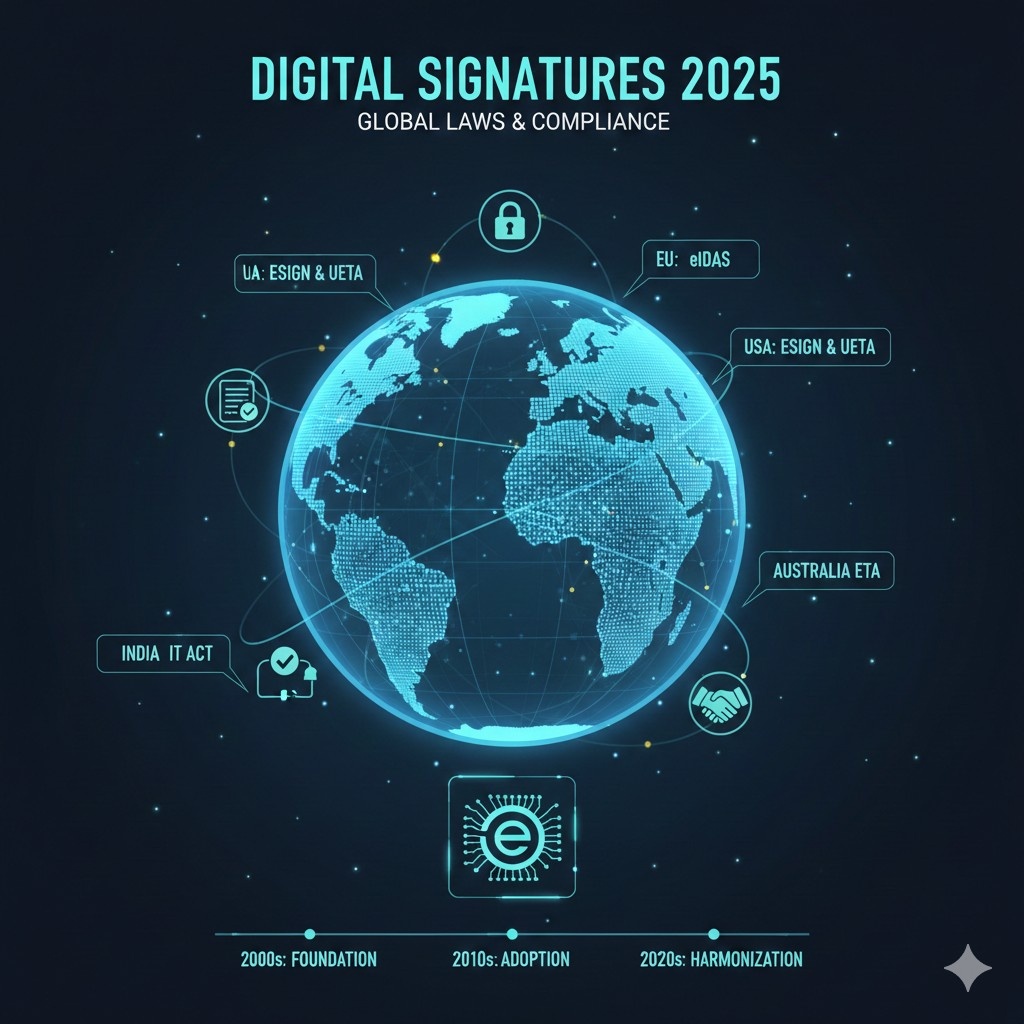
Quick Answer: The 2025 Guide to Global Digital Signatures
If you’ve ever signed a contract on your phone, you’ve already stepped into the future of global commerce. In 2025, digital signatures aren’t just convenient, they’re legally recognised in most parts of the world, from India and the U.S. to the UAE and the European Union. Yet, the laws that govern them differ sharply across borders, making it crucial for startups, SMEs, and cross-border businesses to understand what’s valid where.
This blog walks you through the essentials: what counts as a “digital signature,” how it differs from an e-signature, and the legal frameworks that make these contracts enforceable worldwide. You’ll explore the latest updates from India’s IT Act, the U.S. ESIGN Act, the EU’s eIDAS Regulation, and other leading jurisdictions. Along the way, we’ll also uncover common pitfalls, like when an electronic signature won’t hold up in court, and the best practices to ensure your contracts remain airtight, wherever you operate.
Whether you’re closing deals across continents or onboarding clients remotely, digital signatures can save time, cost, and confusion, provided they’re used within the right legal boundaries. This guide helps you do exactly that: understand the law, comply globally, and sign smarter.
At the end, we’ll also share how legal experts and technology solutions in India are helping companies ensure their contracts meet global digital-signature standards.
Introduction - The Global Shift to Digital Contracting
Imagine signing a multi-country business deal from your laptop in Delhi while your partner in Dubai and your client in California sign from theirs, all within minutes. That’s not futuristic anymore. Digital signatures have become the backbone of international commerce, especially after the pandemic accelerated remote business and paperless transactions.
By 2025, over 80% of contracts worldwide are expected to be executed digitally, and almost every major jurisdiction has built laws recognising them. From India’s Information Technology Act, 2000, to the U.S. ESIGN Act (2000) and the EU’s eIDAS Regulation (2016), digital signatures are now as legally binding as traditional handwritten ones, provided they meet certain authentication and security standards.
But here’s the twist: while the technology is universal, the legal recognition isn’t identical everywhere. Some countries accept scanned or typed names as signatures; others demand cryptographic “digital certificates” issued by licensed authorities. The result? Businesses expanding across borders often find themselves navigating a maze of different e-signature laws and compliance frameworks.
In this blog, you’ll discover how digital signatures work globally, how various countries regulate them, and what startups and multinational teams need to know to make their contracts enforceable from India to the UAE to the U.S. and beyond. We’ll also explore practical steps to verify authenticity, avoid disputes, and ensure every digital document you sign carries the same legal weight as pen on paper.
What Exactly Is a Digital Signature (and How It Differs from an E-Signature)
Most people use “digital signature” and “e-signature” interchangeably, but legally, they’re not the same. An electronic signature can be any electronic method of showing consent, typing your name, scanning your signature, or clicking an “I agree” button. A digital signature, however, uses encryption and authentication technology to verify identity and ensure that a document hasn’t been tampered with after signing.
Globally, laws differentiate between the two:
India’s IT Act, 2000 (Section 3) legally recognises digital signatures based on asymmetric cryptosystems and secure digital certificates issued by licensed Certifying Authorities.
The U.S. ESIGN Act and Uniform Electronic Transactions Act (UETA) recognise both electronic and digital signatures, focusing on intent and consent.
The EU’s eIDAS Regulation defines three levels, simple, advanced, and qualified electronic signatures, the last being equivalent to a handwritten signature in court.
In the UAE, the Federal Decree-Law No. 46 of 2021 and the Electronic Transactions Law provide recognition to digital signatures that meet identity-verification and certification standards.
In short, while every electronic signature isn’t digital, every digital signature is a secure, verified e-signature, making it the gold standard for high-value or cross-border contracts.
Legal Recognition Around the World
Digital signatures have moved from novelty to necessity, and by 2025, nearly every major economy recognises them as legally binding, though the standards differ. Here’s a quick global snapshot of how key jurisdictions regulate electronic and digital contracting:
India - Information Technology Act, 2000
India legally recognises digital signatures under the IT Act, 2000, granting them the same validity as handwritten ones. Section 3 defines digital signatures using asymmetric cryptography and hash functions. Section 5 gives legal recognition to electronic records and signatures. The Controller of Certifying Authorities (CCA) supervises licensed CAs like eMudhra and Sify that issue government-approved digital certificates. They’re widely used in e-contracts, e-filing, tenders, and corporate documentation. However, simple e-signatures like scanned names are enforceable only if intent and consent are proven.
United States - ESIGN Act (2000) & UETA
The Electronic Signatures in Global and National Commerce (ESIGN) Act and the Uniform Electronic Transactions Act (UETA) make electronic signatures legally binding across U.S. states. The approach is technology-neutral, what matters is the signer’s intent to sign and the ability to retain an accurate record. Platforms such as DocuSign and Adobe Sign are valid as long as audit trails confirm identity and consent. Courts routinely uphold such signatures; for instance, in Cloud Corp. v. Hasbro Inc. (2002)[1], the U.S. court reaffirmed the enforceability of e-signed contracts under ESIGN.
European Union - eIDAS Regulation (EU No. 910/2014)
The EU operates under eIDAS, which recognises three signature tiers:
1. Simple Electronic Signature (SES) – for low-value transactions.
2. Advanced Electronic Signature (AES) – uniquely linked and traceable to the signer.
3. Qualified Electronic Signature (QES) – issued by EU-trusted service providers, equivalent to a handwritten signature in all member states.
The upcoming eIDAS 2.0 introduces Digital Identity Wallets, allowing citizens and companies to authenticate and sign across Europe seamlessly.
United Arab Emirates - Federal Decree-Law No. 46 of 2021
The UAE’s Electronic Transactions and Trust Services Law validates digital signatures provided they:
ü Are uniquely linked to the signer,
ü Are capable of verifying identity, and
ü Are created under the signer’s sole control.
The Dubai Digital Economy Court and Abu Dhabi Global Market (ADGM) now fully recognise electronic contracts, especially for international business.
Singapore – Electronic Transactions Act (ETA 2010)
Singapore’s ETA 2010 offers a modern framework aligning with UNCITRAL Model Law. It recognises both electronic and digital signatures, requiring that electronic records be reliable and linked to the signer. Singapore’s model is popular among ASEAN startups for its simplicity and global compatibility.
Where Digital Signatures Are Not Valid
Even in the most advanced regimes, some documents remain exempt:
· Wills and codicils
· Real estate transfers or property deeds
· Powers of attorney
· Court filings requiring notarisation
These typically demand physical or attested signatures for fraud prevention.
Validity, Enforcement & Landmark Cases
Digital signatures are only as strong as the law that stands behind them. Courts across jurisdictions have steadily built a clear position , if a digital or electronic signature shows intent, authenticity, and document integrity, it can be fully enforceable. Here’s how Courts Interpret Digital and E-Signatures :
The key legal tests that courts apply are:
Intent to Sign – Did the signer deliberately indicate agreement?
Record Integrity – Can it be proven that the signed document was not altered later?
Attribution – Can the digital signature be traced to the correct person through certificates, audit trails, or verified credentials?
If these elements are present, courts generally uphold the contract as valid, regardless of whether it was signed on paper or digitally.
India: Trimex International FZE v. Vedanta Aluminium Ltd.[2]
In this landmark Supreme Court case, the Court upheld the enforceability of a contract concluded over email correspondence. Though the parties never met or exchanged physical signatures, the Court ruled that the email chain clearly showed a “meeting of minds.”
This judgment effectively confirmed that digital communication and consent expressed electronically can constitute a valid, binding contract under Indian law.
United States: DocuSign Litigation & ESIGN Enforcement
U.S. courts have consistently upheld agreements executed through platforms like DocuSign or Adobe Sign, as long as audit logs and consent records are available. In Cloud Corp. v. Hasbro Inc. (2002)[3], the court found that electronic records were sufficient proof of intent and acceptance, reinforcing the reliability of authenticated e-signature platforms.
Global Challenges and Grey Areas
Despite global acceptance, digital signature laws still face several practical and legal challenges, especially when contracts cross borders. While technology has simplified signing, the complexity now lies in determining which country’s law applies and how far digital evidence can be trusted.
1. Jurisdictional Conflicts
In cross-border transactions, it’s often unclear which country’s laws will govern the digital contract. For instance, if a company in India signs electronically with a UAE client through a U.S.-based platform like DocuSign, whose jurisdiction applies in case of dispute?
Courts usually look at the governing law and jurisdiction clause in the agreement, but if none exists, parties can face serious procedural hurdles.
2. Cybersecurity Risks & Identity Theft
Digital signatures depend on identity verification and encryption. If credentials are compromised, signatures can be forged or misused. In India, under Section 66C of the Information Technology Act, 2000, identity theft involving digital signatures is a criminal offence, punishable with imprisonment and fine. Globally, regulators like the EU’s ENISA and U.S. NIST now emphasise two-factor authentication and advanced encryption to reduce such risks.
3. Unequal Legal Status
Not all electronic signatures carry the same legal weight.
For example: A simple “I agree” email in the U.S. may be enforceable,
But the same email may not satisfy India’s IT Act requirement of a digital certificate under Section 3. Hence, understanding the hierarchy, simple, advanced, and qualified e-signatures, is key to ensuring enforceability.
4. Restrictions on High-Value or Sensitive Documents
Certain contracts still cannot be signed electronically. Most jurisdictions exclude:
· Wills and codicils,
· Real estate sale deeds,
· Powers of attorney, and
· Court filings or notarised documents.
These typically require wet signatures to prevent fraud or coercion.
5. Data Privacy and Localisation Overlap
Data protection laws are reshaping digital signature compliance.
India’s Digital Personal Data Protection Act, 2023 and the EU’s GDPR impose strict data storage and consent obligations.
This affects how signing platforms handle user data, especially when it’s stored in cloud servers outside the country. Startups must therefore ensure their e-signature service providers comply with local data protection and cross-border transfer rules.
6. Evidence and Admissibility Issues
Even where digital signatures are valid, proving them in court requires authenticated digital logs. If the platform fails to produce credible audit data, courts may question its reliability. Hence, retaining metadata, timestamps, and certificate records is crucial for enforceability.
Digital contracts are transforming global business, but the legal landscape remains uneven. The safest approach is to align every transaction with the most stringent standard applicable to the jurisdictions involved.
Best Practices & Future of Digital Signing (2025 & Beyond)
As global business turns fully digital, the challenge is no longer whether digital signatures are valid, it’s whether your process meets global standards. Here are the most reliable practices that companies, startups, and legal teams should follow in 2025 to make e-signing legally airtight and future-ready.
1. Add Cross-Border Validity Clauses
Every international contract should include a governing law and jurisdiction clause stating which country’s laws apply to the digital signature and any disputes. This prevents confusion when enforcement is required across borders.
For example, an India–UAE deal might specify, “This agreement shall be governed by the laws of India, and the digital signatures affixed shall have the same validity under the Information Technology Act, 2000.”
2. Use Verified Platforms with Global Certification
Always choose signature platforms that meet international trust standards, for instance, those certified under eIDAS, ESIGN, or India’s CCA guidelines. Tools like DocuSign, Adobe Sign, or eMudhra offer audit trails, encryption, and verified signer identities.
3. Leverage Government-Backed Digital IDs
Countries are increasingly integrating national identity systems with digital signing:
Ø India: eSign under Aadhaar authentication allows legally valid signatures under the IT Act.
Ø EU: eIDAS 2.0 introduces Digital Identity Wallets, standardising signatures across member states.
Ø Singapore: SingPass enables residents to sign official documents with government verification.
Such IDs make signatures more reliable and globally recognisable.
4. Integrate Blockchain & AI Verification
Emerging technologies are reshaping how authenticity is verified. Blockchain can store tamper-proof signing records, while AI tools detect anomalies or fraudulent signing patterns. Expect to see smart contracts and automated audit trails becoming part of standard corporate compliance by 2026.
5. Maintain Data Privacy Compliance
Digital signatures involve personal information, names, IDs, IP addresses, timestamps. Ensure your process follows data protection regimes like India’s DPDP Act, 2023, EU’s GDPR, or U.S. CCPA. Always store data on secure, jurisdiction-approved servers and update privacy policies accordingly.
6. Conduct Internal Training & Periodic Audits
Even the best tools fail without human diligence. Companies should train staff on authentication steps, document security, and consent verification. Periodic audits of digital signature logs help ensure compliance and readiness for any dispute or investigation.
The Road Ahead
By 2025 and beyond, digital signing will continue evolving from a convenience to a compliance requirement. Businesses that adopt secure, transparent, and legally aligned processes early will not only avoid disputes but also gain a reputation advantage in global markets.
SolvLegal Insight – Turning E-Contracts into Legal Confidence
In a world where deals are closed in seconds and partners operate across continents, businesses can no longer afford legal uncertainty in their digital documentation. That’s where expert guidance makes the difference.
SolvLegal helps companies move from “digitally convenient” to legally compliant. Its team works with startups, SMEs, and multinational clients to ensure that every electronic agreement, whether signed in India, the U.S., the UAE, or the EU, meets the standards of that jurisdiction.
Here’s how SolvLegal typically supports businesses:
ü Drafting Global E-Contract Templates: Custom-built contracts that comply with both Indian law (IT Act, 2000) and foreign frameworks like the ESIGN Act or eIDAS.
ü Reviewing Cross-Border Terms: Ensuring your agreements specify valid governing law, dispute jurisdiction, and recognition of digital signatures under multiple regimes.
ü Integrating Signature Platforms: Advising on tools that are globally recognised (DocuSign, Adobe Sign, eMudhra) and fully compliant with encryption and data-protection requirements.
ü Policy & Compliance Support: Developing internal workflows for secure signing, retention, and verification, reducing risk of contract rejection in courts.
If your company signs or executes contracts online, it’s worth reviewing how “legally strong” your digital signature process really is.
Book a short consultation with SolvLegal to assess your e-contract workflow before you click “Send.” A few proactive steps can turn a convenient online signature into lasting legal confidence.
Conclusion
By 2025, digital signatures have become the universal language of trust in global business. Whether you’re a startup in Bengaluru, a law firm in Dubai, or a tech company in California, digital contracts now make cross-border deals faster, cleaner, and fully enforceable, if done right.
The key takeaway? Digital signatures are legally valid almost everywhere, but not automatically equal everywhere. Each jurisdiction, India’s IT Act, the U.S. ESIGN, the EU’s eIDAS, or the UAE’s Electronic Transactions Law, adds its own layer of technical and legal compliance. The safest approach is to adopt practices that meet the strictest standards among the countries involved.
As more countries link digital signatures with verified digital IDs, blockchain systems, and privacy frameworks like the DPDP Act (India) and GDPR (EU), the line between “electronic” and “legal” is finally blurring. Businesses that adapt early will gain a competitive edge in efficiency and global credibility.
If your organisation deals with digital contracts across borders, now’s the time to strengthen your signing framework. A quick legal review, checking compliance, data security, and cross-border enforceability, can save you from future disputes.
SolvLegal can assist by ensuring your e-contracts and digital signatures meet global legal standards while protecting your business from compliance risks. In the digital age, a signature isn’t just a click, it’s a commitment. Sign smart, sign securely, and sign with confidence.
FAQs
1. Are digital signatures legally valid worldwide?
Yes, most countries, including India, the U.S., the EU, Singapore, and the UAE, recognise digital signatures as legally valid, provided they meet local authentication and consent requirements. However, the level of recognition (simple, advanced, or qualified) depends on each jurisdiction’s law.
2. Is a DocuSign or Adobe Sign agreement valid in India?
Yes, but with a condition. Indian law (IT Act, 2000) primarily recognises digital signatures that use encryption and are issued by licensed Certifying Authorities. Platforms like DocuSign are acceptable if the process ensures signer identity, consent, and integrity, though official filings or government submissions often require a CCA-issued signature like eMudhra.
3. What’s the difference between an e-signature and a digital signature?
An e-signature can be any electronic method that shows consent, like typing your name or clicking “I agree.” A digital signature is a more secure, encrypted version that verifies identity and prevents tampering, making it the preferred choice for legally sensitive contracts.
4. Can an Indian court enforce a contract signed electronically in another country?
Yes, if the contract meets India’s requirements under the Information Technology Act, 2000 and the parties can prove intent and authenticity. Courts have upheld digital contracts, such as in Trimex International FZE v. Vedanta Aluminium Ltd. (2010), confirming that even email-based agreements can be binding.
5. Which types of documents cannot be digitally signed?
Digital signatures are generally not valid for:
Ø Wills and codicils
Ø Property sale deeds
Ø Powers of attorney
Ø Trust deeds
Ø Court filings or documents requiring notarisation
These still demand traditional handwritten signatures.
6. How can businesses verify if their digital signing process is legally compliant?
Companies should:
ü Use platforms compliant with global standards (ESIGN, eIDAS, IT Act).
ü Retain complete audit trails (timestamps, IP logs, certificates).
ü Include cross-border jurisdiction clauses in contracts.
ü Conduct periodic legal reviews to ensure alignment with evolving data and privacy laws.
Related articles:
1. AI Contract Automation in India: Benefits, Legal Risks, and the Road Ahead for SMEs.
2. Can Whatsapp Or Email Form A Legally Binding Arbitration Agreement.
About the author: Kunal Singh is a second-year B.Sc. LL.B. (Hons.) student at National Forensic Sciences University, Gandhinagar.
Reviewed by Akhil Singh, a corporate lawyer with expertise in intellectual property rights, contract drafting, and compliance advisory. He is a tech-forward legal practitioner at SolvLegal, where he focuses on corporate compliance and data-privacy frameworks. His experience includes IT law and cross-border regulatory issues, and he assists businesses in safeguarding their innovations while strengthening their overall legal and compliance systems.
[1] 2002 U.S. App. LEXIS 24983 (7th Cir. Dec. 5, 2002).
[2] (2010) 3 SCC 1
[3] 314 F.3d 289 (7th Cir. 2002)

Related Articles
Leave a Comment