Annulment vs. Divorce in India: What Is the Difference and Which One Applies to Your Situation?
Read More
CROSS-BORDER INHERITANCE & WILLS: HOW TO CLAIM ASSETS IN MULTIPLE COUNTRIES
By the SolvLegal Team
Published on: Nov. 15, 2025, 9:08 p.m.
QUICK ANSWER
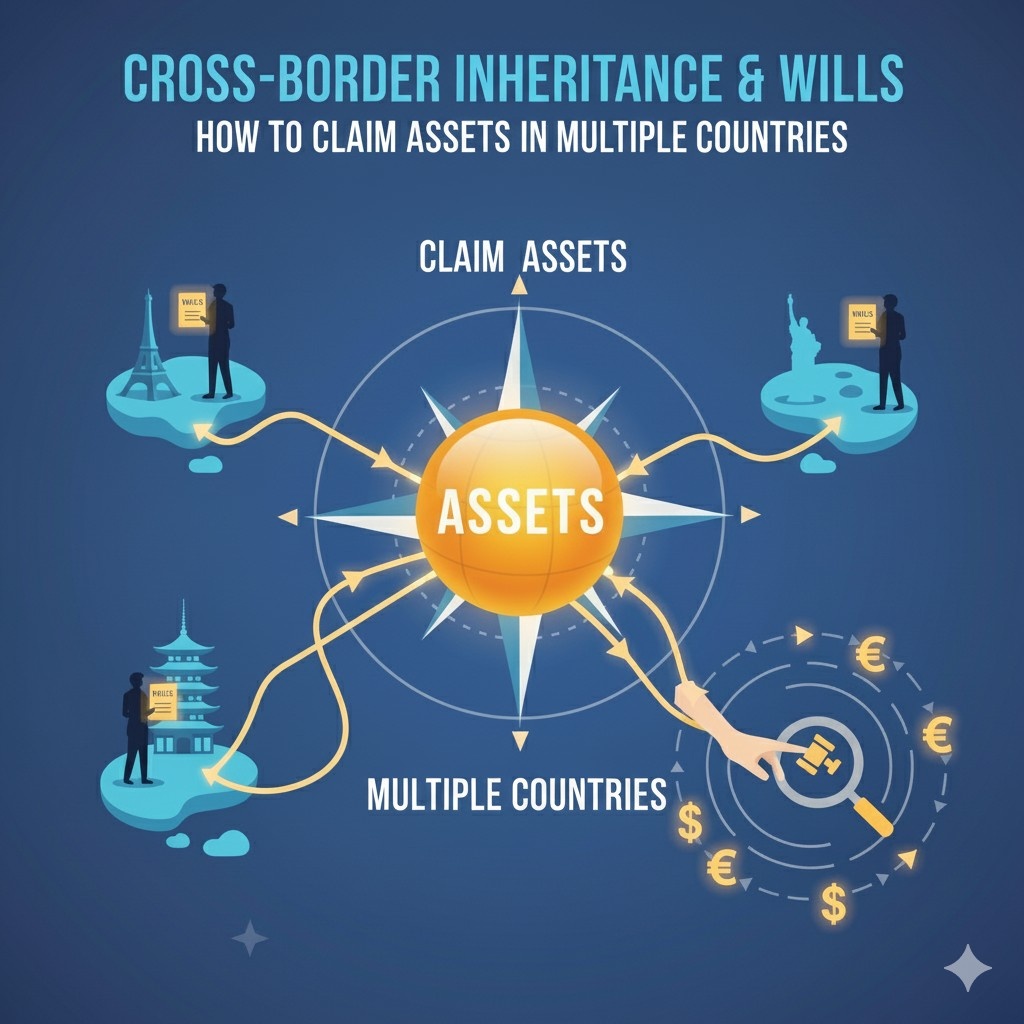
Cross-border inheritance involves claiming or transferring assets that are spread across more than one country. When a person dies owning property, bank accounts, investments or digital assets overseas, the family must deal with different legal systems, probate courts, tax rules and documentation requirements at the same time. A will made in one country may not automatically work in another, and heirs often need local probate, apostille or legalisation, foreign-exchange compliance and specific certificates to access those assets.
This blog breaks down how cross-border inheritance actually works, what laws apply, the challenges you should expect and the steps you must follow to successfully claim assets located in multiple countries.
Need help mapping an estate that spans jurisdictions? SolvLegal’s cross-border inheritance team assists executors, families and fiduciaries with probate, succession certificates, document legalisation and tax planning. Reach out for a short consultation and a clear checklist.
INTRODUCTION
People today live and invest in ways that cross borders far more than before. Families move for work, individuals buy property abroad, and many people hold foreign bank accounts, overseas shares, or digital assets linked to international exchanges. This shift is not theoretical. It is supported by real data. According to the Government of India’s Press Information Bureau, 2.31 lakh taxpayers disclosed foreign assets or overseas income in Assessment Year 2024–25, marking a sharp 45 percent increase from the previous year.
This trend shows how ordinary people, not only high-net-worth individuals, now hold wealth spread across different countries. The same pattern exists globally. Large migrant populations, remote work and international investing have created a world where an individual might live in one country, earn in another and hold long-term assets in a third. As a result, when someone passes away, their estate is no longer confined to a single legal system. It may include property in one jurisdiction, investments in another, and heirs living somewhere else entirely.
The challenge is that inheritance law does not automatically follow people or their assets across borders. Each country has its own probate process, succession rules, tax system and documentation requirements. Banks in one country may accept a will from another jurisdiction, but many do not. Some assets require probate locally. Others require an apostilled will or are sealed grant of probate. Certain countries follow domicile based inheritance, while others rely on nationality or habitual residence. In some places, forced heirship rules apply, which restrict how much of the estate can be freely willed away.
This creates a practical problem for families. What should be a straightforward process often becomes a maze of paperwork, foreign court requirements, translations, legalisation, tax filings and parallel legal procedures. Even locating and proving ownership of assets abroad can be difficult without proper records or access rights. A simple oversight like failing to update a will after acquiring foreign property can lead to avoidable disputes or delays.
This blog is written for anyone who may one day face this situation. It covers people living in India, people living abroad with assets in India, foreign nationals with Indian assets and families dealing with estates spread across multiple countries. The goal is to give you a clear understanding of what cross border inheritance means, how different legal systems interact, the common challenges you may encounter and the steps that help resolve or prevent problems. With more people becoming global in their investments and family links, understanding this area of law has become essential rather than optional.
WHAT IS CROSS-BORDER INHERITANCE?
Cross-border inheritance refers to situations where someone passes away leaving assets that are located in more than one country. This includes real estate, bank accounts, demat portfolios, business interests, retirement funds or digital assets held outside the home country. Today, even ordinary individuals can fall under this category because many people work abroad, buy small investments overseas, or inherit property from relatives living elsewhere.
Cross-border inheritance becomes legally significant when two or more countries claim jurisdiction over the estate. One country may apply the law of domicile, another may apply the law of residence and a third may apply the law where the asset physically exists. As a result, a single estate may require several parallel steps such as probate in one nation, recognition of the will in another, and tax clearances somewhere else.
For example:
· A person living in India may inherit a bank account in Singapore from a relative.
· A family in Canada may inherit ancestral land in India that still requires mutation, tax clearance and a succession certificate.
· A British citizen may die with investment accounts in the United States, property in India and beneficiaries spread across three regions.
In all these cases, the process is no longer a single domestic probate proceeding. It becomes a coordinated exercise across jurisdictions. That is what makes cross-border inheritance a separate legal field of its own.
WHY CROSS-BORDER INHERITANCE BECOMES LEGALLY COMPLEX
The process becomes complex because you are not dealing with one legal system anymore. You are dealing with two or sometimes three at the same time. The most common reasons include:
Different succession rules
Every country interprets inheritance differently. Some follow the concept of domicile, some rely on nationality and others apply the law of the place where the property is situated. This creates a situation where two countries may both claim jurisdiction over the same estate.
For example, many European countries have forced heirship principles where certain family members must receive a fixed share of the estate. India does not apply this rule for most communities. This can cause conflict when an Indian will tries to distribute property located in a forced heirship jurisdiction.
Separate probate or court approvals
A will that is valid in India may still require a new probate process in the foreign country. Similarly, a will probated abroad may need to be resealed or revalidated in India before local banks or land authorities accept it. This duplication confuses families who expect a “one time probate”.
Some countries such as the United Kingdom allow resealing of foreign probate, but only for countries within the Commonwealth. Others, like the United States, require an entirely new proceeding.
Overlapping tax obligations
Estate taxes, inheritance taxes and capital gains taxes differ from country to country. India currently does not levy inheritance tax, but countries like the United States, the United Kingdom and Japan do. Banks abroad may not release funds unless tax compliance is demonstrated.
Even when no inheritance tax exists, foreign exchange rules and withholding tax rules can create delays.
Banking and compliance rules
Banks abroad follow strict compliance rules under FATCA and CRS. If an heir lives in India and tries to claim money from a foreign account without proper identification, notarised documents and apostilled certificates, the bank is legally barred from releasing funds.
Recognition of foreign documents
Death certificates, wills, succession certificates and court orders often need translation, notarisation, apostille or consular legalisation depending on the countries involved. A normal Indian death certificate may not be accepted in other jurisdictions unless legalised through the Ministry of External Affairs.
These overlapping layers create the legal complexity that families often underestimate.
HOW TO CLAIM ASSETS IN MULTIPLE COUNTRIES
1. Start by Identifying Which Law Actually Controls the Inheritance
Every cross-border inheritance begins with one basic question: Which country’s succession law applies? It sounds simple, but different countries use different rules to decide this.
Some countries tie inheritance rights to domicile, meaning the country a person considered their permanent home (for instance, the United Kingdom and Singapore). Others follow nationality, which is common in European civil law jurisdictions. Some apply the law of the person’s residence, while many insist that real estate must follow the law of the country where the property is located. This matters because a will that is perfectly valid in one country might not be interpreted the same way elsewhere.
For example:
An Indian will dealing with property in the UAE may still be subject to Sharia-based inheritance rules unless the will was formally registered in the UAE. In parts of Europe, such as France or Spain, “forced heirship” rules may limit how much of the estate can be left to someone outside the immediate family.
To make this first step smooth, you need the essential documents ready. These usually include the death certificate, the original will, proof of residence or nationality of the deceased and any document identifying the overseas assets. Once you know the applicable law, you will know whether probate is needed only once or separately in each country.
2. Build a Full Picture of All Assets Located Abroad
Most families do not have a complete list of overseas assets. Sometimes the deceased bought shares years ago, opened an account when working abroad or owned property that relatives have forgotten about.
The only way to claim assets correctly is to identify them clearly. This is where you gather information from property registries, foreign bank statements, FATCA or CRS disclosures, tax filings, investment accounts, company registries or even digital platforms where crypto or online assets may be stored.
Foreign institutions usually do not give information freely. They will often ask for identification, notarised or apostilled, before releasing even basic details. Once all assets are located, create a clear inventory with the type of asset, its location, supporting documents, and any outstanding liabilities like mortgages, taxes or liens.
3. Begin Probate or Succession Proceedings Wherever Required
Nothing can be transferred until the legal authority to distribute the estate is established. This is usually done through probate when there is a valid will, or intestate succession when there is no will.
Probate confirms that the will is valid and gives an executor the authority to collect and distribute assets. Without this, no foreign bank or land registry will allow changes to ownership.
If there is no will, then the local inheritance laws of each country take over. In some places spouses and children receive fixed shares. In others, religious or civil law rules apply.
In certain jurisdictions the process is simpler because they permit what is known as re-sealing of probate. This means if one country has already granted probate, another country accepts that order without requiring a full second probate process. The UK and some Commonwealth countries allow this. India allows it only from specific notified countries.
Regardless of re-sealing, you will still need core documents like the original will, the death certificate, identity papers for heirs, asset statements, and certified or apostilled documents. Each country maintains its own timeline, so one jurisdiction might issue probate in a few weeks while another takes months.
4. Authenticate or Apostille All Documents Before Use Abroad
One of the most overlooked steps in cross-border inheritance is document authentication. Countries will not accept court orders, wills, certificates or powers of attorney unless they are legally recognised.
If both countries are members of the Hague Apostille Convention, a single apostille stamp is enough. India, the US, the UK and most of Europe follow this system.
If any involved country is not part of that treaty, then consular legalisation is required. This means the document must be verified by domestic authorities, then by the Ministry of External Affairs, and finally by the foreign embassy.
Without proper authentication, authorities abroad will simply not release property or funds, no matter how correct your claim may be.
5. Address Foreign Exchange Rules and Tax Requirements
This is where cross-border inheritance becomes technical. Each country has its own rules on estate taxes, capital gains and foreign exchange.
Some countries, like the United States and the United Kingdom, impose inheritance or estate tax. India does not, but income generated from inherited assets is taxable. When you eventually sell the asset, both countries may impose capital gains tax, so it becomes important to check if a Double Taxation Avoidance Agreement applies.
Foreign banks usually require tax clearance, FATCA or CRS compliance and proof of beneficiary status before releasing any money. India’s foreign exchange rules allow residents to receive foreign inheritances, but bringing the money back into India requires documents proving the legitimacy of the inheritance.
This is usually the stage where families seek professional assistance, because a single missing clearance can hold up funds for months.
6. Transfer the Assets or Repatriate the Money
Once probate and tax processes finish, the actual transfer begins.
Foreign property has to be transferred through the local land registry, which may ask for stamp duty, registration fees or settlement of any outstanding mortgage. Bank accounts abroad can be closed only after presenting probate, identity documents and apostilled authority letters. Shares or business interests may need filings with foreign corporate registries.
Digital assets bring their own complications. Crypto exchanges and digital platforms will not release funds without strict verification, sometimes including notarised proof of identity and death.
7. Stay Compliant After Receiving the Assets
Even after the inheritance is transferred, there are continuing obligations. Many countries require foreign assets to be declared annually. Some require updates whenever your address or residency changes. If the asset is later sold, you will need to show earlier documents to calculate capital gains.
8. Know When to Seek Legal Assistance
Cross-border inheritance is manageable, but you should consider professional help when the estate spans several countries, when forced heirship or religious law applies, when the will is unclear or when high-value foreign property, business interests or digital assets are involved. A lawyer familiar with both jurisdictions can coordinate filings, help with document authentication and ensure compliance with local rules.
CASE STUDIES: HOW CROSS-BORDER INHERITANCE WORKS IN REAL LIFE
Case Study 1: An Indian Family Tracing Assets in the UK After a Sudden Death (Hindalco Industries Ltd. (India) acquiring Novelis Inc.)
When Mr. Mehra passed away in Delhi, his family believed his estate was limited to a flat and a few investments in India. During routine paperwork, his son found email statements from a UK bank and later learned that his father had purchased a small apartment in Birmingham while working there years ago. There was no clear record of those assets in the Indian will.
The UK bank refused to release the funds until a local probate was obtained. Even though the family had a valid Indian will, the bank required a UK Grant of Probate, supported by an Apostilled set of Indian documents and a certified valuation of the UK property.
This led to a few practical hurdles:
• The Indian will needed to be authenticated through the High Court before it could be accepted abroad.
• The UK solicitor insisted on proof of the deceased's last habitual residence, because UK law treats domicile differently from Indian succession rules.
• The Birmingham property had a pending local council tax issue that the family did not know about. They had to clear arrears before transfer.
Once the UK probate was completed and the tax liabilities were cleared, the son was able to sell the property and transfer the proceeds to India through an RBI-compliant remittance.
This case shows that even small overseas assets can trigger full probate procedures in another country, and banks abroad follow their domestic rules strictly, regardless of the existence of an Indian will.
Case Study 2: A U.S. Citizen Leaving Assets in India Without an Indian Will (Zydus Wellness Ltd. acquiring Heinz India)
A retired U.S. citizen, Ms. Laura, owned a modest house in Goa where she spent a few months each year. When she died in California, her heirs discovered that she never executed an Indian will. The will she made in the U.S. only mentioned “all assets owned globally,” but did not specifically list the Indian property.
When her daughter attempted to claim the house, the local authorities asked for:
• A Succession Certificate or Probate from an Indian court
• A legalised copy of the U.S. death certificate
• Proof that the will was executed according to the law of the jurisdiction where it was made
• Documentation establishing that the daughter was the lawful heir
The family hired counsel in both jurisdictions. The U.S. will had to be validated in California first. After that, the authenticated copy was sent to India with an Apostille under the Hague Convention. The Indian court required additional affidavits to explain that the deceased was a foreign national who owned immovable property in India.
The process took several months, mainly because Indian law requires stricter proof for probate when the testator is not domiciled in India. Once the court granted probate, the Goan property was transferred and eventually sold.
This situation illustrates how a foreign will may be valid but still require full Indian probate when the estate includes immovable property in India.
Case Study 3: Sangha v Estate of Diljit Kaur Sangha (2022 EWHC 2157 Ch)
The Sangha case from the High Court in England is a clear illustration of how inheritance disputes become complicated when assets and wills operate across different countries. The deceased, Diljit Kaur Sangha, had assets in both India and the United Kingdom. She executed wills in each jurisdiction at different times. After her death, her family disputed whether the later Indian will had the effect of cancelling the earlier English will.
The court held that the revocation clause in the Indian will did not automatically cancel the English will. The judge examined the intention behind each will, the location of the assets, and the legal systems that governed the estate in each country. The outcome reinforced a key principle in cross border succession law. A will made in one country does not necessarily revoke another will made in a different country unless that intention is expressed clearly and supported by the governing law.
This case shows what can happen when a person owns property in more than one jurisdiction and does not align their wills. It also highlights the importance of understanding how each country treats foreign wills, probate and revocation language. For families, the lesson is simple. Cross border estates require careful drafting, consistent instructions and clear asset schedules. Otherwise, heirs can end up in lengthy and expensive litigation in multiple courts.
CONCLUSION
Cross-border inheritance has become a mainstream reality. People now hold bank accounts abroad, own holiday homes, invest in foreign stocks and maintain digital assets on global platforms. When they pass away, their families often find themselves dealing with several legal systems at once. That is where most of the difficulty arises.
The laws of each country operate independently. One jurisdiction may require probate, another may require a succession certificate, while a third may insist on local tax filings before releasing assets. Banks, land registries and investment platforms all follow country-specific compliance rules. Even a simple revocation clause in a will, as shown in the Sangha case, may work differently abroad.
The safest way to approach foreign assets is with clarity, early planning and proper documentation. Multiple wills can be used as long as they are drafted thoughtfully. Apostille and legalisation procedures help paperwork travel across borders. Clear asset inventories and nomination details prevent administrative delays. Most important, heirs must be prepared for a step-by-step process in each country rather than expecting one document to work everywhere.
Well-structured cross-border estate planning protects families from stress, uncertainty and unnecessary costs. And when inheritance issues arise, a coordinated approach across jurisdictions makes it possible to claim assets smoothly while staying fully compliant with the law.
FAQs
1. Can one will cover assets in multiple countries?
Yes, a single will can cover worldwide assets. However, many people choose to create separate wills for different countries to avoid delays. Each must be drafted carefully so that one will does not accidentally revoke the other.
2. Do I need separate probate in every country?
Often yes. Most countries require probate or local recognition of a foreign will before releasing property, funds or investments located within their borders.
3. How are foreign wills enforced in India?
A foreign will can be enforced in India, but if it relates to immovable property in India, Indian law usually applies. Probate may be required under the Indian Succession Act depending on the location of the property and nature of the will.
4. Does India recognise Apostille documents?
Yes. India is a member of the Hague Convention. An apostilled document from another member country is valid in India without further consular authentication.
5. What is the biggest challenge in cross-border inheritance?
Multiple legal systems, tax rules and bank procedures operating simultaneously. This can cause delays if documents are not prepared correctly or if assets are not clearly documented.
6. What if the deceased had multiple wills?
Courts examine the intention behind each will and the jurisdiction it applies to. A later will does not automatically cancel all earlier ones, especially for foreign property, as demonstrated in Sangha v Estate of Diljit Kaur Sangha.
7. How long does it take to claim foreign assets?
Timelines vary widely. Simple cases take a few months. Cases involving multiple countries, real estate and tax clearances can take a year or more.
ABOUT THE AUTHOR
Aman Patel is a corporate lawyer focusing on company law, commercial agreements, and compliance strategy. He advises on contract drafting, business structuring, and legal due diligence for growing companies. A graduate of Symbiosis Law School, Hyderabad (B.A. LL.B.), he contributes his practical experience to SolvLegal’s legal resources for professionals and businesses.
DISCLAIMER
The information provided in this article is for general educational purposes and does not constitute a legal advice. Readers are encouraged to seek professional counsel before acting on any information herein. SolvLegal and the author disclaim any liability arising from reliance on this content. Connect with

Related Articles
.jpeg "Investment Risk Review: Hospitality & Condo Projects")
Leave a Comment