Investment Risk Review: Hospitality & Condo Projects
Read More
Will, Mutation & Property Title Explained: Who Really Owns the Property After Death?
By the SolvLegal Team
Published on: Feb. 3, 2026, 4:22 p.m.
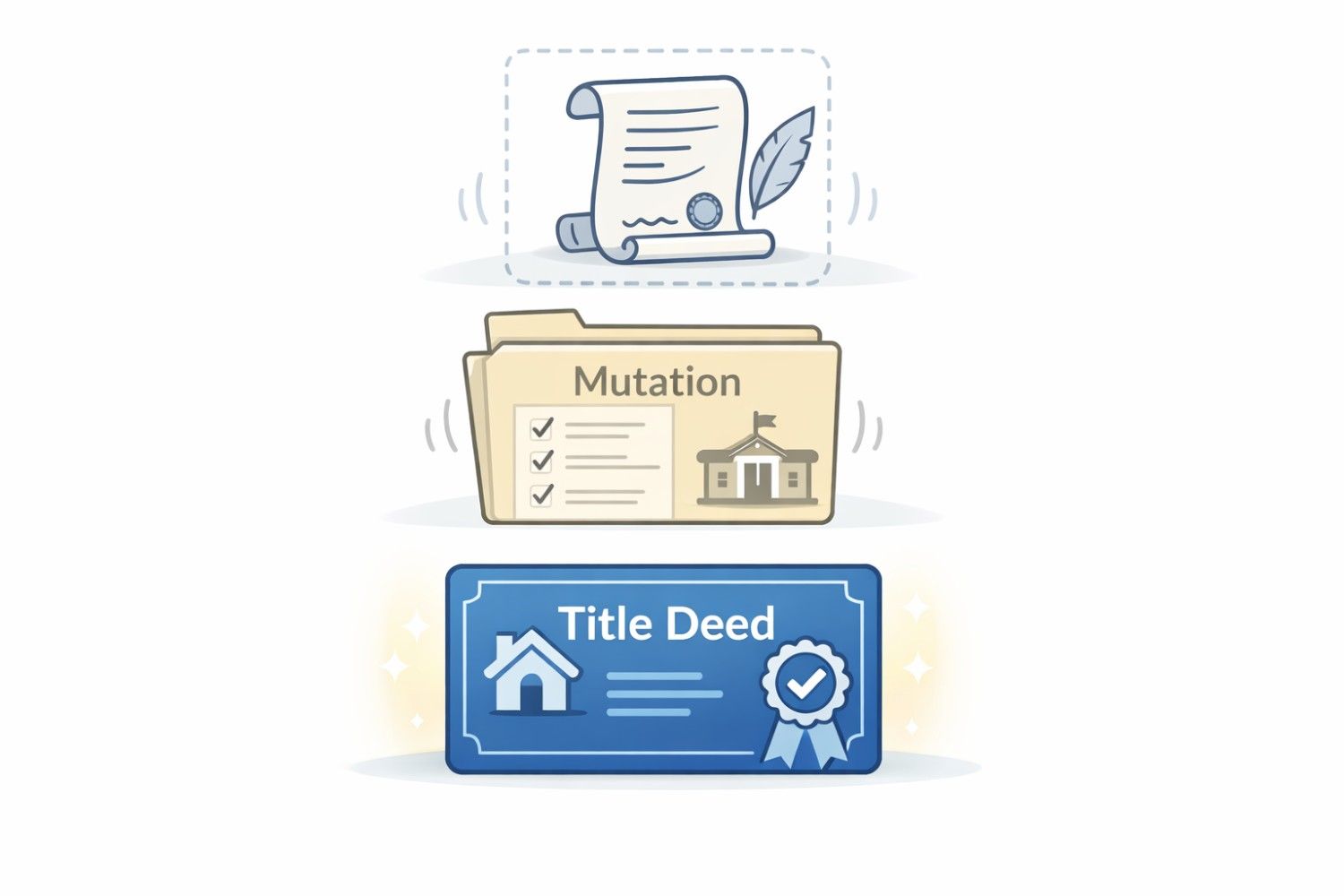
When a property owner passes away, families often assume that ownership passes automatically as soon as a will or mutation is finalized. In Indian property law, this is one of the most prevalent misconceptions. In actuality, the legal functions of a will, property title, and mutation are quite different. Title establishes legal ownership, a will determines who will inherit, and a mutation only modifies official records. Confusing one for the other can result in disagreements, prevented sales, and litigation. This blog describes the relationship between will, mutation, and property title, what each actually establishes, and who, in accordance with Indian law, is the rightful owner of the property after death.
What Happens to Property After Death in India?
What happens to a deceased person's assets is governed by succession law. Succession may be testamentary (under a Will) or intestate (under statutory rules). Importantly, unlike the mechanical transfer of title upon a sale, ownership does not automatically pass upon death. Instead, succession determines who is entitled; the legal processes (probate, letters of administration, court decree, registered transfer) determine how that entitlement is converted into enforceable title and updated in official records. These pathways are governed by the Indian Succession Act and personal law regulations, which also offer the legal foundation for determining heirs and their share.
Key consequences:
l A person named in a Will is a beneficiary (or legatee); but beneficiaries must follow legal processes to convert that right into a transmissible title.
l The distributive scheme in the absence of a will is determined by statutory intestacy rules and the issuance of letters of administration.
What Does a Will Determine?
A Will records the testator’s testamentary intent: who should receive specified assets at death. It is primarily a declaration of intent rather than a transfer deed that creates title immediately.
What a Will does:
l determines the division of the estate and beneficiaries.
l designates executors to carry out instructions.
l May minimize disputes if clearly drafted and registered.
What a Will does not do (automatically):
l Identifies beneficiaries and estate division.
l Appoints executors to carry out directions.
l May minimize disputes if clearly drafted and registered.
It does not immediately produce a marketable title or update government land records. Before the land is transferred or registered in the heir's name, authoritative proof of the will's validity (probate or court recognition) or a transfer backed by title documents is often needed (banks, registrars, municipal bodies).
A will may be contested on the grounds of incapacity, improper execution, or undue influence; these challenges postpone transfer and may necessitate civil litigation.
What Is Property Title and Why It Matters Most?
Property Title is the enforceable right to possess, use, and dispose of immovable property. It is normally proved through registered documents (sale deeds, partition deeds, gift deeds), court decrees, or succession certificates. Title, and not mutation or Will, is the document that will be recognized by courts to decide ownership disputes.
Why title matters:
l Marketability: buyers and banks require clear title before purchasing or lending.
l Enforceability: title gives the holder the right to exclude others and to sue for trespass or ejectment.
l Transferability: title is the foundation for recording a subsequent sale or mortgage.
In case of a dispute between revenue records (mutation) and title, a civil court suit for declaration of title is the appropriate course of action; mutation records cannot be used to create or extinguish title.
What Is Mutation of Property? (And What It Does NOT Do)
Mutation is an administrative procedure by which the local revenue or municipal authorities maintain their records (tax rolls, assessment registers) in respect of a change in the person liable to pay property tax or land revenue. The usual occasion for mutation is sale, inheritance, partition, or gift.
What mutation does:
l It updates the municipal/revenue records for taxation and record-keeping purposes.
l It allows the new record holder to receive tax notices and access to municipal services.
What mutation does not do:
l Mutation does not create, transfer, or certify ownership or title. The Indian courts have consistently held that mutation entries are only for fiscal purposes and do not affect the substantive title to the property. In case of a dispute over title, the mutation entry will carry no presumptive weight to override the title documents or a court decree.
Note* Notwithstanding the administrative nature of mutation, it is often necessary for many authorities and buyers to update the mutation entry as a prelude to transfer, even if it is not the source of title.
Is Mutation Evidence of Ownership of Property in India?
Short answer:
No. Mutation is not a title-conveying document; it is a record, not a creation, of ownership. The Supreme Court and High Courts have held that entries in mutation records have no creative or destructive effect on title and are merely of fiscal and administrative importance. In cases of disputed ownership, the remedy lies in a declaration suit and a consequent judicial decree, not in a mutation application.
Effect on heirs and purchasers:
l Heirs must obtain title-conveying documents (probate, letters of administration, registered transfer) prior to attempting to sell or mortgage the property.
l Purchasers must examine title documents and search for encumbrances, not depend solely on mutation records.
How Heirs Should Proceed After Death
1. Locate the Will (if any) and the original title deeds.
2. Obtain death certificate and notify banks/authorities.
3. If needed, obtain probate or letters of administration - While probate is not necessary in in India, it is highly recommended that it be obtained when selling inherited property. Probate is conclusive evidence of the validity of a will, precluding any later disputes.
4. Execute registered transfer or mutation applications supported by valid title documents.
5. If title is contested, file a declaration suit - a mutation application cannot resolve competing claims to title.
Will vs Mutation vs Title - Quick Comparison
l Will: Testamentary instrument; identifies intended beneficiaries; does not itself transfer title.
l Mutation: Administrative record upkeep for revenue/municipal purposes; does not create ownership.
l Title: Legally enforceable ownership right, evidenced by registered deeds, judicial orders, or statutory grants.
Frequently Asked Questions (FAQs)
Q1) Does mutation give ownership of property?
No. Mutation only updates government/revenue records and does not create or transfer legal ownership. Courts have held mutation to be a fiscal record, not a title document.
Q2) Is mutation mandatory after a Will?
Mutation is generally required to update municipal and revenue records (for taxes and services), but it is not the source of ownership. Ownership follows title-creating steps (probate/transfer/registration), not merely the mutation entry.
Q3) Is a Will enough to claim property ownership?
A Will expresses succession; to obtain marketable title heirs normally obtain probate or complete the statutory transfer process and register deeds as required. In contested situations, a court decree may be necessary.
Q4) Can inherited property be sold without mutation?
Practically, mutation is usually completed before a sale so municipal records match the seller’s name; however, the decisive element is clear legal title and a registered transfer (sale deed), not mutation alone.
Q5) What proves ownership of property after death in India?
Ownership is proved through clear title, which may arise from a registered sale deed, a probated Will, a succession certificate (where applicable), or a court decree. Mutation records alone do not prove ownership.
Author:
Priyansh Tiwari is a 2nd year law student at Maharashtra National Law University Chhatrapati Sambhajinagar, currently interning at SolvLegal.
REVIEWED BY:
Akhil Singh, a corporate lawyer with expertise in intellectual property rights, contract drafting, and compliance advisory. He is a tech-forward legal practitioner at SolvLegal, where he focuses on corporate compliance and data-privacy frameworks. His experience includes IT law and cross-border regulatory issues, and he assists businesses in safeguarding their innovations while strengthening their overall legal and compliance systems.

Related Articles
.jpeg "Investment Risk Review: Hospitality & Condo Projects")

Leave a Comment