ESOP for Startups: Complete Global Guide to Structuring, Vesting & Taxation
Read More
Starting a Company With Co-Founders? The Essential Clauses Every Founder Must Include (2025 Global Guide)
By the SolvLegal Team
Published on: Dec. 8, 2025, 12:46 p.m.
Quick Answer
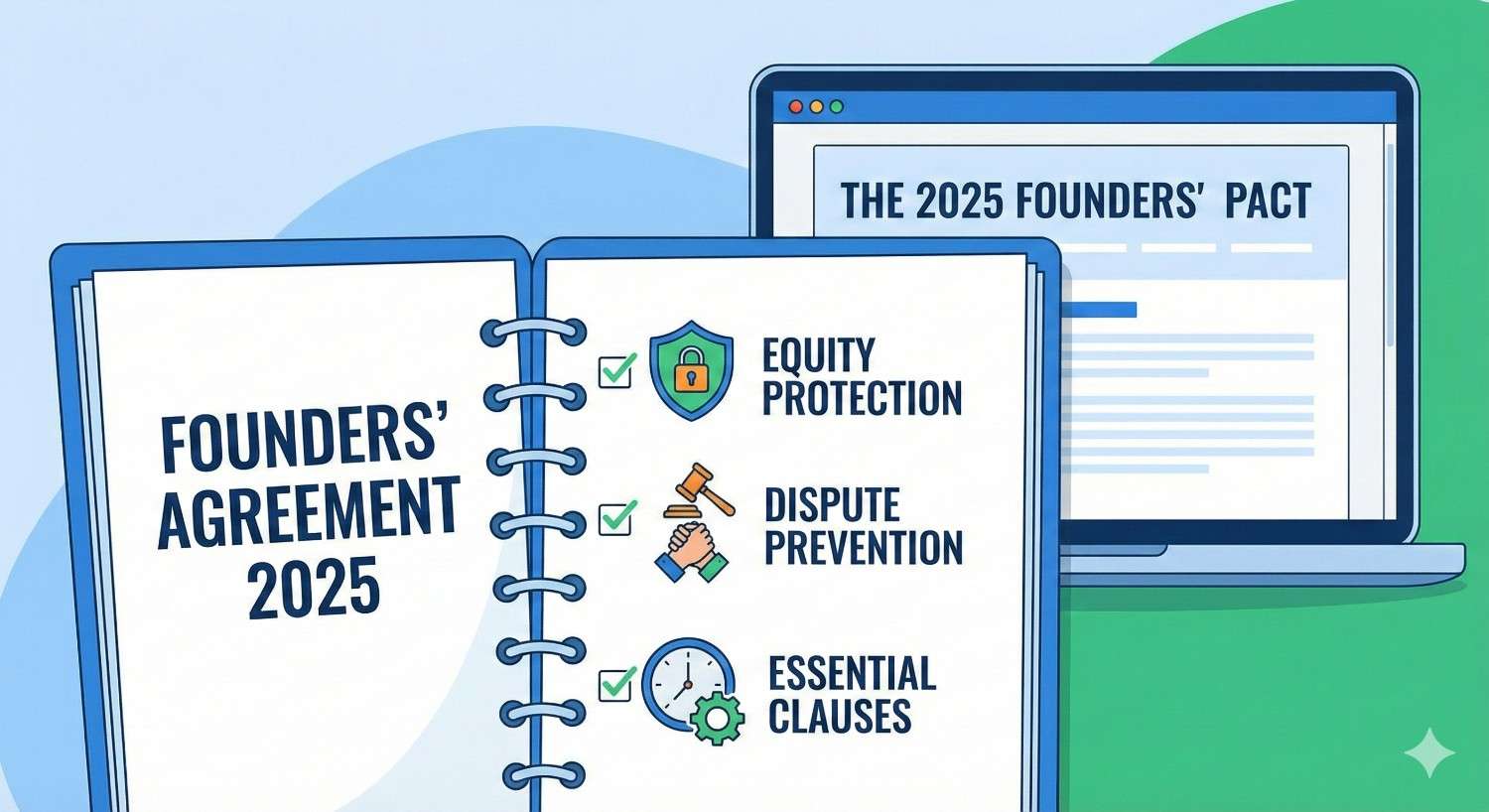
Founder disputes are quietly killing startups worldwide. Just one disagreement over equity, IP, or roles can derail even a billion-dollar idea. This blog breaks down the 10 essential clauses every founder’s agreement must have in 2025, ensuring your startup stays protected from day one.
You’ll learn how to legally safeguard your ownership, set clear roles, handle intellectual property, including AI-generated work, and resolve disputes before they escalate. We also cover global practices across India, the US, UK, UAE, and Singapore, so your agreement is investor-ready everywhere.
Here’s a sneak peek at the 10 must-have clauses:
- Ownership Structure & Equity Split
- Vesting Schedule & Founder Lock-In
- Roles, Decision-Making & Responsibilities
- Intellectual Property & AI Work
- Confidentiality, Non-Compete & Non-Solicit
- Pre-Existing IP Disclosure
- Equity Transfers & Buyback Formula
- Founder Removal & Dispute Resolution
- Data Protection & Cybersecurity Obligations
- Practical Clauses: Social Media, Anti-Dilution & More
Using a platform like SolvLegal, founders can quickly draft a legally enforceable, customizable agreement, avoiding costly conflicts later.
Introduction - The Co-Founder Trap
Picture this: a brilliant idea, two friends passionate about building it, and a shared dream of changing the world. But there’s one problem, they never put anything on paper. Fast forward six months, tensions rise, roles blur, and suddenly, the friendship is strained and the startup is bleeding cash. This is the classic co-founder trap.
Globally, studies suggest that around 70% of startups fail due to co-founder disputes. From disagreements over equity to differences in vision, even minor misunderstandings can spiral into full-blown legal battles. Trust and passion are wonderful, but without legal clarity, they often aren’t enough to sustain a growing business.
In this blog, we’ll guide you through how to avoid these pitfalls with a strong founders’ agreement. You’ll discover the most important clauses that investors expect in 2025, practical tips for handling equity, IP, and decision-making, and how to make your agreement globally compliant, covering India, the US, UK, UAE, and Singapore. By the end, you’ll know exactly how to protect your startup, your co-founders, and your future.
What Exactly Is a Founders’ Agreement?
A founders’ agreement is a foundational legal document that defines the relationship between co-founders and the framework for running the startup. At its core, it ensures that everyone is on the same page about ownership, decision-making, responsibilities, and how to handle disputes before they arise. Think of it as a preemptive safety net, without it, even minor misunderstandings can escalate into major conflicts that threaten the survival of the business.
It’s important to distinguish a founders’ agreement from other business documents:
· Shareholders’ Agreement (SHA): While SHAs govern rights and obligations of all shareholders, including investors, a founders’ agreement focuses specifically on the founding team’s responsibilities, equity, and roles. SHAs often come into play later, once external funding or additional shareholders enter the picture.
· Employment Contract: Contracts for individual employees outline job duties, compensation, and employment terms. They rarely cover ownership, voting rights, or what happens if a founder leaves. A founders’ agreement fills this gap.
· LLP Agreement or Partnership Deeds: These agreements are structured for partnership or LLP entities and generally focus on profit-sharing ratios and managerial duties. They don’t usually address intellectual property ownership, founder lock-ins, or dispute resolution in the way a startup requires.
Timing is critical. Ideally, the founders’ agreement should be signed before creating your MVP, securing seed funding, or incorporating your business. The reason is simple: once the startup begins operating, money is invested, or IP is created, altering ownership or responsibilities becomes legally and emotionally complicated. Early clarity prevents “he said, she said” situations and ensures that equity, contributions, and decision-making powers are transparent from the start.
Beyond the legal necessity, a founders’ agreement also strengthens trust. Many founders hesitate because it feels like they are “planning for disputes” or showing mistrust toward their friends. In reality, it’s the opposite, formalizing expectations protects relationships by setting clear boundaries and avoiding assumptions. For example, who owns the code written before incorporation? What happens if one founder leaves after three months? Who decides on spending large sums or taking loans? Without a written agreement, these questions often lead to friction, even among the most passionate teams.
Another key aspect is future-proofing the startup. A founders’ agreement can include clauses that cover evolving technologies, remote work, AI-generated intellectual property, or expansion to global markets. By anticipating challenges, founders minimize the risk of disputes that could derail operations or scare off investors. In other words, it’s not just a legal document, it’s a strategic tool for sustainable growth.
The 2025 Global Essentials: Clauses Every Founders’ Agreement Must Include
A founders’ agreement is only as strong as the clauses it contains. In 2025, startups face not just domestic challenges, but cross-border complexities, from AI-generated IP to investor expectations across India, the US, UK, UAE, and Singapore. Below, we break down the 10 essential clauses, explained in practical, founder-friendly terms.
1. Ownership Structure & Equity Split
At the heart of any founders’ agreement is ownership allocation. Who owns what percentage of the company? How do capital contributions, sweat equity, or early investments influence that percentage? Getting this right from the start prevents bitter disputes later.
Key considerations include:
· Percentage Ownership: Clearly define each founder’s stake, including shares allocated for future hires or investors. Avoid vague promises like “we’ll split evenly later”, clarity at inception matters.
· Sweat Equity: Founders often contribute time, skills, or IP instead of cash. Document how this “sweat equity” translates into shares, including vesting schedules to prevent a founder from leaving immediately with a significant stake.
· Capital Contributions: Money invested in the startup must be tracked. Whether it’s personal savings, loans, or third-party investments, each contribution should correspond to a percentage of ownership or debt repayment rights.
Global perspectives:
· India (Companies Act, 2013): Equity shares and capital contributions are regulated under the Companies Act. ESOPs (Employee Stock Option Plans) also need to be clearly structured.
· US (Delaware C-Corp): Ownership is often formalized via stock issuance, with clear provisions for founders’ equity, investor rights, and 83(b) elections to reduce future tax burdens.
· UAE & Singapore: Startups often have foreign ownership restrictions. Dubai’s mainland vs DIFC rules, or Singapore’s mandatory IP assignment policies, influence how equity is split and documented.
Practical advice for founders: Avoid informal agreements like WhatsApp messages or verbal promises. Equity splits should reflect not just contribution but also long-term commitment and risk taken by each founder. Clear documentation from day one protects relationships, prevents legal battles, and makes the startup more attractive to investors.
2. Vesting Schedule & Founder Lock-In
Even if equity is split fairly, founders leaving early can create chaos. This is where a vesting schedule and founder lock-in clauses become essential. They protect both the company and the co-founders by ensuring that ownership is earned over time.
Key elements include:
· 4-Year Vesting with 1-Year Cliff: A common approach where founders earn their equity gradually over four years. The first year acts as a “cliff,” meaning if a founder leaves within that year, they forfeit all unvested shares. This prevents early exits from destabilising the startup.
· Reverse Vesting: Founders who already own shares agree that these shares will vest over time. It’s a way to protect the company if someone leaves after incorporation.
· Good Leaver / Bad Leaver Rules: These define scenarios in which a departing founder can retain some equity (“good leaver”) versus situations where they forfeit it entirely (“bad leaver”), such as leaving voluntarily without notice or breaching duties.
Investor Perspective:
Investors often insist on vesting schedules to ensure founders remain committed post-investment. A startup where founders could leave with large equity stakes immediately is risky and may scare off potential funding.
Global Context:
· India: Vesting provisions are enforceable under standard agreements and commonly paired with ESOPs for employees.
· US (Delaware C-Corp): Reverse vesting and cliffs are standard. 83(b) elections are often recommended to minimise tax liabilities.
· UK & EU: Vesting schedules are widely used, particularly in tech startups, with clear “good leaver/bad leaver” definitions to avoid disputes.
· Singapore & UAE: Similar practices apply, but legal enforceability may vary. It’s especially critical in jurisdictions with foreign ownership restrictions to ensure equity remains with the company if a founder exits.
Practical advice for founders: Vesting isn’t about mistrust, it’s about fairness and long-term stability. It ensures that founders contribute consistently to the company’s growth. Combine this clause with clear exit definitions, and you’re far less likely to face heated equity disputes down the line.
3. Roles, Decision-Making & Founder Responsibilities
One of the most common sources of co-founder conflict is role ambiguity. Even if equity and vesting are clear, disagreements about who does what, who decides, and how responsibilities are shared can derail a startup. A founders’ agreement must clearly define roles, responsibilities, and the decision-making framework.
Key components include:
· Major vs. Minor Decisions: Specify which decisions require consensus (e.g., raising funding, selling the company, acquiring other startups) and which can be made independently (e.g., hiring junior staff, day-to-day operations). This prevents disputes over strategic versus operational matters.
· Voting Powers: Align voting rights with equity, but also consider special voting rights for certain founders. For instance, a technical founder may have veto power over product architecture decisions, while a CEO may have final say on business operations.
· Founder KPIs and Deliverables: Outline expectations for each founder, such as product milestones, revenue targets, or fundraising responsibilities. Documenting performance obligations avoids subjective debates about “effort” or “contribution.”
· Full-Time vs. Part-Time Founder Clause: Especially relevant in early-stage startups, this clause defines whether founders must commit full-time and what happens if someone reduces their involvement. This is often overlooked but critical to prevent resentment from overworked co-founders.
Global Insights:
· India: While informal arrangements are common, clearly documenting roles and decision-making authority is enforceable under the Companies Act. It also reassures investors evaluating founder commitment.
· US (Delaware C-Corp): Voting rights and board control are formalised through founders’ agreements and corporate bylaws. Investors often insist on defined decision rights for clarity.
· UK & EU: Role clarity is crucial for both internal governance and regulatory compliance, particularly where founders have fiduciary duties.
· Singapore & UAE: Startups often face cross-border team structures; defining decision-making authority in agreements avoids disputes when founders are in different countries or jurisdictions.
Practical advice for founders: Don’t assume that shared vision equals aligned execution. Explicitly define who does what, how decisions are made, and the accountability structure. This not only prevents conflicts but also improves operational efficiency and demonstrates professionalism to investors.
4. Intellectual Property (IP) Ownership, Including AI-Generated Work (New 2025 Clause)
In 2025, intellectual property isn’t just about code or designs, it now includes AI-generated content, algorithms, and automated systems. For startups, defining IP ownership early is critical to avoid disputes, protect investor interests, and secure freedom to operate globally.
Key elements include:
· Assignment of IP to the Company: All creations, code, designs, inventions, content, and AI outputs, must be formally assigned to the startup. This ensures that the company, not individual founders, owns the rights.
· AI-Generated Work: With AI tools increasingly used to generate code, marketing content, or designs, founders must specify that outputs from AI tools, even if created by humans using AI, belong to the company. Without this clause, ownership disputes could arise, especially if AI outputs are monetized externally.
· IP Warranties: Founders should confirm that any contributions are original, do not infringe on third-party IP, and that they have full rights to assign the work to the company.
· Moral Rights Waiver: Some jurisdictions recognize the moral rights of creators, such as attribution. Founders should explicitly waive these rights for company-owned IP to avoid conflicts over credit or usage.
Global enforceability examples:
· India: The Patents Act and Copyright Act allow assignment of IP, including AI-generated work, to companies. Without proper documentation, disputes over code or design ownership can arise.
· US (Delaware, California): IP assignment agreements are standard. Investors require explicit clauses covering AI-generated work and pre-existing IP.
· EU & UK: Moral rights are strongly recognized in Europe, making waivers essential. AI-generated IP is an evolving legal area, so clear assignment and documentation are critical.
· Singapore & UAE: Both jurisdictions emphasize mandatory IP assignment for founders. Singapore also requires compliance with the Personal Data Protection Act (PDPA) if IP involves personal data.
Practical advice for founders: Treat IP ownership as the backbone of your startup. Documenting both human-created and AI-assisted contributions prevents costly disputes, strengthens investor confidence, and ensures you can scale globally without legal roadblocks. Clearly separate pre-existing IP (from prior projects) from new company-created IP to avoid grey areas that often spark litigation.
5. Confidentiality, Non-Compete & Non-Solicit
Startups live and die by their ideas, trade secrets, and relationships. Even the most well-intentioned founder can accidentally, or deliberately, cause leaks or compete against the company. This is why confidentiality, non-compete, and non-solicit clauses are critical.
Key components include:
· Non-Disclosure Agreements (NDAs): Founders should commit to keeping sensitive information, product plans, customer data, and proprietary processes confidential. NDAs should cover both current and future information, and include consequences for breaches.
· Non-Compete: Restricts founders from starting or joining competing businesses for a defined period after leaving. In India, enforceability is limited under Section 27 of the Contract Act, which prohibits unreasonable restraint of trade. Globally, enforceability varies:
o US: Non-compete enforceability depends on the state; California, for instance, largely bans them, while other states enforce reasonable restrictions.
o UK: Partially enforceable; must be limited in scope, geography, and duration.
o Singapore & UAE: Non-competes are generally enforceable if reasonable in scope and duration.
· Non-Solicit: Prevents departing founders from poaching employees, clients, or contractors. Unlike non-compete clauses, non-solicit agreements are generally enforceable globally, as they protect business relationships without restricting trade.
Practical advice for founders: Don’t assume that loyalty is enough. Clearly defined confidentiality and non-compete clauses protect your startup’s IP, prevent unfair competition, and reassure investors. Make sure the clauses are reasonable and enforceable in your jurisdiction, balancing legal protection with founder flexibility. Also, consider sunset clauses for non-compete and non-solicit obligations, typically 6–24 months, to ensure they remain practical and enforceable.
6. Pre-Existing IP Disclosure (Background IP Schedule)
A frequently overlooked source of founder disputes is pre-existing intellectual property (IP), code, designs, patents, or projects a founder created before joining the startup. Without proper disclosure, these contributions can lead to ownership conflicts, legal claims, or investor concerns.
Key elements include:
· Mandatory Schedule for Pre-Existing Work: Each founder should list all prior inventions, software, content, or other IP relevant to the startup. This schedule ensures transparency about what belongs to the company versus what remains personal.
· Domains, Repositories, and Tools: Include prior code repositories, domain names, and AI models. Even small contributions can spark disputes if they are integrated into the startup’s product.
· IP Ownership & Licensing: Clearly state whether pre-existing IP is being licensed to the startup, assigned, or remains the founder’s property. This prevents accidental claims or infringement later.
· Disclosure Timing: Pre-existing IP schedules should be submitted at the time of incorporation or when signing the founders’ agreement. Updating it periodically is good practice as founders create new ideas outside the company.
Global perspective:
· India: Companies Act and Copyright Act allow clear IP assignment agreements, but disputes often arise if prior work isn’t formally disclosed.
· US (Delaware, California): Investors expect a thorough background IP schedule. California’s IP assignment laws are strict, and failure to disclose can derail funding rounds.
· UK & EU: Mandatory disclosure of pre-existing IP is standard in tech startups; moral rights issues must be considered.
· Singapore & UAE: Both jurisdictions require clear ownership documentation for founders’ pre-existing IP to avoid litigation and facilitate international operations.
Practical advice for founders: Transparency is non-negotiable. Document every piece of IP brought into the startup to avoid “he said, she said” disputes later. Even open-source contributions, prototypes, or AI models must be disclosed. A clear background IP schedule not only protects founders but also strengthens investor confidence, making your startup more credible and investment-ready.
7. Equity Transfers: Tag-Along, Drag-Along, ROFR & Buyback Formula
Equity transfer clauses govern how shares can be sold, bought back, or transferred among founders, investors, and third parties. These clauses are critical for protecting both founders’ control and investor interests, while preventing unexpected changes in ownership.
Key components include:
· Tag-Along Rights: Protect minority founders. If a majority shareholder sells their stake, minority shareholders have the right to “tag along” and sell their shares on the same terms. This prevents small founders from being left behind with new majority owners.
· Drag-Along Rights: Protect investors. If a majority shareholder or investor wants to sell the company, drag-along rights allow them to force minority shareholders to sell their shares under the same terms. This ensures smooth exit deals and avoids holdouts.
· Right of First Refusal (ROFR): Before a founder sells shares to an external party, other founders or the company get the first opportunity to purchase those shares. ROFR protects the startup from unwanted outside shareholders and maintains control within the founding team.
· Buyback Formula: Defines how the company can repurchase shares from a departing founder, including valuation methods (e.g., fair market value, pre-agreed formula). Without this, disputes over price can delay exits and legal resolution.
Global perspectives:
· India: Companies Act provisions and SEBI regulations (for startups with convertible instruments) allow clearly drafted equity transfer clauses. Valuation formulas are critical for founder exits and investor confidence.
· US (Delaware, California): Tag-along, drag-along, and ROFR clauses are standard in stock purchase agreements. Clear definitions prevent litigation and align with VC expectations.
· UK & EU: Shareholders agreements often include these clauses, emphasizing fairness in exits and investor protection. Courts tend to enforce them if terms are clearly documented.
· Singapore & UAE: These clauses are widely used to maintain control and clarity for cross-border shareholders. UAE DIFC companies, in particular, require explicit documentation to recognize rights among foreign and local shareholders.
Practical advice for founders: Without transfer restrictions, a single founder could sell shares to an outsider, potentially diluting control or introducing conflicts. Explicitly define how shares can be sold, at what price, and under which conditions. Clear rules prevent unexpected disputes and make your startup more attractive to both investors and co-founders.
8. Founder Removal, “Cause”, & Dispute Resolution
Even with the best intentions, founders may sometimes need to be removed due to misconduct, non-performance, or strategic disagreements. Without clear clauses, this process can become messy, expensive, and damaging to the company. A modern founders’ agreement must define “cause,” removal procedures, and dispute resolution mechanisms.
Key components include:
· Definition of “Cause”: Clearly define circumstances that justify removal, such as gross negligence, criminal activity, breach of fiduciary duty, or repeated failure to meet agreed-upon responsibilities. Ambiguous definitions often lead to prolonged legal battles.
· Removal Process: Establish step-by-step procedures, including board or founder approval thresholds, notice periods, and options for the departing founder. Decide whether buyback of shares happens automatically and at what valuation.
· Dispute Resolution: Outline how disagreements will be handled. Arbitration is common, providing a quicker and confidential resolution compared to court litigation. Modern agreements increasingly include emergency arbitrator provisions for urgent issues, such as IP theft or financial misappropriation.
· Step-by-Step Clauses: Include mediation, arbitration, and escalation steps. This ensures that minor disputes are resolved amicably before escalating to legal action, protecting relationships and company reputation.
Global perspectives:
· India: Courts enforce removal and dispute resolution clauses if properly documented in the founders’ agreement or SHA. Arbitration clauses are widely recognized under the Arbitration and Conciliation Act, 1996.
· US (Delaware): Founders’ agreements and bylaws often include detailed removal procedures and arbitration clauses. Investors prioritize clear governance structures to mitigate risk.
· UK & EU: Removal for cause and dispute resolution clauses are standard. UK law allows parties to enforce these provisions under contract law, including arbitration or mediation frameworks.
· Singapore & UAE: Startups often include stepwise removal clauses with arbitration or DIFC courts for international founders, ensuring enforceability across jurisdictions.
Practical advice for founders: Removal clauses aren’t about mistrust, they protect the company and all stakeholders. Clearly defining “cause” and outlining dispute resolution ensures fairness and prevents a single founder from paralyzing operations or threatening investor confidence. Early clarity reduces tension, maintains morale, and preserves the startup’s trajectory even during founder exits.
9. Data Protection, Cybersecurity & DPDP/GDPR Obligations (New Legal Requirement)
In 2025, data isn’t just an asset, it’s a legal responsibility. Startups handling user information, whether in India or abroad, must comply with emerging privacy regulations. Founders’ agreements now need dedicated clauses for data protection, cybersecurity, and cross-border compliance.
Key elements include:
· DPDP Act 2023 (India): Founders must commit to compliance with the Data Protection and Digital Privacy Act, including proper handling, storage, and sharing of personal data. Non-compliance can result in severe penalties and reputational damage.
· GDPR (EU & UK): If the startup serves European users, GDPR obligations, like consent, right to erasure, and data breach notifications, must be followed. Clauses should mandate that founders and employees handle data in accordance with these laws.
· Cybersecurity Measures: Define founder responsibilities for device security, password management, access control, and incident reporting. Startups often face breaches from human error; having clear obligations reduces risk.
· Cross-Border Operations: Explicitly address obligations when handling data from multiple jurisdictions. This includes cloud storage locations, AI training data, and transfers between countries.
Global perspective:
· US: No federal law is as comprehensive as GDPR, but several states (California, New York) have stringent privacy regulations. Founders must adopt security policies aligned with local and investor expectations.
· Singapore (PDPA): Personal Data Protection Act requires proper consent and security measures for all user data.
· UAE: DIFC and other free zones have their own data protection frameworks, which may differ from mainland laws.
Practical advice for founders: Even if your startup is small, treating data responsibly is critical. Include clear clauses assigning responsibility for compliance, define reporting protocols for breaches, and document founder obligations. Doing so not only reduces legal risk but also builds trust with investors and users. In the AI era, where personal data and machine learning often intersect, these clauses are no longer optional, they are essential.
10. Today’s Practical Clauses
Beyond the traditional legal provisions, modern startups in 2025 face unique challenges, from social media missteps to founder burnout. Founders’ agreements now need practical clauses that address these day-to-day realities while protecting the company and team dynamics.
Key clauses include:
· Social Media & Reputational Harm: Define expectations for online conduct, including statements about the company on social platforms. This protects the startup from reputational damage caused by impulsive posts or public disputes.
· Anti-Dilution Protections: Ensure founders are not unfairly diluted during future funding rounds. Clauses can specify pre-emptive rights or valuation formulas to preserve ownership percentages, particularly important when negotiating with investors.
· Remote Work & Flexibility: Modern startups often operate across geographies. Founders’ agreements should clarify expectations for remote work, office attendance, time-zone coordination, and productivity reporting.
· Founder Mental Health & Burnout Clauses: Startups are high-stress environments. Agreements can include provisions for mental health support, temporary leaves, or adjustment of responsibilities, helping founders remain sustainable without jeopardizing the company.
· Founder Non-Interference After Exit: When a founder leaves, it’s critical to prevent disruption. Clauses should restrict the ex-founder from soliciting clients, employees, or leveraging insider knowledge to compete with the startup.
Global relevance:
· India & Singapore: These clauses are increasingly recognized by investors and advisors, signaling professional governance.
· US & UK: Practical clauses like non-interference, anti-dilution, and social media obligations are standard in modern agreements and often scrutinized during due diligence.
· UAE: While formal enforcement may vary, including these provisions protects startups from disputes in multi-founder or cross-border setups.
Practical advice for founders: These clauses may seem “soft,” but they prevent real-world conflicts that can threaten early-stage startups. Clear expectations around conduct, responsibilities, and post-exit behavior reduce friction, maintain morale, and help attract investors who value structured governance. Think of them as the behavioral and operational backbone of your startup agreement.
High-Risk Areas Where Most Founder Disputes Start
Even with a solid founders’ agreement, startups often face disputes in predictable areas. Recognizing these high-risk zones early helps founders proactively prevent conflicts.
1. Intellectual Property (IP) Ownership Confusion:
Disagreements over who owns code, designs, patents, or AI-generated content are a leading cause of founder disputes. Lack of clarity about pre-existing IP or AI contributions can quickly escalate, especially if the startup gains traction or funding.
2. Unequal Workload and Contribution:
Perceptions of imbalance, one founder doing more work or contributing more resources, can sour relationships. Without clearly defined roles, KPIs, or vesting-linked equity, resentment grows, potentially leading to disputes or departures.
3. Money and Investment Disputes:
Decisions about capital contributions, salary draws, or investment acceptance often create tension. Ambiguities about funding approvals, valuation, and equity dilution can spark legal battles if not pre-agreed.
4. Lack of Voting or Decision Clarity:
Disagreements about major vs. minor decisions, authority limits, and voting rights can freeze operations. Founders who bypass agreed procedures often trigger conflicts that stall growth or scare investors.
5. Hidden Prior Companies or Conflicts of Interest:
Founders joining a startup with undisclosed existing ventures, clients, or IP can create serious legal and ethical issues. Full disclosure of background IP, prior businesses, and potential conflicts is essential to avoid litigation.
6. Data Breach Incidents:
Startups handling sensitive data face legal risks and investor scrutiny if founders mishandle cybersecurity. Disputes can arise over responsibility for breaches, regulatory penalties, or damage control.
What Different Countries Require (Mini Comparative Guide)
Startups today often operate across borders, whether through co-founders, investors, or user bases. Understanding jurisdiction-specific requirements ensures your founders’ agreement is enforceable and investor-ready. Here’s a quick global comparison:
India
· Contract Act & Companies Act: Equity splits, voting rights, and shareholder protections must comply with statutory requirements.
· ESOPs & Tax Rules: Employee stock options need proper documentation; founder vesting schedules should align with tax laws.
· IP & DPDP Act: Intellectual property must be assigned to the company. The Data Protection and Digital Privacy Act 2023 sets obligations for handling personal data.
United States (Delaware)
· Stock Purchase & IP Assignment Agreements: Founders’ shares, vesting, and IP ownership are formalized through legally binding agreements.
· 83(b) Elections: Filing helps reduce tax liability on early equity.
· Non-Compete & Non-Solicit: Enforceability varies by state; California largely bans non-competes, while other states allow reasonable restrictions.
United Kingdom
· Shareholders Agreements & Vesting: SHAs formalize ownership, decision-making, and exit rights.
· IP Assignment: Required for all founder-created works.
· Non-Compete: Partially enforceable, must be reasonable in scope, geography, and duration.
· Employment Classification: Important for founders taking salaries to avoid misclassification issues.
Singapore
· Startup-Friendly Regime: Clear rules for founder ownership, IP assignment, and equity vesting.
· PDPA Compliance: Founders must handle personal data according to the Personal Data Protection Act.
· Flexibility for Cross-Border Founders: Singapore law allows efficient incorporation and multi-founder agreements.
UAE
· Founder Agreements: Common in both mainland and free zones, with varying legal enforceability.
· DIFC vs Mainland: DIFC offers English common law-based enforcement, while mainland Dubai may require local partner involvement in certain sectors.
· Local Partner Requirements: In some industries, foreign founders must partner with UAE nationals, affecting equity and control.
When You MUST Update Your Founder Agreement
A founders’ agreement is not a “set it and forget it” document. Startups evolve rapidly, and the agreement must reflect changing realities to remain effective. Here are the key triggers that require updates in 2025:
1. Raising Funding:
Bringing in investors often introduces new terms, equity allocations, or voting rights. Founders’ agreements should be updated to reflect these changes, preventing conflicts between pre-existing arrangements and investor requirements.
2. Adding or Removing a Founder:
When a new founder joins, equity splits, roles, and responsibilities need to be recalibrated. Conversely, if a founder leaves, their shares, IP, and exit obligations must be clearly documented.
3. Pivoting the Business Model:
Startups often pivot, introducing new products, services, or markets. The agreement should reflect who owns new IP, decision-making authority, and responsibilities for the pivot to avoid disputes.
4. Launching New IP-Heavy Products:
If the company begins creating software, AI systems, or other IP-intensive products, ownership, licensing, and IP assignment clauses may need revision to cover new technologies.
5. Expanding to a New Country or Jurisdiction:
Operating internationally introduces new legal requirements, tax obligations, and data protection rules. The agreement should include clauses ensuring compliance with local laws in the new jurisdiction.
6. Using AI-Based Tools:
AI-generated work introduces new IP ownership and data compliance considerations. Founders should update agreements to assign AI-created IP to the company and include relevant warranties.
7. Data Privacy Compliance Updates:
Regulations like India’s DPDP Act 2023 or GDPR may evolve. Founders’ agreements must be updated to reflect obligations, breach protocols, and compliance responsibilities.
Practical advice for founders:
Treat your founders’ agreement as a living document. Schedule periodic reviews, at least annually or after major milestones, to ensure it reflects reality. Ignoring updates can lead to costly disputes, investor concerns, and operational inefficiencies. A proactive approach keeps your startup legally sound and relationship-friendly.
SolvLegal Insight, How We Help Founders
Drafting a founders’ agreement can feel overwhelming, especially with cross-border founders, AI-generated IP, and evolving data privacy laws. SolvLegal helps by creating tailored agreements, reviewing existing contracts, ensuring compliance with DPDP/GDPR obligations, and assigning IP properly. Whether you’re incorporating in India, the US, UK, Singapore, or UAE, founders can book a contract review call to safeguard their equity, responsibilities, and legal clarity before disputes arise. Free Template.
FAQs
1. What should a founders’ agreement include in 2025?
A modern founders’ agreement should cover ownership, equity splits, vesting schedules, roles and responsibilities, IP ownership, including AI-generated work, confidentiality, dispute resolution, data protection compliance, and practical clauses like social media conduct, anti-dilution, and remote work policies.
2. Is a founders’ agreement legally binding in India, US, UK, Singapore, UAE?
Yes, when properly executed, a founders’ agreement is enforceable in all these jurisdictions. Local laws affect specific clauses, for example, non-compete enforceability differs between India, the US, and the UK, while DPDP/GDPR obligations apply for data protection.
3. What is the difference between a SHA and a founders’ agreement?
A Shareholders’ Agreement (SHA) governs all shareholders, including investors, while a founders’ agreement specifically addresses the founding team’s equity, roles, and responsibilities. SHAs often follow funding rounds, whereas founders’ agreements are signed at inception.
4. How do we handle equity if one founder leaves early?
Vesting schedules, cliffs, and Good Leaver/Bad Leaver clauses define how departing founders’ equity is treated. Reverse vesting ensures founders earn equity over time, preventing early exits from destabilizing ownership.
5. How do we protect IP if we use AI tools?
Include clear clauses assigning all AI-generated work to the company, with warranties of originality and moral rights waivers. Pre-existing IP schedules and proper documentation prevent disputes over ownership and investor concerns.
6. What if a co-founder refuses to sign a founders’ agreement?
It’s risky to proceed without a signed agreement. Founders should negotiate terms, involve advisors, or delay incorporation/funding until all key stakeholders agree. Documenting roles, equity, and IP is critical to prevent future conflicts.
7. Can foreign co-founders sign an Indian founders’ agreement?
Yes, foreign co-founders can sign, but agreements should account for cross-border enforceability, local regulations, and tax implications. Jurisdiction-specific clauses ensure the agreement is valid in India and aligned with the co-founder’s home country requirements.
Conclusion
A founders’ agreement isn’t just a legal document, it’s the foundation of trust, clarity, and long-term stability for your startup. In 2025, startups face new challenges, from AI-generated IP to global data privacy laws, cross-border founders, and investor expectations. Without clearly defined roles, equity splits, vesting schedules, IP ownership, and dispute mechanisms, even the strongest ideas can falter.
Signing a founders’ agreement early ensures that relationships stay professional, responsibilities are aligned, and all contributors understand their rights and obligations. Regular updates keep the agreement relevant, reflecting funding rounds, pivots, new jurisdictions, and emerging technology.
By proactively addressing legal, operational, and practical considerations, from data compliance to mental health and post-exit non-interference, founders can focus on building, innovating, and scaling without constant fear of internal conflicts. Clarity now prevents crises later, protects your vision, and makes your startup investor-ready.
With careful planning, legal foresight, and periodic reviews, your startup can thrive confidently, even in a rapidly evolving global landscape.
Related articles:
1. Term Sheets & Shareholders’ Agreements 2025: Legal Clauses Indian Founders Often Overlook
2. Outsourcing Software Development Abroad? Legal Clauses Every Business Must Know (2025 Global Guide)
3. Ai Contract Automation In India: Benefits, Legal Risks, And The Road Ahead For Smes
About the author: Kunal Singh is a second-year B.Sc. LL.B. (Hons.) student at National Forensic Sciences University, Gandhinagar.
Reviewed by: Gaurav Saxena is the founder of SolvLegal, where he brings together dual expertise in engineering and law to guide clients through complex corporate and compliance matters. With a strong grounding in the law of contracts, corporate law, intellectual property, IT law and data privacy, he works with startups and established businesses alike to structure agreements, advise on governance and safeguard innovation.
Disclaimer
The information provided in this article is for general educational purposes and does not constitute a legal advice. Readers are encouraged to seek professional counsel before acting on any information herein. SolvLegal and the author disclaim any liability arising from reliance on this content.

Related Articles


Leave a Comment