Cross-Border Dropshipping: Legal Clauses You Need When Suppliers Are Overseas (2026 Guide)
Read More
OUTSOURCING SOFTWARE DEVELOPMENT ABROAD? LEGAL CLAUSES EVERY BUSINESS MUST KNOW (2025 GLOBAL GUIDE)
By the SolvLegal Team
Published on: Nov. 19, 2025, 10:10 a.m.
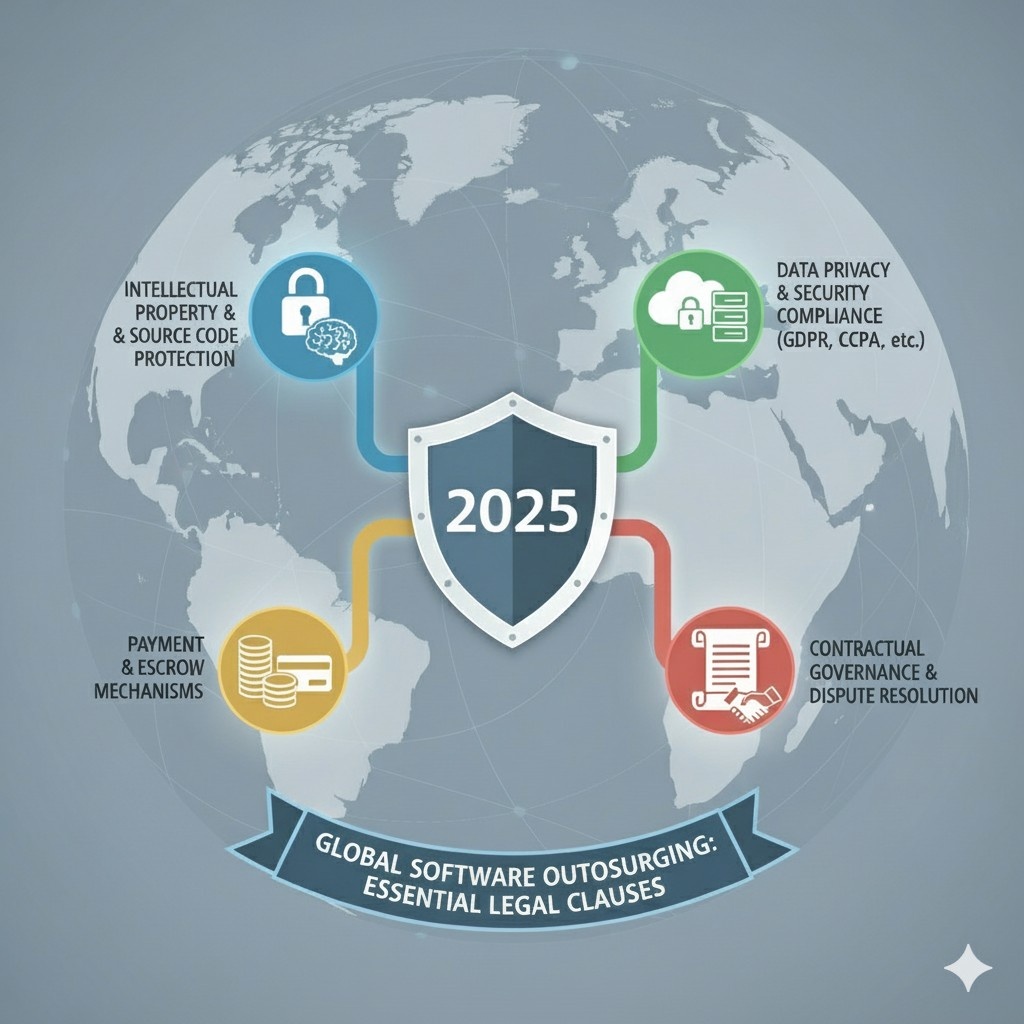
Outsourcing software development abroad can open doors to global talent and big cost savings. In fact, a recent survey found 64% of tech companies leverage external developers. But going globally brings new hazards. Opening your doors to an overseas partner also means risking your intellectual property. For example, 43% of companies worry about IP theft and data breaches when they work with external dev teams. How can you share your innovation safely across borders? The answer lies in a watertight contract. This 2025 guide walks through every key legal clause you need in an outsourcing agreement. We cover IP and ownership, data privacy, payments, dispute rules, and special tips for major countries like India, the US and EU.
Outsourcing deals hinge on clear, short contracts, not vague promises. Every clause should be precise and actionable. Below, we break down the essential contract components explained in plain language that will protect your business and keep the project on track. By the end, you’ll know exactly what to ask for, and why it matters. (Spoiler: it’s better to sweat these details now than face a legal crisis later.)
Key Legal Clauses for Outsourcing
1) Scope of Work and Deliverables
First, nail down the Scope of Work (SOW). This is the backbone of your project. Your contract must clearly describe what the vendor will build or do. Spell out project requirements and deliverables, e.g. specific features, user roles, and platforms. Set up milestones and a timeline so you can check progress at each stage. (For instance, deliver an alpha version by X date, beta by Y date, etc.) Also include a change-control process: software projects often evolve, so the agreement should say how to request changes, approve them, and adjust the budget. Clear scope language avoids “scope creep,” delays, and surprise bills.
Keeping the SOW crystal clear helps both sides. As one guide notes, a good SOW “details what the project will entail, defining the specific tasks, deliverables, and boundaries of the work”. In short, list exactly what you are buying and how you’ll verify it. If you ever need to part ways, a precise SOW makes it obvious whether the work was done or not.
2) Intellectual Property Rights and Ownership
Your IP is your business crown jewel. The contract must say who owns what. Typically, you (the client) should own any new code or designs that the vendor creates for you, while the vendor is granted a narrow license just to do the work. As one expert advises, specify that “the client will own all code, documentation, and IP upon project completion,” and only grant the vendor a temporary, project-specific license. Also include an explicit IP assignment clause: the vendor formally assigns any rights (e.g. copyrights) to you once paid.
For example, your agreement should state that all deliverables become your property and that the developer gets no ownership except to fix bugs on your instructions. Many companies use a “work-for-hire” clause: under U.S. law, code written by an employee is automatically owned by the employer. But to be safe, especially with contractors, your contract should clearly assign the rights in writing. In short: you own the code, designs, and any enhancements. The vendor can keep reusable know-how (like a general algorithm idea), but they should not claim ownership of your custom software.
3) Confidentiality and Data Privacy
You’re likely sharing sensitive info: your code, customer data, business plans. A rock-solid Confidentiality (NDA) clause is non-negotiable. Require the vendor to treat your IP, trade secrets and any data as strictly confidential. This duty should last well beyond the project’s end. Also, the contract must force the vendor to follow all data protection laws that apply. For instance, if you’re in the EU or handling EU citizens’ data, mandate full GDPR compliance. If you have California clients, include CCPA protections.
Best practice is to include sub-clauses for data security: encryption of your data in transit and at rest, strict access controls, and regular security audits. In other words, limit who can see your code and data. As one guide points out, outsourcing contracts should “specify data handling, storage, and disposal procedures,” require encryption and multi-factor logins, and call for compliance with standards like ISO 27001 or SOC 2. Even if you trust the vendor, spell out the exact measures: e.g., “All data must be stored on secure servers with AES-256 encryption and access limited to named personnel,” etc.
Special note on cross-border privacy: Laws differ. In India, for example, a new Data Protection Act (DPDP 2023) just took effect. Interestingly, it exempts Indian BPOs when they process foreign personal data under contract but still forces “reasonable security” safeguards. This means if your developer is in India handling your (non-Indian) data, DPDP rules largely don’t apply, but you should still insist on international security standards. In any case, always add a clause saying “vendor will comply with all applicable data privacy and security laws” so it covers whichever regulations turn out to be in force.
4) Quality and Acceptance Criteria
A contract should also define how the deliverable will be judged acceptable. Specify clear acceptance criteria and testing protocols. For example, require that the software meet agreed performance benchmarks and pass a formal user-acceptance test (UAT) before final payment. List out the types of testing (unit tests, integration tests, etc.) and who does them. Also include a bug-fix warranty: typically, a period (30–90 days) after delivery where the vendor must fix defects at no extra cost. In a well-known guide, this is called “Acceptance Criteria” and “Bug Resolution,” and it’s advised to describe standards for final product performance and a warranty period for bug fixes. This way, you won’t be stuck with broken code the developer must clean it up if it’s not right.
5) Payment Terms and Taxes
Money matters should be crystal clear. Choose your pricing model (fixed price, time-and-materials, or a dedicated team) and state it up front. Then detail the payment schedule: for example, 20% on signing, 30% on mid-point milestones, and 50% on delivery. Specify the currency (USD, EUR, etc.) and how to handle exchange rate fluctuations if any. Cover additional costs too: will you pay for software licenses, third-party services, or hardware?
Importantly, spell out who handles taxes and duties. International contracts often overlook tax language, but you need it. One outsourcing expert advises that the payment clause should cover “software licensing costs, taxes, stamp duties, and any other necessary information”. For instance, if a country levies a service tax or VAT on software development, state whether the price is inclusive or who will pay it. Likewise, clarify if any withholding taxes apply on cross-border payments (some countries require the payer to withhold tax on foreign invoices). Leaving taxes vague can lead to big surprises.
If using milestone payments, include provisions for late-payment interest or dispute resolution over invoices. And consider a payment escrow or letter of credit if you need extra security on a large deal. In short: “When, how, and how much” should all be spelled out. Ambiguity here can sink a project.
6) Liability, Indemnity and Insurance
No one likes to think about disasters, but you must cover them. Include a liability cap clause: often each party’s liability is capped at the total fees paid (except for certain issues). Define indemnities: usually, the vendor should indemnify you if they infringe any third-party IP, breach confidentiality, or cause a data breach. Conversely, you might indemnify them for misuse of their background IP or certain other claims. Also consider requiring the vendor to carry insurance (professional liability and cyber insurance) covering these risks. Ask for proof of coverage (e.g. ISO 27001 certification, or a minimum $1M error-and-omission policy).
(Technical aside: many companies require vendors to cover costs if a data regulator fines you for the vendor’s mistake. This is often part of the security clauses.
While best practices vary by deal, the goal is: if something goes wrong due to the vendor’s fault, they pay for it. Limit your own liability so you’re not at risk for unforeseeable problems. If possible, cap each party’s liability (for example, to the amount paid under the contract), but exclude liability for willful misconduct or gross negligence. These balances risk fairly.
7) Governing Law and Dispute Resolution
Always say which law governs the contract and how disputes will be handled. For example, “This Agreement is governed by the laws of Country X.” Often the client’s home country is chosen, but vendors may insist on their local law. At minimum, pick a neutral location.
For conflicts, many companies prefer arbitration for cross-border tech deals. It’s often faster and enforceable internationally. ICLG notes that U.S. buyers “often favor arbitration in cross-border deals for its neutrality and enforceability”. You might choose a known forum like ICC, SIAC or UNCITRAL rules, and a neutral seat (e.g., Singapore, London, or New York). Alternatively, specify the court of jurisdiction (though a foreign court can be risky).
Also include escalation steps: for example, require good faith talks or mediation first. Make sure to allow injunctive relief in case of IP theft (often called out as an exception, so you can immediately go to court if, say, a red-handed leak happens). The key is: don’t leave dispute procedures blank. Set them clearly so both sides know the path if things go bad.
8) Termination and Transition
Plan for an exit from day one. The contract should list termination scenarios (such as material breach, insolvency, or repeated missed deadlines) and any required notice period (often 30-60 days). For example, “Party B may terminate with 30 days’ notice if deliverables are not met.” If you want an easy out, consider including a termination for convenience right (though vendors usually resist this).
Equally important is an exit/transition clause. It tells the vendor what to do when you part ways. Require them to hand over your data, source code and documentation in a usable format. Specify that they must delete or destroy any confidential info they hold (certifying it in writing), unless you permit them to keep backups. You might also include assistance for a knowledge transfer to a new team. In short, document how you get your project out if you move it elsewhere. A good transition plan clause prevents the “we built it, now we hold it hostage” problem.
9) Employment, Non-Solicitation and Staffing
Many businesses worry about losing talent. If the vendor team is critical, add a non-solicitation clause: for a defined period (e.g. 1–2 years), the vendor won’t hire or poach your employees, and you won’t lure their developers away during the contract.
Also clarify employment transfers. In most countries you cannot just “buy” the outsourcing team. For example, under U.S. law, there is no automatic transfer of employees in a contract employees must resign and be rehired if they move to the client. In India, only certain blue-collar workers can shift jobs under an Industrial Disputes Act provision; white-collar IT staff have no such right. Thus, instead of assuming you’ll inherit the vendor staff, your contract should say whether you are allowed to offer jobs to individual team members (often requiring a minimum notice or a transfer fee).
In practice, it’s best to treat the vendor’s people as your outsourced “resource pool” only for the project’s life. If key personnel become indispensable, consider adding a resource commitment clause (e.g. “John Doe will work on this project for at least 75% of his time”). But be wary of rigid terms, since key staff might resign. Generally, think of your relationship as between two companies, not merging workforces.
10) Compliance and Other Clauses
Finally, include clauses for broader compliance. Require the vendor to obey anti-bribery laws (e.g. FCPA, UK Bribery Act) and export controls. If your project involves encryption or defense tech, specify any relevant export compliance rules. If any work involves personal healthcare or finance data, add HIPAA or GLBA compliance as needed. Also, address software licensing ensures all open-source or third-party code is legal to use, or list them in an attachment.
In short, demand that the vendor follow all applicable laws and industry standards. You can include a generic statement: “The vendor represents and warrants compliance with all applicable laws and regulations (e.g. data protection, export controls, labor, tax).” This catches anything else (like environmental or trade sanctions) that might slip under the radar.
Country-Specific Considerations
1) India
India is a leading software exporter but note its legal differences. Trade secrets and NDA enforcement: India does not have a specific trade-secret statute. Instead, courts enforce confidentiality through contract law and equitable remedies. In practice, your NDA must do all the heavy lifting; expect courts to grant injunctions if it’s breached, but don’t rely on statutory law for “trade secret”.
Employment: As noted, Indian law limits outsourcing transfers. Section 25FF of the Industrial Disputes Act allows only certain blue-collar workers to shift jobs on transfer of a business. White-collar tech staff have no such rights. This means you cannot force the vendor’s team to move over. Instead, use non-solicit clauses and explicit hiring agreements if you want to recruit their engineers after the contract.
Tax and foreign exchange: The RBI (central bank) has rules on payments to foreign vendors and withholding taxes on overseas payments. Make sure to state which party covers these (commonly, the client bears any withholding). Also ensure contractual clauses comply with India’s cross-border transaction rules.
2) United States
In the U.S., technology sourcing follows general contract law (mostly state law). Intellectual Property: Copyright law has a “work-for-hire” doctrine, but it applies only to employees and certain commissioned works. Many U.S. contracts include a clear assignment clause to be safe. If suing in U.S. courts, note that trademark and patent transfers have formal requirements (e.g. writing and registration), so your assignment clause should confirm those formalities.
Privacy and Security: There is no single federal privacy law (though bills come and go). Instead, data is governed by sector laws (HIPAA for health, GLBA for finance) and state laws (CCPA/CPRA in California, SHIELD Act in New York, etc.). Contracts often include a data processing agreement or flow-down clause. For example, U.S. companies contracting with processors must include Article 28-type terms (as required by GDPR and mirrored in U.S. frameworks). Also, nearly every state has breach-notification laws. Practically, require your vendor to meet high standards (ISO 27001, SOC 2) and to notify you immediately of any breach.
Disputes: U.S. parties typically allow for either litigation or arbitration, depending on bargaining power. If your contract chooses U.S. law and courts, remember enforcement abroad can be hard. Arbitration clauses (e.g. under ICC or AAA rules) are common to avoid that.
Employees: As above, U.S. law has no involuntary transfer of employees. Employment is “at-will,” so the vendor’s employees must be hired anew if they join you.
3) European Union / United Kingdom
If outsourcing involves the EU or UK, data protection rules are strict. Both the EU GDPR and the UK GDPR require clear contracts. Under GDPR Article 28 (UK 28), your contract must set roles and obligations for the processor (vendor). It should include, for example, breach of reporting duties, audit rights, security measures, and restrictions on sub-processors. Non-compliance can mean huge fines (up to 4% of global turnover or €20M, whichever is higher).
Data transfers: The EU and UK block exports of personal data to countries lacking “adequate” laws, unless safeguards (standard contractual clauses, binding rules) are in place. If your offshore vendor will see EU/UK personal data, you may need those SCCs or a Data Protection Addendum.
IP and Trade Secrets: The UK implemented the EU Trade Secrets Directive via its 2018 Regulations. It provides a framework for fighting industrial espionage. However, as with most jurisdictions, parties simply rely on a strong NDA. For IP, UK and EU law generally require assignments (transfers of rights) to be in writing and signed. (For example, a UK trademark assignment must include goodwill and be in writing.) So, use the same IP clauses as elsewhere but remember any assignments should ideally meet those formalities.
Other laws: The UK recently overhauled its procurement rules (Procurement Act 2023), but that mainly affects the government side. For private deals, the usual contract of freedom applies. After Brexit, the UK still follows GDPR-like rules, so there’s little difference from EU practice on data.
Other Regions (Quick Notes)
· China: If outsourcing to China, be cautious. China’s Personal Information Protection Law (PIPL) restricts export of Chinese personal data you may need approval or contractual safeguards. IP enforcement can be slower, and foreign ownership is limited in some tech fields. Weigh these risks carefully and add strong dispute and exit clauses.
· Philippines: The Philippines’ Data Privacy Act (2012) is GDPR-inspired. Philippine vendors must comply if they handle personal data. As in most Asian countries, NDAs work similarly. Note also local labor laws: for example, terminations must follow Philippine standards, and compulsory unionization rules.
· Latin America: Many countries have data protection laws (e.g. Brazil’s LGPD). In Mexico and Brazil, for instance, contracts need to comply with local privacy and consumer protection rules. They also often tax imported services so clearly state who pays VAT or local service taxes.
· Australia/Canada: These use common law like the U.S./UK. Australia has strong whistleblower and anti-corruption laws; Canada has PIPEDA (data law) and mandatory breach reporting.
In all cases, do your homework on local law or consult counsel. But the universal principle holds: spell out the rules in writing, tailored to the countries involved.
Conclusion
Outsourcing can drive growth if you manage the legal side wisely. This means more than a handshake or a generic template. Embed all the above clauses into a clear agreement. Use NDAs and contracts to keep ownership, confidentiality and risk where they belong with the vendor, not your company. Always vet the partner and involve legal experts to align the contract with local laws.
Think of your contract as insurance for the project. It’s not just paperwork; it’s your safety net if there’s a disagreement or mistake. With solid clauses on IP, data protection, payments, liability, and governing law, you’ll sleep easier knowing your business is covered on the legal front.
Ready to sign an outsourcing deal? Make sure your lawyer checks off these points first. That way, you get the benefits of global development and avoid surprises that could cost you dearly.
If you’re ready to outsource with confidence, let Solv Legal support you with airtight contracts, risk-proof documentation, and expert legal guidance.
Reach out to Solv Legal today and protect your software outsourcing journey from day one.
Frequently Asked Questions
1. What legal clauses are essential in an international software outsourcing contract?
Every cross-border outsourcing agreement must include clauses on Intellectual Property (IP) ownership, confidentiality, data protection, Service Level Agreements (SLAs), payment terms, liability, termination, and dispute resolution. These clauses help protect your business legally and commercially.
2. How can I protect my intellectual property when outsourcing abroad?
You can protect your IP by including strong IP ownership clauses, work-for-hire language, assignment of rights, strict NDAs, and access-control restrictions. Ensuring the vendor cannot reuse or claim ownership of your codebase is crucial.
3. Is outsourcing software development safe in 2025?
Yes, outsourcing is safe when supported by detailed contracts, proper vendor vetting, and compliance with international privacy laws. Strong legal clauses reduce risks related to IP theft, data breaches, delays, and miscommunication.
4. Which countries have the strongest data protection requirements for outsourcing?
The EU, UK, and Canada have some of the strictest data protection requirements. GDPR and UK GDPR require processors to follow defined contractual obligations, making outsourcing with these regions highly regulated and safer when handled correctly.
6. How do I choose the right jurisdiction for dispute resolution in outsourcing contracts?
Most businesses choose a neutral arbitration center such as Singapore, London, or New York. Arbitration is often preferred over litigation because it is faster and enforceable internationally.
7. Do I need a Data Protection Agreement (DPA) when outsourcing development overseas?
Yes. If customer data or personal information is involved, you must sign a DPA to ensure compliance with laws like GDPR, CCPA, or Brazil’s LGPD. It defines security obligations, breach of notifications, and data handling rules
RELATED ARTICLES
1. India’s New DPDP Rules Explained: What Startups and SMEs Must Do in the Next 18 Months.
2. CROSS-BORDER INHERITANCE & WILLS: HOW TO CLAIM ASSETS IN MULTIPLE COUNTRIES
3. Remote Work & Freelancer Contracts: What US, Australian & Indian Businesses Need in 2025
ABOUT THE AUTHOR
This blog is authored by Shridansh Tripathi, a second-year law student at the Department of Legal Studies and Research, Barkatullah University, Bhopal.
REVIEWED BY Yashvardhan Singh, a technology-driven legal professional specialising in contracts, corporate compliance, and data-privacy frameworks at SolvLegal.
DISCLAIMER
The information provided in this article is for general educational purposes and does not constitute legal advice. Readers are encouraged to seek professional counsel before acting on any information herein. SolvLegal and the author disclaims any liability arising from reliance on this content.
OUR TEMPLATES

Related Articles

.jpg "Cross Border Arbitration: When Should Founders Choose Singapore, London, Dubai or India? (2025 Global Perspective)")
Leave a Comment