Master Service Agreements for IT Services in India: 10 Clauses Technology Companies Should Review Carefully
Read More
IP Clauses in SaaS Agreements: Why Your Software May Not Be Fully Protected
By the SolvLegal Team
Published on: May 6, 2026, 5:55 p.m.
Quick Answer
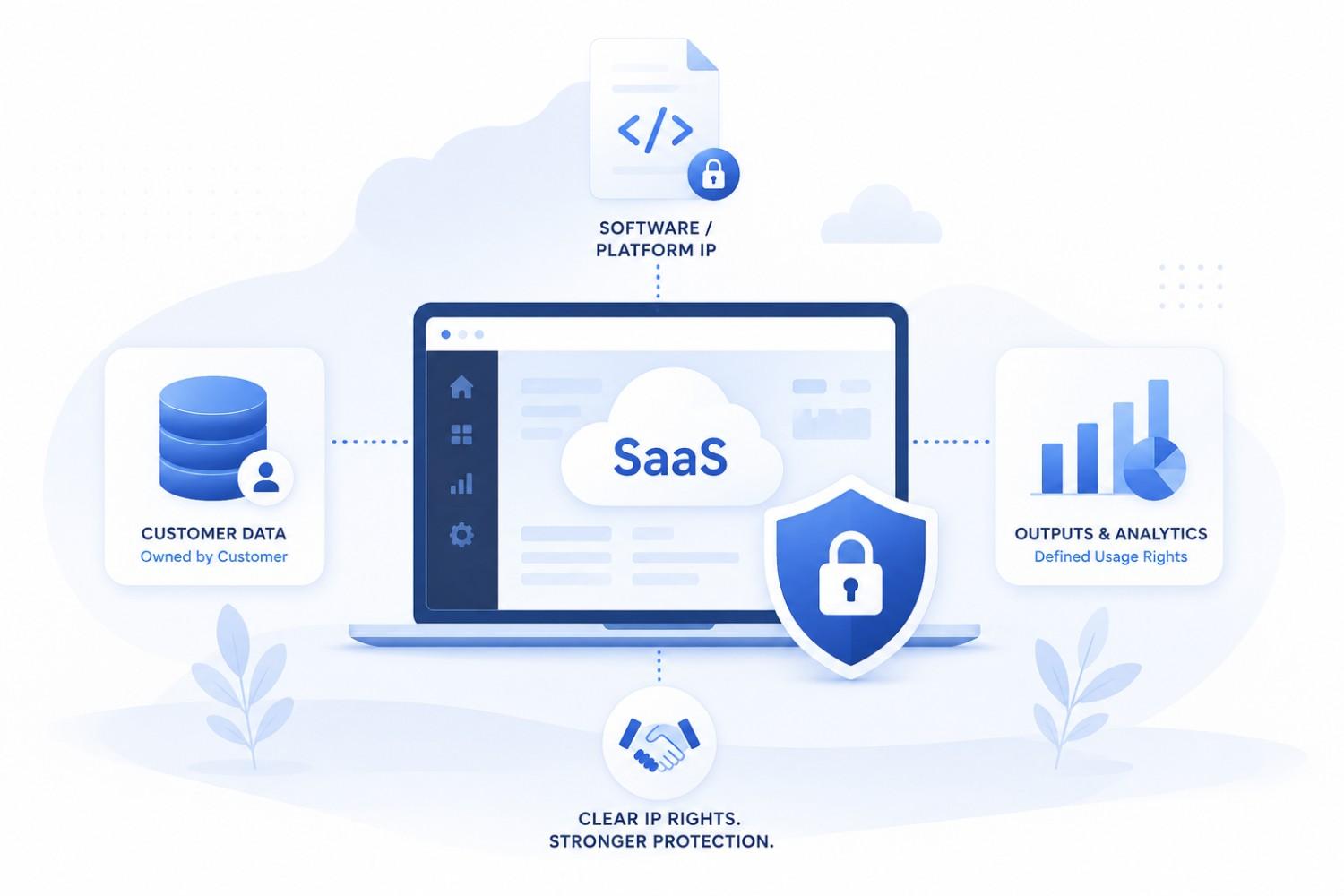
An IP clause in a SaaS agreement determines who owns the software, customer data, and any outputs generated through the platform. While the provider typically retains ownership of the software, customers retain ownership of their data, with the provider receiving limited rights to process it. However, if the clause is not clearly drafted, it can create ambiguity around ownership, usage rights, and derived data leading to disputes, regulatory risks, and potential loss of control over core technology.
Introduction
In a SaaS business, your product is not something you sell it is something users access. And that distinction changes everything from a legal perspective.
Unlike traditional software models where ownership and licensing are relatively straightforward, SaaS operates through continuous access, data exchange, and system-driven outputs. The software stays with the provider, but its use becomes deeply integrated with the customer’s data and operations. This creates a layered ecosystem where multiple forms of intellectual property exist at the same time.
This is exactly where the role of the IP clause becomes critical.
Most SaaS providers assume that because they developed the software, their ownership is automatically protected. In reality, ownership in a SaaS model is defined not by creation, but by contract. If the agreement does not clearly distinguish between the platform, the data, and the outputs generated through it, the boundaries of ownership can quickly become unclear.
And once that ambiguity exists, it is no longer just a legal issue it becomes a business risk affecting control, scalability, and long-term value.
Why the IP Clause Matters in SaaS Agreements
In a SaaS model, intellectual property is not confined to a single asset, it is distributed across the entire system. Your platform processes customer inputs, generates outputs, and continuously evolves through usage. This makes ownership less obvious and far more dependent on how your agreement is structured.
The risk, therefore, is not just about losing ownership of your software. It is about losing clarity over how different elements of your product are controlled and used.
For instance, while your core software may remain yours, the value increasingly lies in how that software interacts with data. If your agreement does not clearly define rights over data usage, analytics, and outputs, customers may begin to assert claims over insights generated through their use of the platform. In some cases, they may even restrict how you improve or scale your product.
This has direct commercial consequences. It can:
· Limit your ability to reuse learnings across clients
· Create friction during enterprise negotiations
· Raise red flags during due diligence or investment rounds
· Expose your business to disputes over ownership and usage rights
What makes this particularly complex is that these risks do not arise from misuse they arise from ambiguity. A clause that appears acceptable at an early stage can become a point of contention as the business grows, onboard larger clients, or enters regulated markets.
In essence, the IP clause is not just about protecting what you have built. It is about preserving your ability to use, adapt, and scale that technology without restrictions.
Practical Understanding: How IP Actually Works in SaaS Agreements
To properly understand the role of an IP clause, you need to move beyond definitions and look at how a SaaS product actually operates in practice. Unlike traditional software, SaaS is not a single asset it is a combination of technology, user interaction, and continuous data processing.
This means that different types of intellectual property coexist within the same system, and each must be treated differently in the agreement.
1. The Software (Platform IP)
At the centre of every SaaS business is the platform itself—the code, the logic, the interface, and the overall system that makes everything work. This is your core asset. It is what you have built, what your users depend on, and what ultimately gives your business its value.
In a SaaS model, however, you are not selling this software. You are only allowing users to access it. While this may seem like a small distinction, it has significant legal implications. Your agreement must clearly establish that the software always remains your property, and that the customer is only granted a limited right to use it for defined purposes.
The problem is that many SaaS agreements do not handle this properly. Even if ownership is mentioned, the usage rights are often drafted too broadly. When that happens, the line between access and control starts to blur. It can create confusion around whether a customer can replicate certain features, reuse outputs in unintended ways, or internally build on what they are accessing.
Over time, this lack of clarity can weaken your control over your own technology. That is why, in practice, protecting your platform IP is not just about stating ownership. It is about ensuring that the rights you grant are clearly defined, limited, and aligned with how your product is actually meant to be used.
2. Customer Data Ownership in SaaS Agreements
Alongside your platform, the second key layer in a SaaS model is customer data the information that users upload, store, or generate while using your service.
Unlike the software, this data does not belong to you. In most SaaS arrangements, the customer retains ownership of their data, and you are only given a limited right to process it for the purpose of providing the service.
This sounds straightforward, but in practice, this is where a lot of confusion begins.
Your platform does more than just store data. It processes, structures, and sometimes even transforms it into useful outputs. Because of this, the agreement needs to clearly define what you are allowed to do with that data. Without this clarity, questions can arise around whether you can analyse it, use it to improve your product, or retain it after the relationship ends.
This is also the point where legal compliance becomes important. Laws like the Digital Personal Data Protection Act, 2023 and GDPR require clear accountability on how personal data is handled. If your agreement does not properly reflect these obligations, the issue is not just contractual—it becomes regulatory.
In simple terms, the IP clause should not treat customer data as just another category of information. It needs to clearly separate ownership from usage, and define exactly how that data can be accessed, processed, stored, and ultimately returned or deleted.
3. Outputs, Analytics, and Derived Data
This is usually the most overlooked part of a SaaS agreement and often the most complicated.
Modern SaaS platforms do much more than provide access to software. They analyse user behaviour, process large amounts of information, generate insights, automate decisions, and continuously improve through usage patterns. As a result, the platform starts creating new forms of value that did not exist originally.
This is where the question becomes difficult: who owns that value?
For example, if your platform generates analytics based on customer data, does the customer own those insights because the data came from them? Or do you own them because the system, logic, and algorithms generating those insights belong to you?
The same issue applies to product improvements. Many SaaS companies refine their software based on customer usage, feedback, and behavioural trends. But if the agreement is silent on this, customers may later argue that they have rights over features or improvements developed using their inputs.
The risk here is not always direct ownership claims. Sometimes the bigger issue is restriction. A poorly drafted clause can unintentionally limit your ability to reuse learnings, improve your platform across clients, or commercially benefit from aggregated insights.
That is why SaaS agreements need to specifically address derived data, analytics, and feedback. The agreement should clearly state what rights the provider has over anonymised insights, platform improvements, and system-generated outputs, while also ensuring that customer confidentiality and data protection obligations are maintained.
Without that clarity, one of the most commercially valuable parts of your SaaS business can end up sitting in a legal grey area.
Where Most SaaS Agreements Go Wrong
One of the biggest misconceptions around SaaS contracts is that simply adding an IP clause is enough. In reality, the problem is rarely the absence of the clause it is the way the clause is drafted.
A lot of SaaS agreements rely on generic templates that use broad, one-size-fits-all language. On paper, the ownership position may look protected, but once you examine how the platform actually functions, the gaps start becoming visible.
A common issue is the failure to distinguish between different types of IP. The software, customer data, analytics, outputs, and improvements are often grouped together without properly defining who owns what and how each element can be used. As the product evolves, this creates uncertainty around rights and limitations.
Another problem is overly broad usage rights. Many agreements grant customers extensive access permissions without clearly setting boundaries. Over time, this can create confusion around replication, internal exploitation, or the commercial use of outputs generated through the platform.
The issue becomes even more serious when the platform relies heavily on analytics, automation, or AI-driven functionality. In such systems, the line between customer input and platform-generated value becomes increasingly blurred. If the agreement does not address this properly, disputes can arise not because someone acted dishonestly, but because the contract never clearly anticipated how the technology would operate in practice.
This is why strong SaaS IP clauses are usually very deliberate in structure. They separate ownership, usage rights, restrictions, and data-related permissions into clearly defined layers rather than treating intellectual property as a single concept.
A Better Way to Structure IP Clauses in SaaS Agreements
A strong SaaS IP clause is usually not a single paragraph. It works better when it is structured in layers, with each layer dealing with a different aspect of ownership and usage.
The first layer should deal with ownership. This is where the agreement clearly states that the platform, software, code, APIs, and related technology remain the exclusive property of the provider. At the same time, it should separately clarify that customer data continues to belong to the customer.
The second layer should define the license being granted. Since SaaS operates on access rather than transfer, the agreement should explain exactly what the customer is allowed to do with the platform, and more importantly, what they are not allowed to do. This helps maintain a clear boundary between usage rights and ownership rights.
The third layer should focus on restrictions. This typically includes limitations on reverse engineering, unauthorised reproduction, sublicensing, or attempts to commercially exploit the platform outside the permitted scope of use. These restrictions become particularly important when the platform contains proprietary logic or unique workflows.
The final layer usually deals with data usage, analytics, and improvements. This is where the agreement explains whether the provider can use anonymised or aggregated insights to improve the service, monitor performance, or develop new features. Without this section, one of the most commercially valuable aspects of a SaaS business can remain legally uncertain.
In practice, the goal of a well-drafted IP clause is not just to state ownership. It is to create a structure where ownership, access, data rights, and platform improvements all work together without overlapping or conflicting with each other.
FAQ
Q: What is an IP clause in a SaaS agreement?
An IP clause in a SaaS agreement defines ownership and usage rights over the software platform, customer data, and any outputs or analytics generated through the service. It establishes that the provider retains ownership of the core technology, while the customer retains ownership of their data. A well-drafted IP clause also sets clear boundaries on how each party can use, process, or commercially benefit from different elements of the platform.
Q: Who owns data in a SaaS model?
In a SaaS model, customer data generally belongs to the customer. The provider is typically granted only a limited right to process that data for the purpose of delivering the service. However, ownership of derived data such as anonymised insights, analytics, or platform improvements generated through usage depends entirely on how the agreement is drafted. Without clear contractual language, this area can become a significant source of disputes.
Q: Can a SaaS provider use customer data to improve its platform?
Only if the agreement expressly permits it. Many SaaS providers rely on usage patterns, behavioural data, and customer inputs to refine their product. However, doing so without clear contractual authorisation can expose the provider to legal and regulatory risk, particularly under data protection laws such as the Digital Personal Data Protection Act, 2023 in India or GDPR. The IP clause should specifically address whether anonymised or aggregated data can be used for product development purposes.
Q: What happens if the IP clause in a SaaS agreement is poorly drafted?
A poorly drafted IP clause can create serious ambiguity around ownership of outputs, analytics, and platform improvements. As the product scales, this ambiguity can lead to customer disputes, restrictions on how the provider uses its own technology, complications during investment due diligence, and regulatory exposure. In many cases, the risk does not arise from deliberate misuse but simply from unclear contractual language that was never updated as the business evolved.
Q: Is a SaaS agreement IP clause different from a traditional software license?
Yes, significantly. In a traditional software license, the product is transferred or licensed to the customer who then uses it independently. In a SaaS model, the software never leaves the provider's control the customer only accesses it remotely. This changes the nature of ownership, usage rights, and data obligations entirely. A SaaS IP clause must therefore account for continuous access, real-time data processing, and platform-generated outputs, none of which typically arise in conventional software licensing arrangements.
Related Blogs
1. https://solvlegal.com/blogs/ip-ownership-saas-agreements-guide
3. https://solvlegal.com/blogs/founders-lose-ip-without-realising
4. https://solvlegal.com/blogs/dpdp-act-2023-complete-guide-for-businesses-india
5. https://solvlegal.com/blogs/ai-development-agreements-ownership-models-data-outputs
Conclusion
In a SaaS business, intellectual property is not limited to the software alone. It extends across the platform, the data flowing through it, the insights generated from it, and the improvements built over time. That is what makes SaaS IP clauses far more complex than traditional software licensing provisions.
The real issue is not whether an agreement contains an IP clause, but whether the clause actually reflects how the platform operates in practice. A generic ownership statement may appear sufficient initially, but as the product scales, processes more data, and generates more outputs, vague drafting can quickly turn into commercial and legal uncertainty.
A well-structured IP clause brings clarity to this ecosystem. It separates ownership from access, distinguishes customer data from platform technology, and defines how outputs, analytics, and improvements can be used. More importantly, it protects the provider’s ability to continue developing and scaling the product without unnecessary restrictions.
For SaaS businesses, this is not just a contractual formality. It is a foundational part of protecting the long-term value of the business itself.
ABOUT AUTHOR
This blog was written by Yashvardhan Singh, a legal professional focusing on legal research, contract analysis, and regulatory compliance. He works closely with corporate and technology-driven legal frameworks, with particular exposure to data protection, commercial documentation, and legal process optimisation. His work supports businesses in strengthening compliance structures and ensuring legally sound operations.
DISCLAIMER
The information provided in this article is for general educational purposes and does not constitute a legal advice. Readers are encouraged to seek professional counsel before acting on any information herein. SolvLegal and the author disclaim any liability arising from reliance on this content.

Related Articles
Leave a Comment