How to Protect an App Idea: Copyright, Design and Patent Explained
Read More
We Built the Product - But Don’t Own It: How Founders Lose IP Without Realising
By the SolvLegal Team
Published on: Jan. 24, 2026, 11:47 a.m.
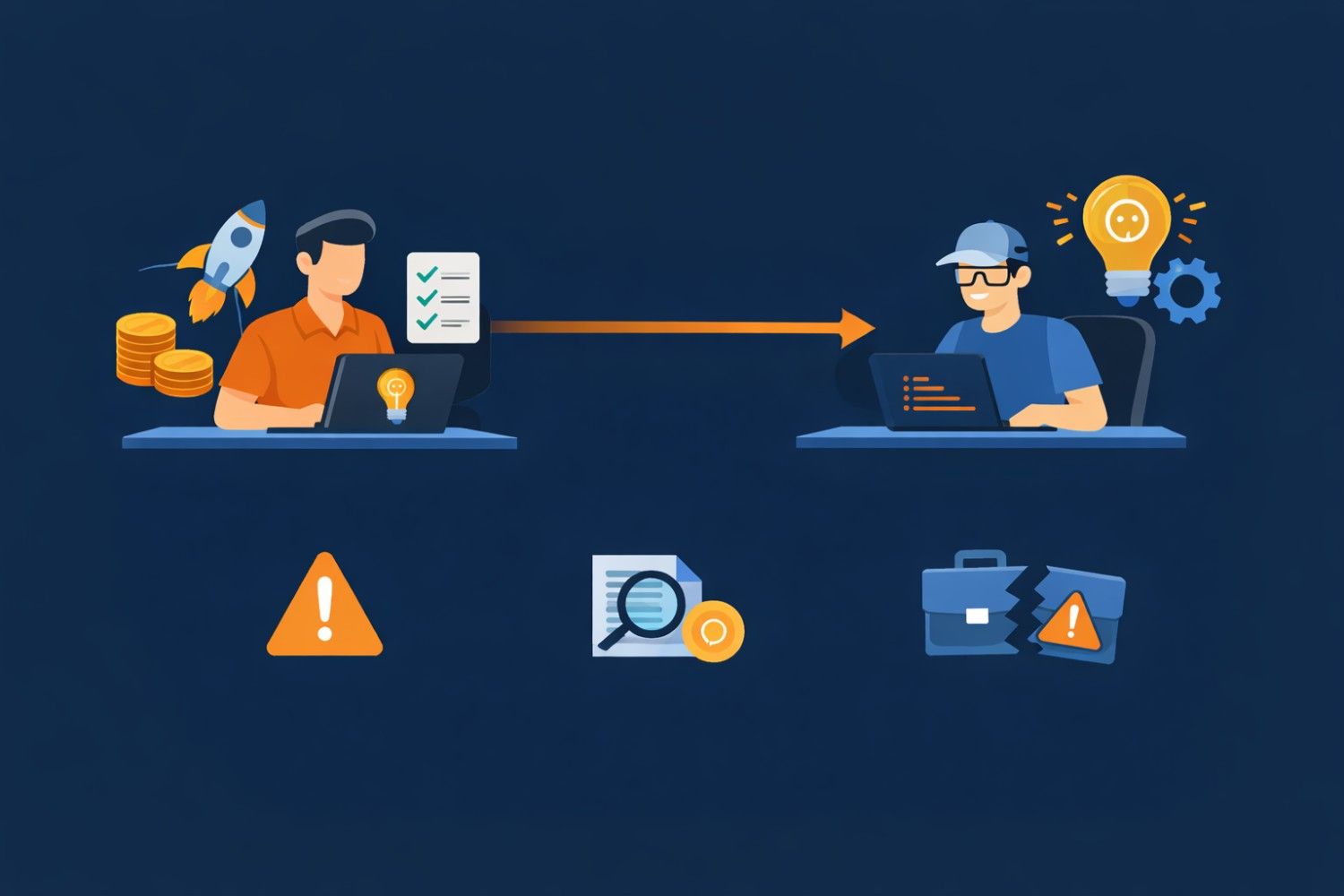
Quick Answer: How Founders Lose IP Without Realising It
Many founders assume that paying for product development automatically gives them ownership of the intellectual property. In outsourced development arrangements, this assumption is legally incorrect in most cases. When software, designs, or other creative work is built by freelancers, agencies, or external developers, the law generally treats the creator as the first owner of the intellectual property, unless ownership is clearly transferred in writing.
The problem is not obvious at the start. The product functions, customers come on board, and the business begins to take shape. From the founder’s perspective, everything feels owned and controlled. Legally, however, the absence of a proper IP assignment clause often means the founder has only a limited right to use the product, not the right to fully own, modify, license, or sell it.
This gap usually becomes visible only when the business reaches an inflection point. Investors begin due diligence, acquirers ask for proof of ownership, or disputes arise with the original developer. At that stage, founders discover that what they thought they owned was never formally theirs.
This blog explains how outsourcing creates this risk, why missing IP assignment clauses cause founders to lose ownership without realising it, and what steps can be taken to prevent or correct the problem before it damages the business.
The Founder Assumption That Creates the Problem
The problem almost always starts with a belief that feels obvious to founders: if we paid for the development, the product must belong to us. From a business standpoint, this sounds reasonable. Money was spent, work was delivered, and the product exists only because the founder funded it. In day-to-day operations, this assumption goes unquestioned.
The legal reality is different. Intellectual property law does not equate payment with ownership. Paying for development only gives the payer a right to receive the agreed deliverables. It does not automatically transfer ownership of the underlying intellectual property created during that work. Unless ownership is expressly assigned in writing, the law generally treats the creator as the first owner of the IP.
This assumption survives because outsourced development rarely feels like “outsourcing” to founders. Freelancers and agencies often work closely with the founding team, attend calls, and iterate on feedback. Over time, the product feels internal. That sense of control masks the fact that, legally, the people writing the code or designing the system may still own it.
The danger is that this belief is never tested early. Nothing breaks. The product launches. Users sign up. The company grows. Ownership only becomes a real question when someone external asks for proof, an investor, an acquirer, or a lawyer during due diligence. That is when founders discover that what felt like ownership was never formally secured.
This gap between assumed ownership and legal ownership is what makes the issue so common and so damaging. The next section explains what the law actually says about default IP ownership when development is outsourced, and why founders usually do not own the IP by default.
Who Owns the IP by Default When Development Is Outsourced
When development is outsourced, the default rule is simple but counter-intuitive for founders: the person or entity that actually creates the work is the first owner of the intellectual property. This principle exists across jurisdictions, including India, the US, the UK, and the EU, and it applies unless ownership is clearly transferred through a written assignment.
The key distinction the law makes is between employees and independent contractors. When an employee creates software or other IP in the course of employment, ownership usually vests in the employer by default. Outsourced developers, freelancers, and agencies, however, are not employees. They are independent contractors. In their case, ownership does not automatically move to the client just because payment was made.
This is where founders often misread service relationships. A development agency may feel like an extension of the internal team, but legally it remains a separate creator. Without an IP assignment clause, the agency or freelancer typically retains ownership of the source code and related IP, while the founder receives, at best, an implied licence to use it for the intended purpose.
Another misconception is that detailed specifications or close supervision change ownership. They don’t. Even if the founder provided the idea, the roadmap, or constant feedback, the law still recognises the developer as the author of the code or designs they created. Ideas are not owned; expression is, and ownership follows authorship unless assigned.
This default rule is precisely why IP disputes arise so late. Founders operate under the assumption of ownership, while developers may quietly retain legal rights. Until something forces the issue, both sides continue without clarity.
What an IP Assignment Clause Actually Does
An IP assignment clause is the legal mechanism that changes default ownership. Without it, the law assumes the creator owns the work. With it, ownership is expressly transferred from the developer to the founder or the company. This transfer does not happen by implication or goodwill. It happens only when the contract clearly says so.
A proper IP assignment clause does more than say “the company owns the work.” It identifies what IP is being assigned, when the assignment takes effect, and to whom it is assigned. In outsourced development, timing matters. If the clause assigns IP only at the end of the project or only upon full payment, gaps can arise where ownership is unclear during development or for interim versions.
Founders often rely on vague language such as “all work shall belong to the client” or “work made for hire.” That language is risky. In many jurisdictions, “work made for hire” applies narrowly and does not automatically cover independent contractors unless statutory conditions are met. Courts look for a clear present assignment of IP, not aspirational statements.
Another critical point is scope. A weak assignment clause may transfer ownership of the final deliverable but stay silent on background IP, tools, libraries, or frameworks used by the developer. This can leave founders owning a product that cannot be freely modified or commercialised without ongoing dependence on the developer.
In short, an IP assignment clause is not boilerplate. It is the clause that determines whether the product you are building is truly yours to control, scale, sell, or invest in. The next section explains what happens when this clause is missing altogether, and why the consequences are far more severe than founders expect.
What Happens When There Is No IP Assignment Clause
When there is no IP assignment clause, founders usually assume there is a gap that can be fixed later. In reality, the absence of an assignment does not create uncertainty; it creates a default outcome, and that outcome usually favours the developer, not the founder.
Legally, the developer remains the owner of the intellectual property they created. The founder may have an implied or limited licence to use the product for the specific purpose it was built for, but that licence is often narrow and fragile. It may not allow modification, sublicensing, resale, or use beyond the original scope. In some cases, it may be revocable or disputed altogether.
This creates immediate business risk. If the developer relationship breaks down, the founder may not have the legal right to continue development with another team. If the product needs to be scaled, rebuilt, or integrated with other systems, ownership gaps surface quickly. What looks like a technical problem is actually a legal one.
The bigger damage appears when third parties get involved. Investors, acquirers, and even strategic partners expect clear proof that the company owns its core technology. Without an IP assignment, founders are forced into explanations, renegotiations, or last-minute clean-up exercises. At that stage, the developer holds leverage, and the founder has very little.
This is why missing IP assignment clauses do not usually cause early-stage problems. They cause late-stage failures. By the time the issue is discovered, the product is valuable, timelines are tight, and fixing ownership becomes expensive, uncertain, or sometimes impossible.
How This Happens in Real Founder Situations
This problem rarely comes from deliberate risk-taking. It usually grows out of how early-stage development actually happens. Founders outsource fast, focus on building, and postpone legal structure until later.
A very common situation is hiring freelancers or small agencies through informal channels. Development starts over email or WhatsApp, sometimes backed by a basic service agreement that talks about scope, timelines, and payment, but says nothing about IP ownership. The product gets built, paid for, and used, while ownership is never discussed.
Another frequent scenario is working with startup studios or development partners who offer to “build the product” while retaining rights to their underlying code or frameworks. Founders often misunderstand what is being assigned and what is merely licensed. On paper, the product exists, but legally it sits on someone else’s foundation.
Early MVP development is another risk point. Founders rush to validate ideas and cut corners on documentation, assuming they will “fix the legal side later.” By the time the MVP becomes the core product, the original contracts are forgotten, and the developers who built it may no longer be cooperative or even reachable.
These situations feel harmless at the time because nothing breaks immediately. The danger lies in the fact that ownership issues do not announce themselves early. They surface only when the product becomes valuable and scrutiny increases. The next section explains why this scrutiny usually appears during fundraising or exits, and why IP gaps become deal-breakers at that stage.
Why This Becomes a Problem During Fundraising or Exit
IP ownership rarely matters until someone outside the founding team starts asking hard questions. That usually happens during fundraising, acquisitions, or serious partnerships. Investors and acquirers don’t rely on assumptions. They look for documented proof that the company owns what it claims to be building value on.
During due diligence, one of the first checks is whether the company owns its core technology. If development was outsourced and there is no clear IP assignment, this immediately raises red flags. From an investor’s perspective, a product that the company does not legally own is not an asset; it is a risk. Valuations can drop, deals can be delayed, or funding can be made conditional on fixing IP ownership.
This is where the timing hurts founders the most. By the time fundraising or exit discussions begin, the product is valuable and timelines are tight. If ownership gaps are discovered then, founders are often forced to go back to old developers to negotiate assignments under pressure. At that point, leverage shifts away from the founder. Developers may demand additional payment, impose conditions, or refuse cooperation altogether.
In some cases, deals fall through entirely. Not because the product isn’t good, but because ownership cannot be cleanly established. What could have been fixed cheaply at the start becomes expensive, uncertain, and sometimes impossible to repair later.
This is why missing IP assignment clauses are not just legal oversights. They directly affect fundraising outcomes, deal confidence, and the long-term value of the company. The next section explains a closely related issue founders often misunderstand: the difference between owning IP and merely having a licence to use it.
IP Assignment vs Licence: The Difference Founders Miss
One of the most damaging misunderstandings founders have is confusing ownership with permission to use. When there is no IP assignment clause, founders often assume they still “have rights” because they can use the product. What they usually have is a licence, not ownership, and that difference matters far more than it sounds.
An IP assignment transfers ownership completely. Once IP is assigned, the company can modify the product, rebuild it, license it to others, sell it, integrate it into new offerings, or raise investment on it without seeking anyone’s permission. The IP becomes a core asset of the business.
A licence, on the other hand, is only permission to use the IP in a limited way. It may be restricted by purpose, duration, geography, or scope. It may prevent sublicensing, modification, or commercial expansion. In some cases, licences can even be terminated. From a founder’s perspective, this means the business is operating on borrowed ground.
This distinction becomes critical as the company grows. Investors do not invest in licences; they invest in assets. A startup that merely has the right to use its own product, rather than own it outright, carries structural risk. That risk shows up in valuation, deal conditions, and investor confidence.
Founders often miss this because licences feel invisible in day-to-day operations. The product works, users don’t notice, and revenue comes in. But legally, the business is constrained in ways that only become apparent when control, scaling, or exit is on the table.
Understanding this difference is essential because it explains why “we can use the product” is not the same as “we own the product.” The next section focuses on how founders can avoid this situation altogether, or fix it before it becomes irreversible.
How Founders Can Avoid or Fix This Problem
The safest time to deal with IP ownership is before development begins, but the second-best time is as soon as you realise there is a gap. In both cases, the solution is not complicated, but it does require being deliberate.
For new or ongoing development, the first step is ensuring that every outsourced engagement includes a clear IP assignment clause. This clause should expressly state that all intellectual property created during the engagement is assigned to the founder or the company, not merely licensed. It should cover all forms of IP, including source code, designs, documentation, and derivative works, and it should apply regardless of whether the work is complete or paid for in stages.
For founders who have already built products without proper documentation, the issue can still be fixed in many cases through a retroactive IP assignment. This involves going back to the developers who worked on the product and formally assigning ownership of the IP created in the past. While this is usually possible, it becomes harder as time passes, relationships cool, or leverage shifts. That is why waiting until fundraising or exit to address IP is risky.
It is also important to align contracts with reality. If development is being done through agencies or startup studios, founders should understand what is being assigned and what remains background IP of the developer. Clear boundaries prevent future disputes and hidden dependencies.
The key takeaway is that IP ownership is not something to “sort out later.” It should be treated as foundational infrastructure, just like incorporation or equity structure. When ownership is clear early, growth, fundraising, and scaling become far smoother.
How SolvLegal Helps Founders Secure and Clean Up IP Ownership
Founders usually approach SolvLegal when something feels off but isn’t yet a crisis. The role here is not to overlawyer the product, but to identify where ownership actually sits and whether the documents reflect that reality. This often starts with reviewing existing development contracts, service agreements, emails, and statements of work to see whether IP was ever properly assigned.
Where gaps exist, SolvLegal helps founders fix them before they become deal-breakers. This may involve drafting clean IP assignment clauses for ongoing development, negotiating retroactive assignments with past developers, or restructuring arrangements with agencies and startup studios so that ownership is unambiguous. The focus is on ensuring that the company, not third parties, holds clear and defensible rights over its core technology.
For founders preparing for fundraising or exit, this kind of IP cleanup is critical. Clear ownership reduces investor friction, shortens diligence cycles, and avoids last-minute renegotiations under pressure. The objective is simple: make sure the product the founder is building is also the product the company legally owns.
Conclusion: Building the Product Is Not the Same as Owning It
For most founders, losing IP is not the result of carelessness or bad faith. It happens because ownership is assumed instead of documented. Outsourced development feels operational, not legal, and by the time the question of ownership is asked, the product has already become central to the business.
What this shows is that intellectual property is not something that automatically follows effort, ideas, or payment. It follows clear legal assignment. Without that assignment, founders may end up running companies built on assets they do not fully control. That risk stays hidden while things are going well and surfaces only when scrutiny increases.
The uncomfortable truth is that IP mistakes are cheapest to fix at the beginning and most expensive to fix later. Founders who treat IP ownership as foundational infrastructure protect not just their product, but their ability to raise capital, scale confidently, and exit cleanly.
Building the product is hard. Losing ownership because of a missing clause should not be the reason that effort goes to waste.
FAQs
1. Do founders automatically own IP if they paid for development?
No. Paying for development only establishes a commercial transaction, not ownership of intellectual property. Under IP law, the default rule is that the person who creates the work is the first owner, unless ownership is expressly transferred through a written assignment. This is why founders can fully fund development and still legally not own the source code, designs, or core technology. Ownership must be documented; it is never assumed.
2. Is an invoice or proof of payment enough to claim IP ownership?
No. Invoices, receipts, and bank transfers only prove that money was paid for services. They do not prove that intellectual property rights were transferred. During legal due diligence, investors and acquirers do not treat payment records as evidence of ownership. What they look for is a clear IP assignment clause in a contract that legally transfers rights from the developer to the company.
3. Does a service agreement automatically transfer IP to the founder or company?
Only if it clearly says so. Many service agreements focus on scope of work, timelines, and fees, but say nothing about IP ownership. In such cases, the agreement may govern delivery, but ownership still stays with the developer by default. This creates a dangerous illusion of safety, where founders believe they are protected simply because a contract exists, even though the most critical clause is missing.
4. Can IP be assigned after development is already complete?
Yes, IP can often be assigned later through a retroactive assignment agreement. However, this depends entirely on the developer’s cooperation. Once the product becomes valuable or fundraising begins, the developer may have leverage and demand additional compensation or impose conditions. What is easy and inexpensive to fix early can become complex, expensive, or even impossible to resolve later.
5. What is the difference between owning IP and having a licence to use it?
Ownership gives the company full control over the IP. This includes the right to modify the product, create derivatives, license it to others, sell it, or raise investment without restrictions. A licence only allows limited use of the IP, often tied to specific purposes or time periods. Licences can restrict growth and may be revoked or challenged, which is why investors view licences as risk, not assets.
6. Why do investors and acquirers care so much about IP assignment?
Because intellectual property is often the startup’s most valuable asset. If ownership is unclear, the company may not legally control what it claims to sell, scale, or monetise. This creates uncertainty around valuation, enforceability, and long-term viability. Clean IP ownership reduces risk, speeds up due diligence, and signals that the business is legally and operationally mature.
Related articles:
1. Software Development Agreement in India: Legal Risks and How to Avoid Them.
2. Outsourcing Software Development Abroad? Legal Clauses Every Business Must Know (2025 Global Guide)
3. Source Code Protection for Startups: Why Even “Non-Unique” Business Ideas Need Strong IP Clauses.
About the author: Kunal Singh is a second-year B.Sc. LL.B. (Hons.) student at National Forensic Sciences University, Gandhinagar.
Reviewed by:
Akhil Singh, a corporate lawyer with expertise in intellectual property rights, contract drafting, and compliance advisory. He is a tech-forward legal practitioner at SolvLegal, where he focuses on corporate compliance and data-privacy frameworks. His experience includes IT law and cross-border regulatory issues, and he assists businesses in safeguarding their innovations while strengthening their overall legal and compliance systems.
Check out our Intellectual Property related templates:
https://solvlegal.com/contract-template/technology-and-intellectual-property/
Read this blog about Trademark Infringement for your brand:
Disclaimer
The information provided in this article is for general educational purposes and does not constitute a legal advice. Readers are encouraged to seek professional counsel before acting on any information herein. SolvLegal and the author disclaim any liability arising from reliance on this content

Related Articles
.jpeg "How to Protect an App Idea: Copyright, Design and Patent Explained")

Leave a Comment