ESOP for Startups: Complete Global Guide to Structuring, Vesting & Taxation
Read More
Global Data Privacy Laws Compared: GDPR, CCPA, PDPL, PIPEDA & India’s DPDP Act – 2025 Guide
By the SolvLegal Team
Published on: Dec. 29, 2025, 1:14 p.m.
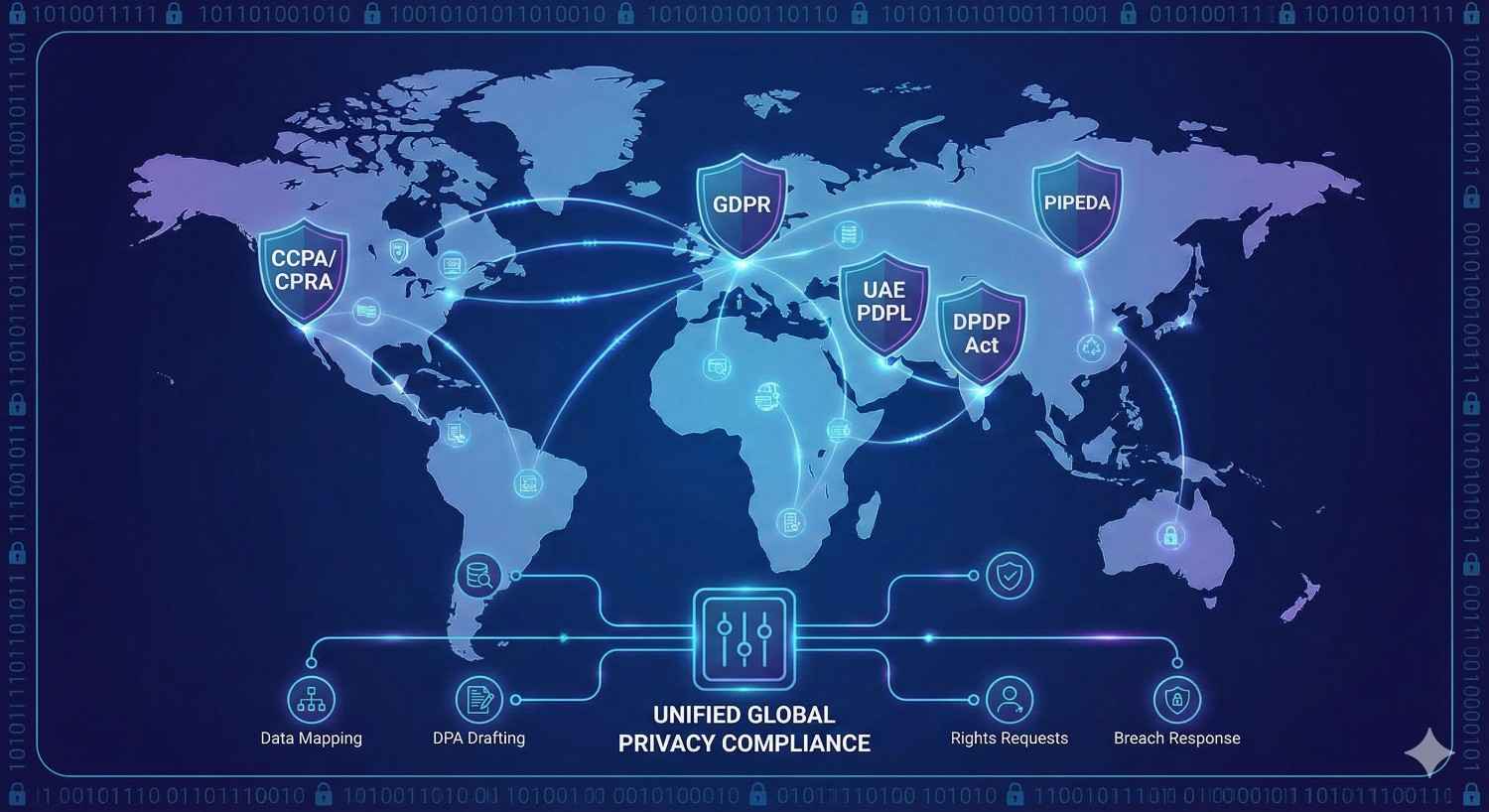
1. High-Level Objectives & Jurisdictional Reach
In global markets, data protection laws embody several different legislative philosophies but they all converge on one common goal: protecting people’s personal information and regulating how organizations collect, store and use it. The GDPR, and modern data privacy at large, places personal data protection as á fundamental human right. It applies to both controllers and processors, and its extraterritorial effect means that businesses worldwide are accountable if they target or monitor EU residents. Which is why, with its focus on accountability, legal basis for processing, DPIAs and massively regulated rights mechanisms – GDPR has already become a de-facto global standard.
California’s CCPA (together with the CPRA which extends it) in turn is based on consumer protection rather than a right. It places a strong emphasis on consumer transparency, allowing individuals to see their personal data, delete it and correct information as well as opting out of sale or sharing. In addition to this, CPRA created new rights regarding sensitive personal information and formed the California Privacy Protection Agency as evidence of the US movement towards tighter privacy regulation at a state level.
The UAE PDPL by Federal Decree Law No. 45 of 2021 seeks to establish a contemporary privacy regime which is compliant with international norms, during furtherance of the UAE’s vision for establishing a robust digital economy. It covers not only the processing of information within the UAE but also some types of processing that impacts residents. Its need for lawful bases, the principle of accountability and appointing specific roles including Data Protection Officers (in certain circumstances) are based on a model seen through GDPR but moulded to suit the UAE’s regulatory landscape.
In the meantime, PIPEDA is still Canada’s federal privacy law in effect for processing personal data of individuals by privatesector organizations and businesses. It stresses quality of consent, responsible data processing, purpose limitation and transparency. While segments of Canada’s federal privacy reform are pending, PIPEDA remains the basis for Canada’s privacy structure, complimented by guidance from the, Office of the Privacy Commissioner (OPC).
Lastly, the Digital Personal Data Protection (DPDP) Act of India, which is being held in phases until 2024-2025, follows the same model of outlining the rights of Data Principals, responsibilities of Data Fiduciaries and a framework of legally based principles that mimic GDPR but are structured to suit the demands of Indian governance. The DPDP Act is applicable to digital personal data that is being processed in India as well as the processing of digital personal data outside India that involves Indian data subjects. The 2025 DPDP Rules specify the consent principles, complaint policies, the conditions of data of children, and the mechanisms of transfers across borders, which is the most important step of India towards a strong privacy policy.
2. Scope:
Even though the five frameworks put control over personal data, they vary as far as their scope and applicability are concerned. According to GDPR, personal data comprises any information concerning an identifiable individual, and the law is applicable regardless of the physical presence of the organization in case the data subjects in the EU are targeted. Such an extensive area of coverage forces international companies to take into account the applicability of GDPR every time they are expanding their presence online. The CCPA/CPRA is a hybrid model that extends its application to businesses that qualify as such based on the criteria of revenue or volume of data, irrespective of their location in California. This renders CCPA to be well-globalized to consumer-facing platforms. Compliance was complicated by the fact that CPRA broadened the meaning of sharing data to conduct cross-context behavioral advertising. The UAE PDPL is relevant to companies that work within the UAE or handle information of local residents of the country. It also includes data processing by free zone entities unless expressly superseded by particular free zone legislation (e.g. DIFC or ADGM which contain their own data protection legislation). The application of its territory is a strategy on data protection that is harmonized by the UAE and that retains regulatory freedom within the special economic zones. PIPEDA is applied to the data that is handled during the commercial activity within Canada, unless it is overridden by the provincial privacy laws (like the Quebec Bill 64). Its area of focus is any organization that engages in commercial transactions, which makes it the key to multi-province operations. The DPDP Act of India covers both processing of digital personal data in India and processing outside of India as long as it involves the provision of goods or services to Indian individuals. Having a wide definition of Data Principal and Data Fiduciary, the Act takes into consideration virtually any digitally data processing. The 2025 Rules that come with it give operational clarity on the timeframe a certain obligation takes into effect especially when it comes to children data and the significant data fiduciaries.
3. Legal Bases for Processing, Consent & Special Categories
The GDPR provides 6 legal grounds of personal data handling, among them being consent, obligation to contract, legal requirement, vital interest, public interest, and legitimate interest. The consent should be express, informed, voluntary, and retractable. In the case of sensitive categories (like health or biometric data), GDPR imposes even stronger protection in favor of its rights-first approach. The CCPA/CPRA does not need a lawful basis framework, which is the case of GDPR. Its main idea is the empowerment of the consumers by giving them transparency and opt-out options. Rather than attaching processing to particular legal grounds, the CCPA is oriented to explaining the clear notice and giving consumers the right to refuse the sale or sharing of their data. CPRA also established regulations of sensitive personal information whereby businesses must grant users right to limit some of the uses. The UAE PDPL proposes a hybrid approach, where legitimate grounds are employed similarly to GDPR but with the focus on consent to particular processing operations. Strong protection is given on sensitive personal data, and documentation on the processing activities is to be kept. Consent is the main requirement under PIPEDA. Organizations should get proper, material consent to any collection, usage, or disclosure except when an exemption exists. The OPC has underlined the importance of informed consent, specific, and understandable consent and the need to restrict collection by organizations based on the organization’s legitimate business requirements. The DPDP Act is also similar in that consent is also a valid legal ground of the act, but legitimate processing is also seen as an option under contract, legal duty and other allowed purposes as well. According to the 2025 Rules, the consent should be free, specific, informed, unambiguous, and with clear notice. The processing of the data of children is obligatory with the parental consent, and the sensitive types of the personal data are subject to special safeguards.
4. Individual Rights & Remedies
All the frameworks provide individuals with some rights concerning their personal data, albeit to varying degrees and with varying levels of enforcement. The GDPR provides wide-ranging rights such as access, rectification and erasure, processing restriction, portability and right to object. It also limits automated decision making and profiling. The mechanism of the GDPR enforcements is strong, as the regulators can impose penalties of 4% of yearly worldwide income or EUR20 millions. The CCPA/CPRA entitles California residents to access, deletion, correction and the do not sell or transfer of personal information. It also permits the understanding of people to restrict the use of delicate individual data and sets responsibilities on companies to unmistakably present opt-out systems. The UAE PDPL offers the same collection of rights including access, correction, deletion, and objection. It also allows people to request clarification on automated processing. PDPL enforcement is centralized on the supervisory bodies of UAE and is backed by administrative penalties. PIPEDA includes access, correction, and withdrawal of consent rights which pay a lot of attention to the concept of reasonableness. Citizens can report to the Office of the Privacy Commissioner where violations can be investigated and corrective action proposed. The DPDP Act of India brings about rights of access, correction, deletion, and redressal of grievance. It also sets rigid deadlines within which Data Fiduciaries should act and establishes ways of imposing fines on non-compliance by the Data Protection Board. The trends in enforcement of the EU and US markets show that regulators are increasingly moving to an active mode and therefore businesses have to internalize rights request processes.
5. Cross-Border Transfers & International Compatibility
One of the most complicated areas of the global compliance of privacy concerns cross-border data transfer requirements. The GDPR requires transfers not within the EU to only be done through mechanisms like adequacy decisions, Standard Contractual Clauses (SCCs), Binding Corporate Rules (BCRs) or limited derogations. The consequences of Schrems II underlined the importance of Transfer Impact Assessments (TIAs) and increased due diligence. The CCPA/CPRA does not specifically limit the cross-border transfers but imposes a duty on businesses to provide adequate protections and disclosures on the activities of processing. The companies should have good contractual safeguards with their service providers to prevent being considered as selling data. The UAE PDPL obligates the companies to adhere to the accepted transfer mechanisms like adequacy approvals or contractual protection. Freer zone laws could come up with other or other mechanisms. With PIPEDA, organizations that have foreign-processing relationships are still responsible in ensuring the protection of personal information. Although it does not introduce a set of strict transfer rules, PIPEDA demands similar protection, openness, and contractual governance of foreign suppliers. The DPDP Act of India with the supporting rules in 2025, provides an allowlist framework on key to approving cross-border transfer, and might also mandate particular contractual protection or government licensing. These are the mechanisms which can draw India towards EU modality of regulatory convergence without losing sovereignty.
Need a unified privacy policy or data processing agreement covering multiple jurisdictions? Our Solvlegal data protection lawyers draft custom, compliance-ready documents for India, UAE, EU, and North America.
6. Practical Compliance Obligations for Businesses
When it comes to compliance in different jurisdictions, organizations really need some kind of structured way to handle operations. I think data mapping comes first as the basic step. It helps figure out which places like the EU or US actually apply to what the company is doing with data.
Once you have those data flows laid out, businesses have to document the legal reasons for processing. Privacy notices need updates too, with specific info for each jurisdiction. And then there are the procedures for handling rights requests, which have to fit the timelines from EU rules, US ones, Canada, UAE, and India. That part gets a bit complicated.
Vendor contracts cannot stay the same. They must get updated to include things like DPAs that meet GDPR standards. For CPRA, there are specific obligations. PDPL has its clauses, PIPEDA wants safeguards, and DPDP has its own requirements. It feels like a lot to cover all at once.
security measures have to be strong no matter what. Encryption and access controls are key, plus breach notifications that match up with the different regulatory timelines. Some people might overlook how those timelines vary. For high-risk stuff, like profiling or automated decisions, or especially data on kids, DPIAs or risk assessments are necessary
7. Drafting a Unified DPA/Privacy Policy - Practical Checklist
A unified privacy policy or data processing agreement seems like it should start with a solid GDPR base, and then add on those extra parts for different places. The main part of the document needs to cover what counts as personal data, who does what in terms of roles, how long to keep stuff, and some overall security rules that work everywhere.
For the annexes, they have to handle the specific stuff in each area. Like for GDPR, you need clauses about standard contractual clauses and appointing a data protection officer. Then CPRA has addenda that define what selling or sharing data means. In the UAE, the PDPL parts deal with keeping records locally. PIPEDA focuses on how consent works. And Indias DPDP rules include things like processes for handling grievances and protecting childrens data.
Organizations probably should put in a clause about conflicts of law, you know, to figure out how to deal with rules that overlap. It also makes sense to spell out the steps for dealing with data rights requests, notifying about breaches, and bringing on new vendors
8. Enforcement Landscape & Recent Trends (2023–2025)
Things have really sped up privacy enforcement from 2023 to 2025, across different places. In Europe, they keep hitting big tech companies with huge fines, which makes it clear that companies need strong compliance setups or else.
California is getting more active too, with their CPRA group expanding audits and handing out penalties for stuff like dark patterns, bad opt-out options, and notices that are not clear enough. It feels like they are cracking down harder on those tricky designs.
Over in the UAE, they are still working on setting up enforcement under the PDPL, which seems important for getting things started there. India has these new 2025 DPDP Rules that let the Data Protection Board start fining people who do not comply, paving the way for actual actions.
Canadas OPC is involved in ongoing disputes, especially around cross-border data transfers, AI profiling, and making sure algorithms are fair. That part gets a bit complicated, with all the back and forth.
Overall, it looks like regulators worldwide are coordinating more, and they are ready to punish organizations that skip out on proper privacy and security steps.
9. Practical Compliance Roadmap (90-Day Priorities)
For enterprises that require swift synchronization, a 90-day compliance plan is critical. First and foremost, the process requires the creation of a map for data flows and the identification of high-risk or multi-jurisdictional processing. After that, entities have the duty to update their privacy notices, cookie notifications, and user interfaces based on the respective jurisdictions’ rights. Additionally, the vendor contracts must be modified to include a standardized DPA with the required annexes. Data subjects’ right-to-access request automation and the formulation of an incident response plan with the respective jurisdictions’ data breach notification timelines also have to be carried out. Finally, governance structures such as the nomination of privacy leads and staff training have to be implemented.
10. When to Get Legal Help
Legal expertise would be imperative in the case of cross-regional processing of personal data, especially in the development of DPAs or the assessment of transfer methods. Organizations should seek the assistance of legal experts in drafting SCCs or BCRs, developing CPRA-compliant addenda, formulating PDPL-compliant frameworks for the UAE region, or developing DPDP-specific grievance redressal channels. Legal experts can offer assistance in the assessment of the transfer impact or in the documentation of fulfillment of the queries of the regulators.
11. Key Takeaways
The state of privacy globally in 2025 is increasingly harmonized in terms of principles but varies in practices. The GDPR norm remains the strongest global standard, and then there is CPRA/CCPA, with a focus on consumer protection laws that impact privacy discourse in the US. The UAE’s PDPL and DPDP Act in India enhance their respective regions’ regulatory frameworks. PIPEDA remains an essential privacy standard in Canada. The ultimate harmonization tactic is thus baseline GDPR programs developed in annexes for key regions.
FREQUENTLY ASKED QUESTIONS:
1. What are the major global data privacy laws businesses must comply with in 2025?
The key laws are GDPR (EU), CCPA/CPRA (USA–California), UAE PDPL, Canada’s PIPEDA, and India’s DPDP Act. Companies handling international user data must ensure compliance with all applicable frameworks.
2. Which law has the strictest data protection standards?
The EU GDPR is widely regarded as the most stringent due to its broad scope, mandatory DPO requirements, explicit consent standards, and heavy penalties (up to 4% of global turnover).
3. Do these laws apply to companies operating outside their countries?
Yes. All five regulations have extraterritorial reach. Any business offering goods/services to residents or processing their data can be subject to GDPR, CCPA, PDPL, PIPEDA, and India’s DPDP Act—even if the company has no physical presence there.
4. How does GDPR consent differ from DPDP Act consent?
GDPR requires consent to be freely given, specific, informed, unambiguous, and documented.
The DPDP Act requires free, informed, specific, unambiguous, and unconditioned consent with a simple withdrawal mechanism. GDPR is more detailed, while DPDP is simpler but strict.
5. Do all these laws require breach notifications?
Yes, but timelines differ:
- GDPR: within 72 hours
- PDPL: without undue delay
- PIPEDA: as soon as feasible
- DPDP: as prescribed by the Data Protection Board
- CCPA: notification must be prompt
All require notifying affected individuals when harm is likely.
6. Do businesses need separate privacy policies for each jurisdiction?
Not necessarily. A unified global privacy policy can work if it incorporates jurisdiction-specific disclosures and aligns with all major frameworks. This is increasingly common among multinational companies.
7. Can companies transfer personal data internationally under these laws?
Yes, but subject to conditions.
- GDPR: requires adequacy decisions, SCCs, or BCRs
- DPDP: government will notify permitted jurisdictions
- PDPL & PIPEDA: require adequate safeguards
- CCPA: focuses on transparency and consumer opt-outs rather than transfer rules
Cross-border data agreements and transfer assessments are essential for compliance.
REFERENCES:
1. Office of the Privacy Commissioner of Canada – PIPEDA Requirements in Brief.
2. UAE legislation - Federal Decree by Law No. (45) of 2021 Concerning the Protection of Personal Data.
3. European Commission - Legal framework of EU data protection.
4. European Commission – Data Protection
5. Reuters - In a first, EU Court fines EU for breaching own data protection law
7. Digital Personal Data Protection Act, 2023
8. DLA Piper - Data Protection Laws in India
ABOUT THE AUTHOR
This blog is authored by Navya Mishra, a fourth-year law student at the School of law, Bennett University, Greater Noida.
REVIEWED BY:
Gaurav Saxena is the founder of SolvLegal, where he brings together dual expertise in engineering and law to guide clients through complex corporate and compliance matters. With a strong grounding in the law of contracts, corporate law, intellectual property, IT law and data privacy, he works with startups and established businesses alike to structure agreements, advise on governance and safeguard innovation.
DISCLAIMER
The information provided in this article is for general educational purposes and does not constitute legal advice. Readers are encouraged to seek professional counsel before acting on any information herein. SolvLegal and the author disclaims any liability arising from reliance on this content.

Related Articles


Leave a Comment
