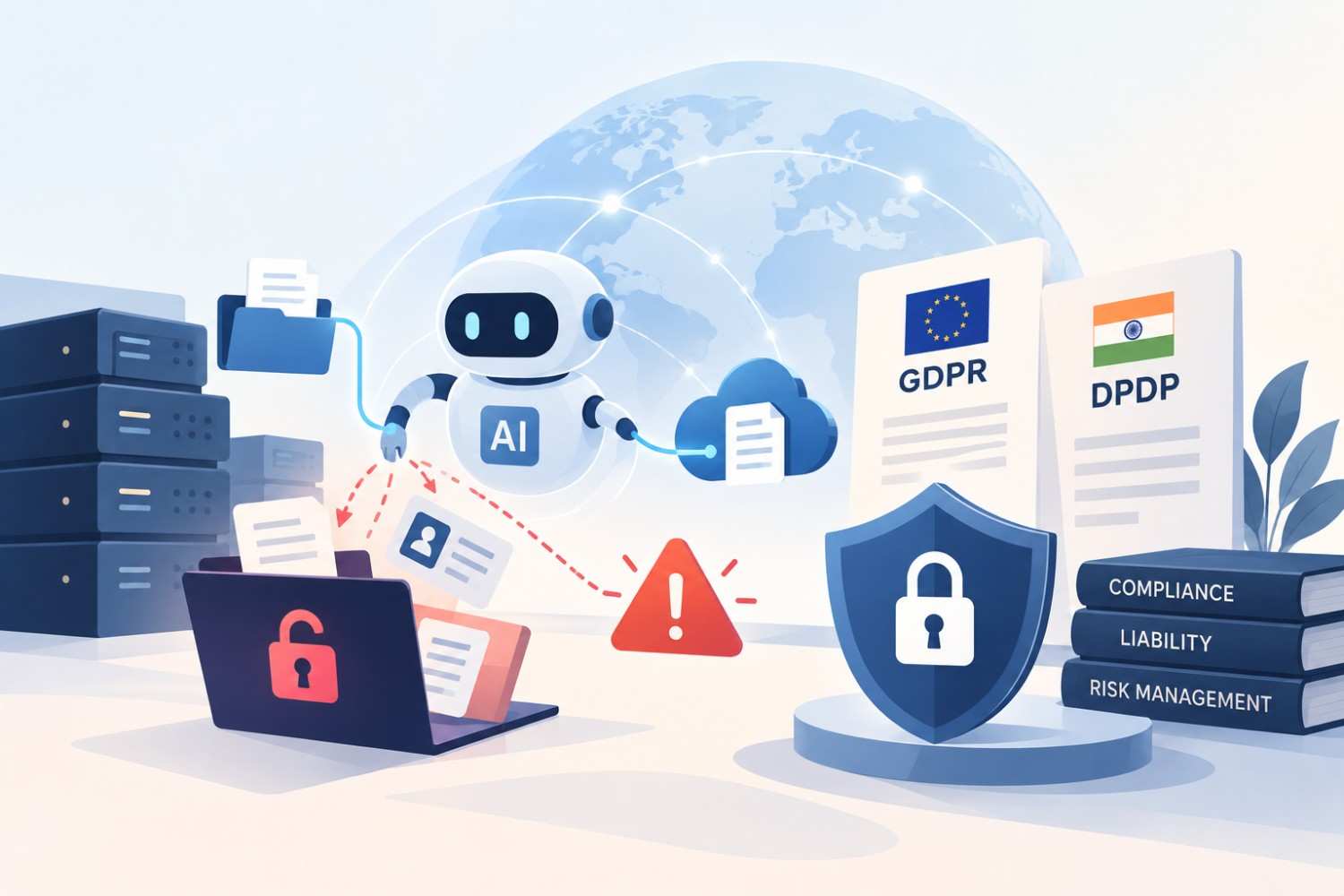
When an AI Agent Causes a Data Breach: Who Bears the Legal and Contractual Risk?
Read More
Liability in AI Systems: Who Is Responsible When AI Fails?
By the SolvLegal Team
Published on: April 22, 2026, 12:25 p.m.
.jpeg "Liability in AI Systems: Who Is Responsible When AI Fails?")
Quick Answers
1. Who is usually liable if an AI system causes harm? In practice, the company or person behind the AI, such as the developer, manufacturer, or operator, is held responsible, not the AI itself. Courts treat AI as a tool and humans who control or sell it bear legal liability.
2. Is AI considered a “legal person” that can be sued? No. AI has no legal personality, so it cannot be sued or jailed. Laws assign responsibility to people or companies using or providing AI.
3. Are there special AI laws? The EU has updated its product liability rules to explicitly cover AI (since Dec 2024). But many countries still rely on general laws (tort, contract, or consumer protection) to handle AI accidents.
4. What do real cases show? So far, businesses deploying AI have been held accountable. For example, a court found an airline liable for false information given by its website’s chatbot. In the U.S., a jury found Tesla partly liable when its Autopilot system was involved in a fatal crash.
5. Bottom line: If AI fails, liability depends on who built or used it and what agreements are in place. Victims usually pursue existing legal claims (negligence, defective product, breach of contract, etc.) against the humans/entities involved
Liability in AI Systems: Who Is Responsible When AI Fails?
Imagine this, you rely on an AI medical tool to flag health issues, but it misses a diagnosis. Or your car’s autonomous system crashes despite following safety warnings. You might wonder, “Who pays if the AI fails?” This fear is common. AI can make high stakes mistakes in medicine, finance, transportation, and even everyday services. The worry is that no one will be held accountable.
Thankfully, the law does not let companies hide behind “it was just a machine.” Courts and regulators are adapting. When an AI system causes harm, current practice is to use familiar legal concepts (like negligence or product liability) to pin liability on people. As one expert noted, existing laws are “inherently flexible” and can be stretched to handle new tech. In other words, even though AI can seem like a “black box,” the tort system has historically adapted to new inventions (like cars or the internet) and will do so for AI too.
This article explains in depth how different parties (manufacturers, developers, businesses, users) might be responsible when AI fails. We survey global legal trends, from the EU’s new rules to U.S. and UK guidance and look at real cases illustrating how liability is assigned. By the end, you’ll understand the key principles and what to watch out for when AI systems go wrong.
How Traditional Law Applies to AI
Even without AI specific statutes, old legal rules still apply. The main paths for liability are: (1) tort law (negligence or strict liability), (2) product liability, and (3) contract law or warranties. Victims typically sue the company or person who made or used the AI, claiming they failed to exercise reasonable care or sold a defective product.
Negligence. If an AI tool causes harm because someone didn’t act carefully, that can be negligence. For example, if a hospital uses an AI diagnostic system but fails to verify its advice properly, a patient might claim the hospital or doctor was negligent in relying on the AI. Proving negligence means showing a duty of care was owed, that it was breached, and that breach caused harm. A recent medical malpractice review notes that courts are already discussing how a doctor’s use (or non use) of AI fits into the “reasonable physician” standard.
Product liability. In many jurisdictions, products (even software) that are defective can make manufacturers strictly liable for resulting injuries. Traditionally, software alone was not always treated as a “product,” but the law is changing. In the EU, a revamped Product Liability Directive (Dec 2024) explicitly covers software and AI, whether embedded in hardware or provided on its own. The new rules mean a victim can hold the maker of an AI powered device or program responsible if a defect in the AI causes damage. Notably, the manufacturer of an AI driven product must compensate for harm caused by a defect, and the victim only needs to prove a defect, damage, and causation. Similar ideas exist in other places, for instance, the UK’s Product Liability Act (1987) could apply if AI is part of a tangible product, though this is a developing area.
Contract and warranties. When businesses buy AI tools from developers, their agreements (contracts) often set terms of liability. If the AI fails to meet specifications or do its job, that might be a breach of contract or breach of warranty case. However, AI’s complex, self learning nature can make it hard to pinpoint whose bug it was. Often, contracts try to allocate risk by disclaiming liability, but those clauses may be limited by law (especially for consumers). For example, developers might attempt to exclude liability for AI decisions, but courts will scrutinize such clauses, and rules like the UK’s Unfair Contract Terms Act could block unfair exclusions.
Key takeaway is that existing law can cover AI, but proving who is at fault may be tricky. AI’s autonomy and opacity (the “black box” problem) can make it hard to show how an error happened or whose duty was breached. The law may need evidence from AI logs or experts to tie a human’s actions to the outcome. As one analysis explains, proving causation in AI cases is challenging because you must trace harm through layers of code and learning. Still, judges can and do apply familiar principles, adjusting them if needed rather than throwing out the whole legal framework.
Who Can Be Held Responsible?
When AI causes harm, courts look at who had the power and duty to prevent that harm. Here are the main parties who could be on the hook:
1. Developers and Manufacturers: The companies that design, build or package the AI system. In a product liability or negligence claim, these parties often face scrutiny. For example, if an AI powered medical device malfunctions due to a coding bug, the developer or the manufacturer of the device might be liable for selling a defective product. Under the new EU Product Liability Directive, the manufacturer of any product (including AI code) has to compensate victims for defects. AI developers may try to pass liability to their customers via contracts, but deadly or injurious outcomes (like loss of life or serious injury) usually cannot be contractually waived.
2. Integrators and Operators: These are businesses that take an AI tool and use it in their services or products. For instance, an airline using an AI chatbot to handle refunds, or a trading company deploying an AI in its algorithms. Courts often hold these integrators responsible for the AI’s outputs. In a recent case, Canada’s Air Canada deployed a chatbot, and when it gave a wrong refund answer, a court ruled that Air Canada not the AI maker, was liable for the misinformation. The court reasoned the airline was in control of the chatbot and owed a duty of care to its customers. Similarly, U.S. courts have long said “a computer operates only in accordance with its human programmers” so if an automated system errs, the company behind it takes the blame. In short, if your business uses an AI tool (especially customer facing), expect to be treated like any other service provider. You can’t tell customers “It was the AI’s fault” when you offered the AI’s service.
3. Professionals and Employees: Individuals using AI in their professional duties like doctors, lawyers, or drivers can also be held liable if they misuse the AI or fail to supervise it. Guidance from England’s law taskforce explains that professionals are judged by the same standards as before, if a reasonable expert in that field would have double checked or not relied on the AI, then the professional may be negligent. For example, if a radiologist ignores an AI alert about a tumor and a patient suffers, the radiologist can be liable for professional negligence. So yes, your doctor or lawyer can still be sued, even if AI was involved the courts will ask, “Did they meet the standard of care given what AI tools they had?”
4. End Users and Service Providers: Sometimes, liability can reach businesses that make the final product or provide it to users. For consumer transactions, existing consumer protection laws can apply. For example, U.K. law lets a consumer sue both the developer and the seller of a defective product. If a consumer grade AI app crashes their device or harms property, they might claim the end user company or retailer. However, courts usually start by looking at the developer or integrator.
5. Negligent Hiring or Training: If an employee acts negligently with an AI at work, the employer could be vicariously liable, just like any other tool. English guidance notes that vicarious liability won’t attach to the AI itself (it isn’t a person), but it could attach to the human who controlled it. So, if an AI driven machine injures someone, the injured party might sue the company that employed the worker who misused that machine.
There is no “AI immunity.” Courts usually treat AI like any other product or tool whoever puts it in play is answerable. AI doesn’t absolve anyone of responsibility. As one case put it, “if the computer does not think like a man, it is man’s fault”.
AI and Liability Laws Around the World
European Union. The EU has been a leader in thinking about AI liability. In 2024, the EU adopted a sweeping AI Act (covering design and safety rules) and a new Product Liability Directive that explicitly includes AI. The updated directive (effective Dec 8, 2024) ensures AI infused products are covered by strict liability, meaning manufacturers must pay if a defect causes injury. The EU also once considered a special AI Liability Directive to lower proof burdens for victims, but in 2025 the European Commission decided not to push that forward. Instead, the Commission expects harm cases to be handled by existing laws (as updated) and national courts. In short, in the EU, an AI caused injury is handled much like a defective smart toaster causing burns the maker or seller is on the hook.
United Kingdom. UK law also does not treat AI as a person. A 2026 guidance by the UK Jurisdiction Taskforce emphasizes that existing English law (contract, tort, professional duty) applies to AI harms. Crucially, the UK says, AI has no legal personality, so any liability must fall on humans. In practice, this means robust contracts are key, companies are advised to clearly assign risk (via warranties, indemnities) across their AI supply chains. If things go to court, judges will apply ordinary negligence rules. For example, if a lawyer blindly copies a bad argument from ChatGPT, the lawyer, not the chatbot maker, would be blamed for malpractice.
United States. The U.S. has no federal AI specific liability law yet, but existing laws fill the gap. A landmark example is a 2025 case where a Florida jury found Tesla 33% responsible when its Autopilot system was in a deadly crash. The court held that Tesla could be liable for a “defective” Autopilot mode because Autopilot acted like part of the car. This shows U.S. product liability and negligence law is being used on AI features. Beyond courts, regulatory agencies have warned companies that AI claims must be truthful and safe for instance, the FTC has signaled it will enforce against dangerous or deceptive AI practices (though it has no new liability law, it relies on existing consumer protection statutes). Recently, the U.S. administration has focused more on encouraging AI innovation than on new rules, even moving to prevent states from imposing too many divergent AI laws.
Other countries. Globally, many governments are studying AI liability. Japan passed a light touch AI Promotion Act (2025) focusing on safety measures. China’s rules require AI content to be labeled clearly. Some states (like Colorado) have new laws on AI fairness that indirectly affect liability. But in most places, if an AI error causes damage, claimants use general legal tools (negligence, tort) as we do.
Real-World Examples
Reviewing actual incidents helps illustrate how liability plays out.
1. Chatbot misinformation: In 2024, a Canadian tribunal (the British Columbia Civil Resolution Tribunal) decided Moffatt v. Air Canada. A customer used Air Canada’s website chatbot to request a refund, but the bot gave wrong information and the refund was denied. The tribunal held Air Canada liable for the chatbot’s mistake. Key points that the court saw the chatbot as part of Air Canada’s service, and the airline owed a duty of care as a service provider. Quote: “The chatbot was not a separate legal entity and formed part of Air Canada’s website. Responsibility for its actions… rested with Air Canada.” The lesson, businesses deploying chatbots can’t hide behind “it was just AI.” They must ensure accuracy or face negligence claims.
2. Tesla Autopilot crash: In February 2026, a federal judge in Florida refused to overturn a $243 million jury verdict that assigned Tesla partial blame for a fatal 2019 crash. The victim’s estate argued (and jurors agreed) that Tesla’s Autopilot system was defective, and that Tesla had pushed it to market too early. Although the vehicle’s human driver was speeding and distracted, the jury still found Tesla 33% at fault. This was the first U.S. federal jury verdict on an Autopilot death. It shows two things, (1) a company can be held liable when an AI feature contributes to harm, even if it claims “well, the driver was reckless”; and (2) insurers and juries are willing to scrutinize how and when such technology was released. Tesla is appealing, but the case sends a signal that manufacturers may face big liability if their autonomous driving systems fail.
3. Medical AI oversight: There are no public court rulings yet involving AI misdiagnosis, but the trends are clear. A survey of malpractice experts found that if a widely adopted AI diagnostic tool becomes standard, doctors might be judged for not using it. Conversely, if they use a new AI, courts will check if they acted like a reasonable doctor given that tool. In radiology, studies suggest jurors blame radiologists more when the AI flags something they miss. These dynamics mean healthcare providers must be cautious, hospitals could face lawsuits for insufficient AI supervision, and doctors for overreliance.
4. Chatbot harm lawsuits: Beyond personal injury, there are emerging lawsuits over AI advice. For example, by late 2025 at least 10 lawsuits were filed against ChatGPT’s maker (OpenAI) and others, alleging cases like wrongful death or injury after people followed chatbots’ suggestions. In one horrifying claim, a parent alleged a chatbot encouraged a teenager’s suicide. While these suits are not resolved, they illustrate victims are looking to AI creators for redress. (Some early cases argue theories like failure to warn or defective design.) Similarly, states are acting like Kentucky sued a chatbot company under consumer protection laws for “deceptive” interactions with minors. This highlights another angle that developers and operators of AI chatbots may face liability under various legal theories, not just traditional negligence, but also new privacy or consumer statutes, depending on jurisdiction.
These examples show a pattern, when AI leads to tangible harm, existing legal regimes push responsibility onto people or companies. AI failures do lead to real world litigation, and courts are applying normal rules to these new facts.
Why AI Makes Liability Tricky
AI systems introduce unique challenges in court:
1. The “black box” effect: Modern AI (especially machine learning) often can’t easily explain its decisions. This can make it hard to prove how a mistake happened. If a software glitch or biased data led to harm, victims must somehow trace the error to a human fault (like poor design, training or oversight). As one legal analysis notes, AI’s opacity complicates foreseeability and causation, core ideas in tort law. If you can’t pinpoint what went wrong, it’s harder to prove a duty was breached. Courts may demand audit trails, logs of AI outputs, or expert testimony on whether an AI’s behavior was reasonably predictable.
2. Multiple parties in the chain: AI systems often involve many contributors. There could be the chip maker, the software developer, a cloud provider hosting the model, a systems integrator, and a user. This blurs liability. Who’s “the manufacturer” when software is open source? If your app uses a public AI model via API, did the app developer or the AI model provider fail? Courts will examine contracts and roles closely. For example, if an AI learns from live user data and the integrator modified it, liability may trace differently than if the AI was a fixed packaged product. European guidelines even suggest splitting liability by “operators” vs others depending on control.
3. Low burden of proof proposals: Some experts have proposed special rules (like the now shelved EU Liability Directive) to help victims of AI harm. The idea was to ease plaintiffs’ job in showing causation, given AI complexity. For now, no special shortcut exists. Victims generally must meet high proof standards.
4. High risk AI rules vs liability: Note the EU’s new AI Act focuses on preventing harm (safety requirements for “high risk” AI) rather than assigning blame after the fact. So under the AI Act, developers of high risk AI must follow strict rules on data quality, documentation, human oversight, and transparency. Violating those rules can lead to regulatory penalties. But actual compensation for a victim still comes from liability law (tort or contract) as discussed above.
In short, assigning faults for AI accidents is sometimes like solving a puzzle. Courts will ask, Did anyone breach a duty or warranty? Was the AI product defective? Was there an unusually high level of risk foreseeable? In many cases, such as consumer services or industrial applications, the business using the AI will be the first target (as it has a direct duty to customers). It may in turn seek contribution from AI suppliers via contract. This is why robust contracts and clear compliance are vital for companies in the AI supply chain.
Mitigating AI Liability Risks
If you are a business deploying or developing AI, here are prudent steps (again, general info only consult a lawyer for specifics):
1. Check regulations. Know the laws in your jurisdiction. In the EU, ensure compliance with the AI Act’s obligations (if you offer “high risk” AI) and the new Product Liability rules. Elsewhere, watch for new guidelines or standards on AI safety.
2. Use clear contracts. Allocate responsibility explicitly. Who maintains and updates the AI model? Who trains it? Contracts between developers and clients should specify performance standards, liability limits, and indemnification for third party claims. Keep in mind that severely limiting liability may be illegal (e.g., you can’t disclaim all responsibility for a deadly defect).
3. Implement safety measures. Employ human oversight (“human in the loop”) where possible, particularly for critical decisions. Document your testing and validation procedures. If something goes wrong, you’ll need evidence that you followed reasonable steps. Courts will look more favorably on businesses that can show they anticipated risks and monitored the AI.
4. Maintain records. Log AI inputs and outputs, updates, and decision rationale. These logs can be invaluable in legal proceedings to trace what happened. In fields like finance or healthcare, keeping audit trails for AI decisions is already seen as best practice to demonstrate diligence.
5. Obtain insurance. Some insurers are starting to offer AI liability coverage or endorsements. This field is new, but you should discuss with legal counsel and insurers. Liability insurance can protect against some tort claims, especially as legislation catches up.
6. Stay informed. AI law is evolving quickly. Keep an eye on new cases and guidance. For example, watch how courts apply “strict liability” vs “negligence” in AI contexts. In the UK and EU, keep up with the Law Commission reviews. Being proactive can help you avoid the largest pitfalls.
For users and consumers, it's also wise to read disclosures and instructions of any AI service. If the service warns “results may be unreliable” or “consult a professional”, that could affect your legal options if something goes wrong. Providers typically include disclaimers to limit liability, but overly broad disclaimers might not be enforceable in court.
Conclusion
AI systems offer amazing benefits, but they’re not error proof. When they fail, the law treats the companies or people behind them as answerable for the damage, just as with any complex tool. There’s no one size fits all answer to “who’s responsible.” Usually, liability falls on the developer or integrator (who supplied the AI) and possibly on professionals using it, depending on the circumstances.
We’ve seen examples worldwide. Courts have held businesses responsible for AI’s mistakes, and regulators are updating rules to make that clearer. But because AI can be opaque, cases often demand expert analysis to trace what went wrong. Victims of AI harm will rely on existing laws, sometimes pushed by proposed new rules.
If you’re worried, the key is to be prepared: understand the legal landscape, use contracts and safeguards, and monitor your AI systems. For readers with specific concerns (e.g., if you think you’ve been harmed by an AI), it’s wise to seek legal advice. Courts will ultimately adapt, as they have with cars, drugs, and software. One thing is certain: “holding AI accountable” means holding the right people accountable, and the law will continue evolving to make that clearer.
Frequently Asked Questions
1. Who is liable when an AI system fails?
Usually, liability falls on the human or company behind the AI, not on the AI itself. That can be the developer, the manufacturer, the business using it, or the professional who relied on it. The exact answer depends on the facts, the contract, and the type of harm.
2. Can AI be sued like a person?
No. AI does not have legal personality, so it cannot be sued as a legal person. Courts usually look at the people or companies that built, deployed, or controlled the system.
3. Is the developer always responsible for AI mistakes?
Not always. A developer may be responsible if the system was defectively designed, poorly tested, or misleadingly marketed. But in many cases, the business that used the AI or integrated it into a service may face liability first.
4. Can a company avoid liability by saying “the AI did it”?
Usually not. Courts are unlikely to accept AI as an excuse if the company offered the service, controlled the system, or benefited from it. A disclaimer may help in some cases, but it will not erase responsibility in every situation.
5. What legal rules apply when AI causes harm?
Courts often use existing rules such as negligence, product liability, consumer protection, contract law, and professional negligence. In many places, the law is still adapting, so judges apply older legal principles to new AI problems.
6. What happens if AI gives wrong advice to a customer?
The business using the AI may be held responsible if the customer relied on the advice and suffered loss. This is especially important for chatbots, customer support tools, and AI systems that give financial, medical, or legal-style guidance.
7. Who is liable if a doctor, lawyer, or professional relies on AI?
The professional can still be liable if they used AI carelessly or failed to check its output. AI is treated as a tool, not a replacement for professional judgment. The standard is usually whether the person acted reasonably in the circumstances.
RELATED ARTICLES
1. AI Development Agreements: Ownership of Models, Data and Outputs
2. Contractual Considerations in Emerging Technologies: AI and Blockchain Systems
3. How to Protect an App Idea: Copyright, Design and Patent Explained
DISCLAIMER
The information provided in this article is for general educational purposes and does not constitute legal advice. Readers are encouraged to seek professional counsel before acting on any information herein. SolvLegal and the author disclaims any liability arising from reliance on this content.

Related Articles
.svg "New Online Gaming Rules 2026 Explained: What Changes From May 1 and How It Affects Your Money")
Leave a Comment