Launching a Web3 or dApp Product: Legal, Regulatory & Compliance Checklist for Founders
Read More
Contractual Considerations in Emerging Technologies: AI and Blockchain Systems
By the SolvLegal Team
Published on: April 20, 2026, 11:09 a.m.
Introduction
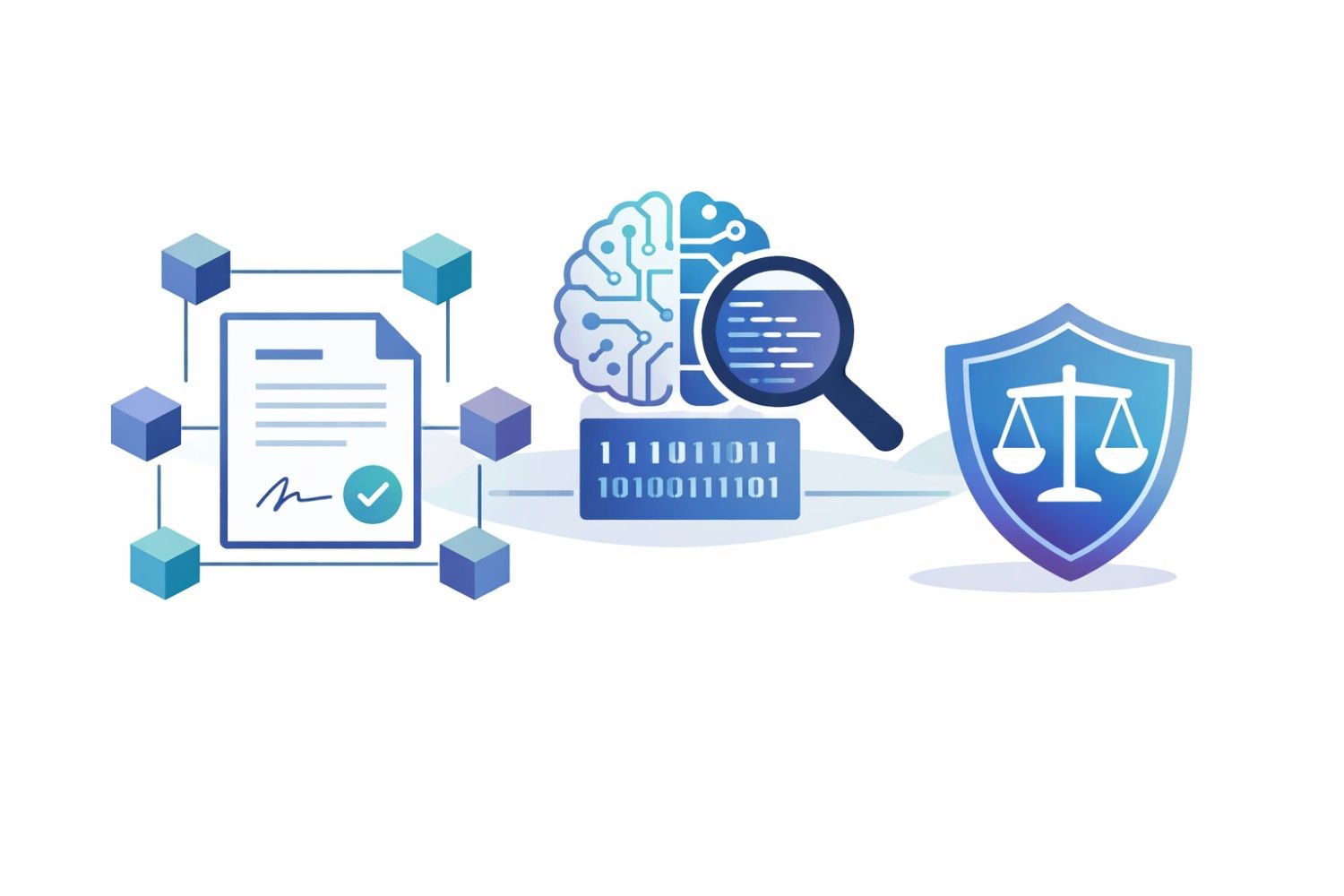
Contract law has, for centuries, operated on relatively stable conceptual foundations: offer, acceptance, consideration, and the capacity to be bound. What the digital revolution and more specifically, the emergence of blockchain-based smart contracts and artificial intelligence has introduced is not merely a new medium for executing these principles, but a set of conditions under which those principles are genuinely tested. Where traditional contracts depend on human interpretation, institutional trust, and third-party intermediaries, smart contracts substitute code for language and automated execution for judicial discretion. In other words, the question that faces legal theorists and lawyers is whether our current frameworks can be adapted to handle this substitution or whether we are already seeing the beginning of a fundamental transformation of the nature of private law.
It is clear that the banking industry serves as one of the primary areas of application for these new technologies. For instance, as noted by Chatterjee in her systematic review featured in the Indian Journal of Science and Technology, the blockchain technology provides us with an efficient system for recording financial operations which increases both security and transparency, whereas machine learning algorithms can perform predictive analysis impossible for lawyers before. This is illustrated by Chowdhury et al.'s research into Santander bank implementing a cross-border blockchain-based payment platform. Yet, when it comes to contract law, it takes more than research papers in journals for change to happen – sometimes it happens in courtroom, sometimes in regulatory agencies, and sometimes in code libraries.
The Architecture of Smart Contracts
Before looking into any legal consequences of smart contracts, it is necessary to understand what exactly they are. Smart contract does not refer to any kind of legally binding agreement. It is an automated piece of software placed on the blockchain and performing certain actions based on specific criteria. The operative logic is essentially conditional: if a specified state of affairs is verified on-chain, then a corresponding action payment, transfer of title, issuance of a token is triggered without any human intervention. Ethereum's documentation, cited across multiple sources reviewed here, describes this as "if/when... then" logic embedded into a distributed execution environment.
This architecture has several important properties. The contract is transparent, in the sense that its code is readable by any party with access to the blockchain. It is tamper-resistant, because altering a transaction record would require re-validating every subsequent block in the chain. And it is, in principle, deterministic the same inputs will always produce the same outputs, regardless of who initiates the transaction or under what circumstances. For businesses seeking to automate routine commercial arrangements loan disbursements, insurance payouts, supply chain milestones these properties are genuinely attractive. AXA's Fizzy platform, which automatically processes flight delay insurance claims through smart contracts linked to real-time flight data, demonstrates the practical efficiency gains on offer.
But determinism cuts both ways. A smart contract does not interpret intent; it executes code. If the code contains an error, or if the conditions it encodes do not adequately capture the commercial intent of the parties, the contract will still execute precisely and incorrectly. The famous collapse of The DAO in 2016, remains the most cited example of this risk at scale: a vulnerability in the contract code was exploited to drain funds worth tens of millions of dollars, and the code, by design, did exactly what it was instructed to do. The lesson is not that smart contracts are inherently unsafe, but that coding mistakes carry consequences that traditional contract remedies are ill-equipped to address.
Artificial Intelligence in Contract Analysis and Enforcement
If smart contracts represent the automation of contract execution, artificial intelligence represents the automation of contract cognition. Natural language processing tools can now review contractual clauses at speed, flag ambiguous or non-compliant terms, assess risk exposures, and even predict the likelihood that particular provisions will generate disputes. Platforms such as Kira Systems and LawGeex, are already in operational deployment within legal departments of financial institutions. The efficiency gains are real: tasks that previously required days of attorney time can be completed in hours, with a degree of consistency that human review cannot always guarantee.
Predictive enforcement is a more ambitious application. By training models on historical contract performance data and records of past disputes, AI systems can estimate the probability that a given contractual arrangement will be breached, or that a particular clause will prove difficult to enforce. This capacity for prospective risk assessment has obvious value for institutions operating large contract portfolios, and it represents a meaningful extension of what legal analysis can accomplish. The use of AI algorithms to analyze data about past performance could highlight areas of weakness, pointing out where a different clause formulation would improve enforceability—another process lying somewhere between legal writing and risk management.
It is crucial, however, to consider the potential pitfalls of relying on such an approach. AI technology learns from the data used in its training, and any biases existing within that data with regard to certain parties, sectors, or even regions—will be reflected in the decisions the technology reaches. According to a case study featured in the 2021 Harvard Law Review, one AI arbitration system favored stronger financial players in 65% of cases analyzed. The importance of addressing algorithmic bias in AI technology becomes clear when one considers the high stakes associated with the application at hand. Contract enforcement directly involves financial and legal ramifications, which makes fairness a major issue. The issue cannot be addressed through better programming alone. As early as 2023, the EU Artificial Intelligence Act began to introduce requirements for transparency in AI governance of high-risk applications.
Legal Validity, Jurisdiction, and the Enforcement Gap
One of the biggest problems with smart contracts and the use of artificial intelligence for enforcing them is the question of legality. There is quite a big difference in legal approaches towards recognizing smart contracts as legally binding agreements between countries. In the US, UK, and Singapore, smart contracts have already been made legal, while in many others, they have not. This unevenness creates genuine risk for parties to cross-border transactions, who cannot always determine with certainty which law governs their arrangement or which court has jurisdiction to resolve a dispute.
The jurisdictional problem is compounded by the borderless character of blockchain networks themselves. A smart contract deployed on Ethereum is not resident in any particular legal territory; it runs on nodes distributed across multiple countries simultaneously. When a dispute arises because a contract executed in a way the parties did not intend, or because external data fed to the contract through an oracle was incorrect determining the appropriate legal forum is genuinely difficult. Blockchain-based arbitration platforms such as Kleros have emerged as one response to this problem, offering community-driven dispute resolution mechanisms that mirror the decentralized character of the technology. Their legal recognition, however, remains limited in most jurisdictions, and the enforceability of their decisions in national courts is far from settled.
The gap between what the technology can do and what the law can currently accommodate is further illustrated by the question of contract interpretation. Traditional contract law permits courts to look beyond the literal terms of an agreement to determine the parties' actual intention. Smart contracts, encoded in programming languages and executed by machines, do not admit of this kind of purposive interpretation. If the code says funds transfer when Condition A is met, funds transfer when Condition A is met regardless of whether the parties would, on reflection, have wanted a different outcome. Courts and legal scholars are still determining whether and how doctrines of mistake, frustration, and unconscionability might apply to automated execution, and the answers will have substantial practical consequences.
Regulatory Frameworks in Development
However, responses to these changes in regulatory terms are being formulated albeit inconsistently. The European Union's Markets in Crypto-Assets (MiCA) regulation, seeks to create a legal framework concerning digital assets including smart contracts and the EU AI Act deals with AI governance issues in cases where AI is used in decision-making processes where significant decisions regarding the future of people's lives should be made. As regards the US legislative environment, the Uniform Law Commission suggests adopting certain legislation dealing with digital assets and smart contracts. Data protection frameworks, including GDPR, introduce additional complications especially when speaking about smart contracts dealing with personal data because the immutability property, which proves valuable in cases of fraud prevention, creates problems whenever a data subject exerts his/her right to erasure.
Scalability constitutes another issue that deserves discussion separately. Smart contracts integrated with AI prove much more resource-intensive compared to their traditional peers. Recent research found out that running AI-powered smart contracts on Ethereum can lead to an average increase in processing time by about 30%. Layer 2 solutions and other blockchain ecosystems provide partial help in solving scalability issues related to the usage of machine learning models on blockchain networks.
Conclusion
The integration of AI and blockchain into contractual practice represents a genuine legal frontier one that is being defined less by legislative deliberation than by technological deployment. Smart contracts reduce transaction costs, eliminate certain categories of fraud, and automate processes that formerly required institutional intermediaries. AI-assisted analysis makes contract review faster and, in some respects, more accurate. These are not trivial achievements. At the same time, the legal frameworks that might govern disputes, assign liability, protect against algorithmic bias, and resolve jurisdictional ambiguity are still catching up. The most productive path forward is not to slow technological adoption pending legislative resolution, but to develop the interdisciplinary mechanisms involving legal scholars, technologists, regulators, and commercial practitioners through which emerging practice and evolving law can inform each other in something closer to real time.
Frequently Asked Questions (FAQs)
1) What are smart contracts and how do they function in blockchain systems?
Smart contracts are self-executing programs stored on a blockchain that automatically perform actions when predefined conditions are met. They operate on an “if/when…then” logic, meaning that once a condition is verified, the contract executes without human intervention. This eliminates intermediaries and enhances efficiency, transparency, and security in transactions.
2) Are smart contracts legally binding under current contract law frameworks?
Smart contracts are not inherently legally binding; their enforceability depends on whether they satisfy traditional contractual elements such as offer, acceptance, and consideration. Some jurisdictions like the US, UK, and Singapore recognize them, while others lack clear legal frameworks, creating uncertainty in cross-border transactions.
3) What are the key advantages of using AI in contract analysis?
Artificial Intelligence significantly improves contract review by using natural language processing to identify risks, detect ambiguous clauses, and ensure compliance. It enhances efficiency by reducing review time and can even predict potential disputes based on historical data, making it a powerful tool for legal professionals and financial institutions.
4) What risks are associated with smart contracts and AI in legal systems?
The primary risk of smart contracts lies in their rigidity, if the code contains errors, it will still execute exactly as written, potentially leading to unintended consequences. AI systems also pose risks such as algorithmic bias, where decisions may unfairly favor certain parties based on biased training data.
5) How do jurisdictional issues affect blockchain-based contracts?
Blockchain operates across decentralized global networks, making it difficult to determine which country’s laws apply in case of disputes. This creates jurisdictional ambiguity, especially in cross-border transactions, and complicates enforcement in traditional courts.
6) What role do regulatory frameworks play in governing AI and blockchain contracts?
Regulatory frameworks such as the EU AI Act and MiCA aim to address legal gaps by introducing standards for transparency, governance, and digital asset regulation. However, global inconsistency in these frameworks continues to pose challenges for uniform enforcement and compliance.

Related Articles
Leave a Comment