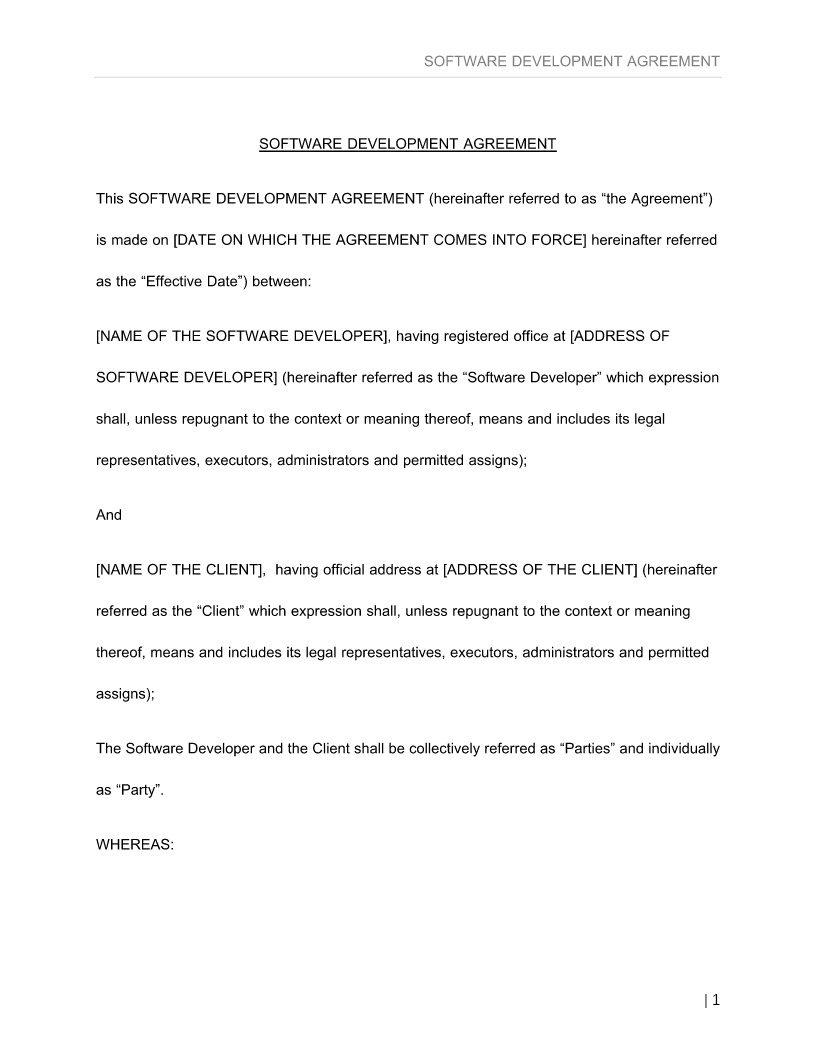
SOFTWARE DEVELOPMENT AGREEMENT
How does it work?
1. Choose this template
Start by clicking on "Fill out the template"
2. Complete the document
Answer a few questions and your document is created automatically.
3. Save - Print
Your document is ready! You will receive it in Word and PDF formats. You will be able to modify it.
Software Development Agreement Template – Free, Lawyer-Drafted & Globally Compliant
Most software disputes happen because nobody clarified who owns the code, what happens if deadlines slip, or who bears risk when things go wrong.
A Software Development Agreement exists to reduce common legal risks in software development, such as ownership disputes, missed deadlines, and payment conflicts. It defines the legal and commercial framework for software creation before work begins, helping both parties avoid misunderstandings and costly disputes later.
This free Software Development Agreement template follows commonly accepted principles under contract law and intellectual property law, and can be adapted for cross-border use with appropriate governing law and project-specific review.
Quick Legal Summary (At a Glance)
- Software Development Agreements are legally binding contracts when properly drafted
- This template defines scope, IP ownership, milestones, and payment terms
- Enforceability depends on clarity of terms, governing law, and regulatory compliance
- Legal review is strongly advisable for complex, high-value, or cross-border projects
What Is a Software Development Agreement and When Do You Need One?
A Software Development Agreement is a legal contract between a client and a software developer (individual or company) that governs the development, delivery, and ownership of software, applications, or digital solutions.
You typically need a Software Development Agreement when:
- Building custom software or applications
- Hiring freelance developers or development agencies
- Outsourcing development to offshore or remote teams
- Protecting source code, IP rights, or confidential data
- Structuring milestone-based payments and delivery timelines
A well-drafted agreement clearly outlines:
- Project scope and technical specifications
- Development milestones and delivery timelines
- Intellectual property and source code ownership
- Payment structure and invoicing terms
- Confidentiality, data protection, and remedies for breach, commonly supported by a standalone NDA
This clarity protects both parties and provides a reliable reference if disputes arise.
Types of Software Development Agreements
This Software Development Agreement template can be adapted for various development arrangements:
- Custom Software Development Agreement: For bespoke software or internal systems
- Mobile or Web Application Development Agreement: For iOS, Android, or web-based applications
- Maintenance & Support Agreement: For ongoing updates, bug fixes, and support
- IT Services & Development Agreement: For broader technology or integration services
- Outsourced Development Agreement: For offshore teams or third-party agencies. Outsourcing development to overseas teams involves additional legal clauses and compliance considerations, jurisdictional risks, that often require careful legal review.
Each type may require tailored clauses depending on project complexity and jurisdiction.
Are Software Development Agreements Legally Enforceable Internationally?
Software Development Agreements are widely recognised under contract and intellectual property laws across jurisdictions. Enforceability depends on lawful purpose, clarity of obligations, governing law, and compliance with mandatory regulations such as data protection laws.
This template reflects general legal principles that may be adapted for cross-border use, subject to appropriate governing law selection and local legal review:
- United States: Governed by state contract law, copyright law, and software licensing principles
- United Kingdom & European Union: Enforced under contract law, with GDPR and digital compliance requirements
- United Arab Emirates & Saudi Arabia: Recognised under civil and commercial law frameworks
- Australia & Canada: Supported by contract and IP laws, focusing on transparency and performance
- Hong Kong: Governed by common law and software IP protections under the Copyright Ordinance
Courts assess these agreements based on clarity, fairness, compliance, and actual implementation.
Why a Lawyer-Drafted Software Development Agreement Matters
While generic online templates exist, templates drafted by legal professionals generally offer clearer structure and reduced ambiguity compared to generic online templates.
- Clear Scope and Deliverables: Minimises scope creep and performance disputes.
- Strong IP and Source Code Protection: Defines ownership, licensing, and reuse rights clearly.
- Payment and Milestone Clarity: Reduces disputes over invoices, delays, and acceptance.
- Regulatory Awareness: Allows adaptation for data protection, open-source licensing, and cross-border compliance.
For higher-risk projects, legal review significantly reduces long-term exposure.
When You Should Definitely Consult a Lawyer
This Software Development Agreement template is suitable for many standard development projects. However, legal advice is strongly recommended if your project involves:
- High-value or long-term software development contracts
- Complex intellectual property ownership, licensing, or source-code escrow arrangements
- Cross-border or offshore development teams across multiple jurisdictions
- Handling of sensitive data, personal information, or regulated data (e.g., fintech, healthtech, SaaS)
- Use of open-source software, third-party APIs, or proprietary integrations
- Milestone-based payments with strict delivery, penalty, or termination clauses
- Custom warranties, indemnities, or limitation-of-liability provisions
In such cases, having the agreement reviewed or customised by a legal professional help reduce the risk of IP disputes, compliance failures, and costly project delays.
When This Software Development Agreement Template May Not Be Enough
This template works well for many standard development projects.
However, legal advice is strongly recommended if your project involves:
- High-value or long-term development contracts
- Complex IP licensing or SaaS models
- Open-source or third-party software dependencies
- Cross-border data transfers or sensitive user data
- Regulated industries such as fintech, healthtech, or AI
In such cases, professional customisation ensures the agreement is properly aligned with your business model, jurisdiction, and risk profile.
Want This Software Development Agreement Reviewed or Customised by a Lawyer?
If your software project involves high-value development, complex IP ownership, SaaS or licensing models, sensitive data, milestone-based payments, or cross-border teams, a standard template may not be sufficient, a SolvLegal lawyers can review and customise this Software Development Agreement to align with your technology stack, jurisdiction, and commercial risk profile.
Common Mistakes People Make With Software Development Agreements
Many software disputes do not arise from bad intent, but from avoidable drafting and execution mistakes, such as:
- Using vague or incomplete scope descriptions that lead to scope creep
- Failing to clearly define ownership of source code and intellectual property
- Assuming milestone payments alone protect against delays or non-delivery
- Ignoring confidentiality, data protection, or security obligations
- Overlooking open-source software and third-party licensing risks
- Missing governing law, jurisdiction, or dispute-resolution clauses
- Copy-pasting generic online templates without adapting them to the project
Understanding these risks helps ensure Software Development Agreements are used correctly, reduce misunderstandings, and protect both parties throughout the development lifecycle.
Who Should Use This Software Development Agreement Template?
This template is commonly used by:
- Software development companies and freelance developers
- Startups building apps, platforms, or SaaS products
- Businesses outsourcing development work
- Agencies hiring contract developers
- Corporations formalising internal development projects
It provides a reliable starting point for structuring software engagements.
How to Use This Software Development Agreement Template Safely
Step-by-Step
- Click Fill Out the Template
- Enter client and developer details
- Define scope, milestones, timelines, and payment terms
- Specify IP ownership and licensing structure
- Select the governing law and jurisdiction
- Review the agreement for project-specific risks
- Download in Word or PDF format
- Sign electronically or physically, as permitted by law
Electronic signatures are generally recognised under ESIGN (U.S.), eIDAS (EU), and similar laws worldwide.
Frequently Asked Questions (FAQs)
Is this Software Development Agreement valid internationally?
Yes. This Software Development Agreement is based on widely accepted contract and intellectual property principles. With the correct governing law selection and jurisdiction-specific adjustments, it can be adapted for international projects.
Does it address ownership of source code and intellectual property (IP)?
Yes. The agreement clearly defines who owns the source code and intellectual property, whether through full ownership transfer, licensing, or work-for-hire arrangements. This helps avoid disputes and protects long-term business interests.
Can it be used for offshore or remote development teams?
Yes. The template is well-suited for offshore and remote development, including cross-border collaborations. It can be customised to address communication, timelines, jurisdiction, and data security requirements.
Are Agile or milestone-based projects supported?
Yes. The agreement allows flexible structuring of scope and deliverables, making it suitable for Agile sprints, milestone-based development, or traditional Waterfall models. This helps align payments and timelines with actual project progress.
Does it cover confidentiality and data protection obligations?
Yes. The agreement includes strong confidentiality and data protection clauses to safeguard sensitive business information, source code, and client data. These provisions can also be tailored to meet GDPR or other data protection requirements.
Download the Software Development Agreement Template
Protect your software project with a free, lawyer-drafted Software Development Agreement template that provides a clear, adaptable framework for defining scope, deliverables, intellectual property rights, timelines, and payment terms in everyday commercial and technology-driven projects.
