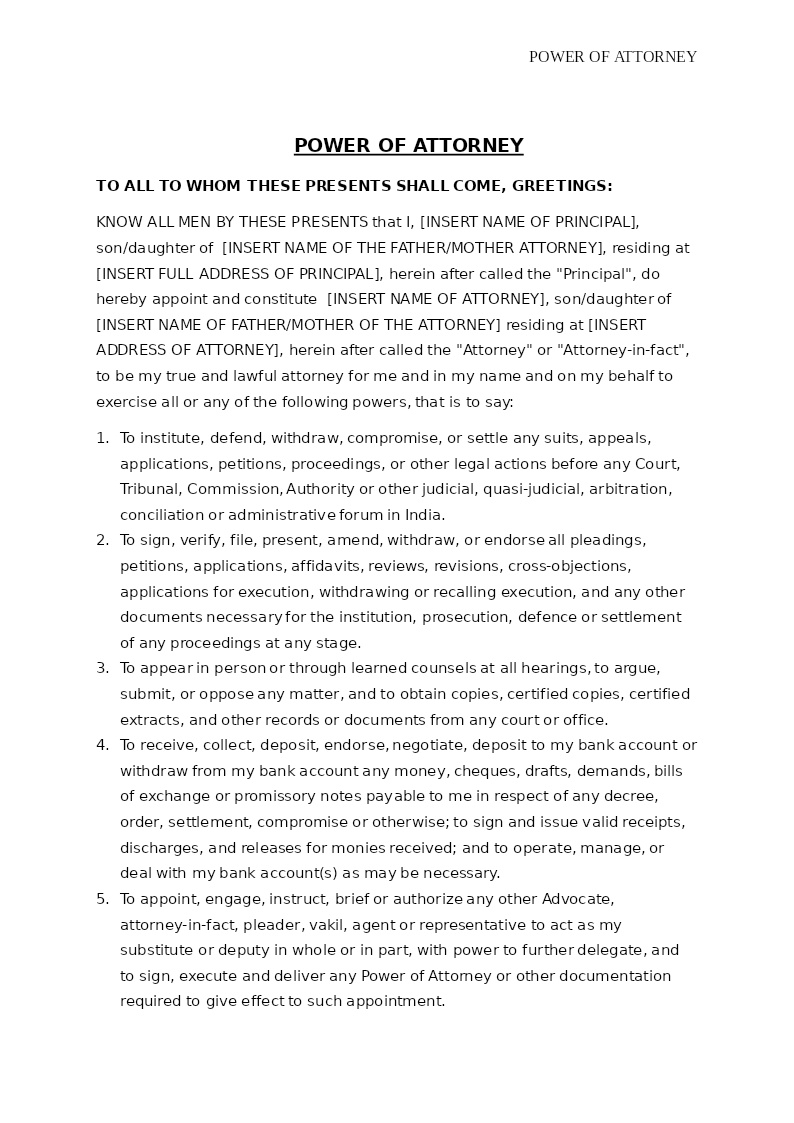
POWER OF ATTORNEY
How does it work?
1. Choose this template
Start by clicking on "Fill out the template"
2. Complete the document
Answer a few questions and your document is created automatically.
3. Save - Print
Your document is ready! You will receive it in Word and PDF formats. You will be able to modify it.
Lawyer-Drafted | Globally Compliant | Customizable in Word/PDF
Most property and financial disputes arise because someone acted without valid legal authority, relying on expired, unregistered, or informal permissions that were never legally enforceable.
Unregistered powers, vague authority, expired mandates, or improperly executed documents often result in invalid transactions, delayed registrations, rejected bank instructions, or costly legal challenges.
A Power of Attorney exists to prevent these issues before they arise. It creates a clear, legally enforceable framework allowing one person to act on behalf of another, while defining limits, duration, and responsibility.
This Power of Attorney template provides a general legal framework for delegating authority and can be adapted across jurisdictions with appropriate governing law clauses and local legal review.
Quick Legal Summary (At a Glance)
- Power of Attorney documents are legally binding when properly executed
- Authorizes another person to act on your behalf within defined limits
- Can be general, specific, durable, medical, or time-bound
- Registration may be mandatory for property-related transactions
- Strongly recommended for NRIs, property owners, business owners, and seniors
What Is a Power of Attorney and When Do You Need One?
A Power of Attorney is a legal document through which one person (the Principal) authorizes another person (the Attorney or Agent) to act on their behalf in legal, financial, property, medical, or administrative matters.
You typically need a Power of Attorney when:
- You are unable to be physically present to complete transactions
- You live abroad and require representation in another jurisdiction
- You want someone to manage property, banking, or legal affairs
- You anticipate illness, incapacity, or long-term absence
- You wish to delegate authority while retaining ownership
A well-drafted Power of Attorney clearly defines:
- The scope of authority granted
- The duration and validity of the authority
- Conditions for revocation or expiry
- Governing law and jurisdiction
- Safeguards to prevent misuse
Proper documentation reduces uncertainty, prevents misuse, and ensures legal recognition by courts, banks, and authorities.
Types of Power of Attorney Arrangements
This Power of Attorney template can be adapted for different delegation needs, subject to applicable law:
- General Power of Attorney: Broad authority over financial, legal, and administrative matters
- Special or Specific Power of Attorney: Authority limited to a defined task or transaction
- Durable Power of Attorney: Continues to remain valid even if the Principal becomes incapacitated
- Medical Power of Attorney: Authority limited to healthcare and medical decisions
- Limited or Time-Bound Power of Attorney: Authority valid for a specific period or purpose
Each arrangement carries different legal consequences and may require jurisdiction-specific customization.
Are Powers of Attorney Legally Enforceable Internationally?
Powers of Attorney are widely recognized across jurisdictions under principles of contract, agency, and civil law, provided they are executed voluntarily, grant clear authority, and comply with applicable execution, notarization, and registration requirements.
This Power of Attorney template follows commonly accepted legal principles and can be adapted for cross-border use with appropriate governing law clauses and jurisdiction-specific legal review. Individuals using Powers of Attorney for international or cross-border matters should also be aware of local formalities, including consular attestation, stamping, translation, and registration requirements, which may vary significantly between jurisdictions.
- United States: Governed primarily by state law; enforceability depends on compliance with state-specific statutes, with durable powers requiring express language to remain valid upon incapacity.
- United Kingdom & European Union: Enforceable under common law and statutory frameworks, with particular emphasis on mental capacity, voluntariness, and clearly defined authority.
- United Arab Emirates & Saudi Arabia: Recognized under civil and Sharia law principles; notarization, consular attestation, and Arabic translation are commonly required.
- Australia & Canada: Enforceable under state or provincial legislation, with additional registration requirements for real estate or enduring powers.
- India & Southeast Asia: Recognized under contract and agency law; written Powers of Attorney are strongly recommended, with registration mandatory for property-related matters.
Across jurisdictions, capacity of the Principal, clarity of authority granted, and proper execution are central to the enforceability of a Power of Attorney.
Why a Lawyer-Drafted Power of Attorney Offers Better Protection
Generic or copied Power of Attorney formats often fail to address real-world legal risks.
Power of Attorney templates drafted by legal professionals generally provide:
- Clear limitation of authority to prevent abuse
- Proper durability and revocation mechanisms
- Jurisdiction-compliant execution requirements
- Enforceability before registrars, courts, and banks
- Reduced risk of transaction rejection or dispute
In many cases, small drafting errors can invalidate an entire transaction.
When You Should Definitely Consult a Lawyer
This template is suitable for many standard delegation needs.
However, legal advice is strongly recommended if:
- Property or immovable assets are involved
- The Power of Attorney is executed outside the country of use
- Authority granted is broad or long-term
- Medical or incapacity planning is involved
- Multiple attorneys are appointed
- High-value or business transactions are contemplated
Preventive legal review is significantly cheaper than correcting invalid authority later.
When This Power of Attorney Template May Not Be Enough
This template works well for straightforward delegation.
However, legal customization is recommended if the arrangement involves:
- Cross-border property or inheritance matters
- Corporate or commercial signing authority
- Ongoing management of substantial assets
- Regulatory or court-sensitive transactions
- Risk of dispute among family members or stakeholders
In such cases, tailored drafting helps ensure enforceability and risk mitigation.
Want This Power of Attorney Reviewed or Customised by a Lawyer?
If your situation involves property transactions, cross-border authority, medical decision-making, or long-term delegation, a SolvLegal lawyer can review and customise this Power of Attorney to reflect your specific authority limits, execution requirements, and jurisdictional rules.
Common Mistakes People Make With Power of Attorney Documents
Many disputes arise from avoidable errors, including:
- Granting overly broad or vague authority
- Failing to register POAs for property transactions
- Using expired or improperly executed documents
- Ignoring revocation procedures
- Assuming scanned or informal authorizations are sufficient
- Copy-pasting generic templates without legal review
Understanding these risks helps ensure Powers of Attorney are used safely and effectively.
How to Use This Power of Attorney Template Safely
Step-by-Step
- Click Fill Out the Template
- Enter the details of the Principal and the Attorney
- Clearly define the powers granted, limitations, and duration
- Customize governing law, place of execution, and revocation terms
- Review the document to ensure compliance with local notarization and registration requirements
- Download the Power of Attorney in Word or PDF format
- Execute the document and complete notarization or registration as required by law
Electronic signatures may be accepted for limited purposes, but physical execution is typically required for property and court-related matters.
Frequently Asked Questions (FAQs)
Is a Power of Attorney legally binding?
Yes. A Power of Attorney is legally binding once it is properly executed by a competent Principal and complies with applicable laws. Courts, banks, and authorities generally recognize it as valid proof of delegated authority when execution requirements are met.
Does a Power of Attorney require registration?
Registration is mandatory for Powers of Attorney involving immovable property or real estate transactions. For general, administrative, or financial purposes, notarization is usually sufficient, though local requirements may vary.
Can a Power of Attorney be revoked?
Yes. A Power of Attorney can be revoked at any time by the Principal through a written revocation, provided the Principal has legal capacity. The revocation should be communicated to the Attorney and relevant third parties to avoid misuse.
What happens if the Principal becomes incapacitated?
A regular Power of Attorney generally becomes invalid if the Principal becomes incapacitated. Only a Durable Power of Attorney, which specifically states continued validity, remains enforceable in such circumstances.
Can a Power of Attorney be executed abroad?
Yes. A Power of Attorney can be executed outside the country of use, provided it is notarized or attested by a consulate and later stamped or adjudicated as required under local law.
Download the Power of Attorney Template
Delegate authority safely, reduce legal risk, and ensure enforceability with a lawyer-drafted Power of Attorney template designed for real-world use and cross-border recognition.
