Adding a Crypto Wallet to Your App? 12 Legal Questions to Answer before Launch
Read More
Launching a Web3 or dApp Product: Legal, Regulatory & Compliance Checklist for Founders
By the SolvLegal Team
Published on: Oct. 21, 2026, 6:12 p.m.
Quick Answer
Review a Web3 launch from the product outward. Before going live, map the user journey, money and digital-asset flows, control over key functions, personal-data processing, third parties and target markets. Those facts shape the legal analysis.
A label such as “dApp”, “utility token”, “DAO” or “non-custodial wallet” is not a legal conclusion. The same product can raise different issues across markets. This checklist identifies likely workstreams, not universal legal clearance.
1. Start With the Product Architecture, Not the Legal Label
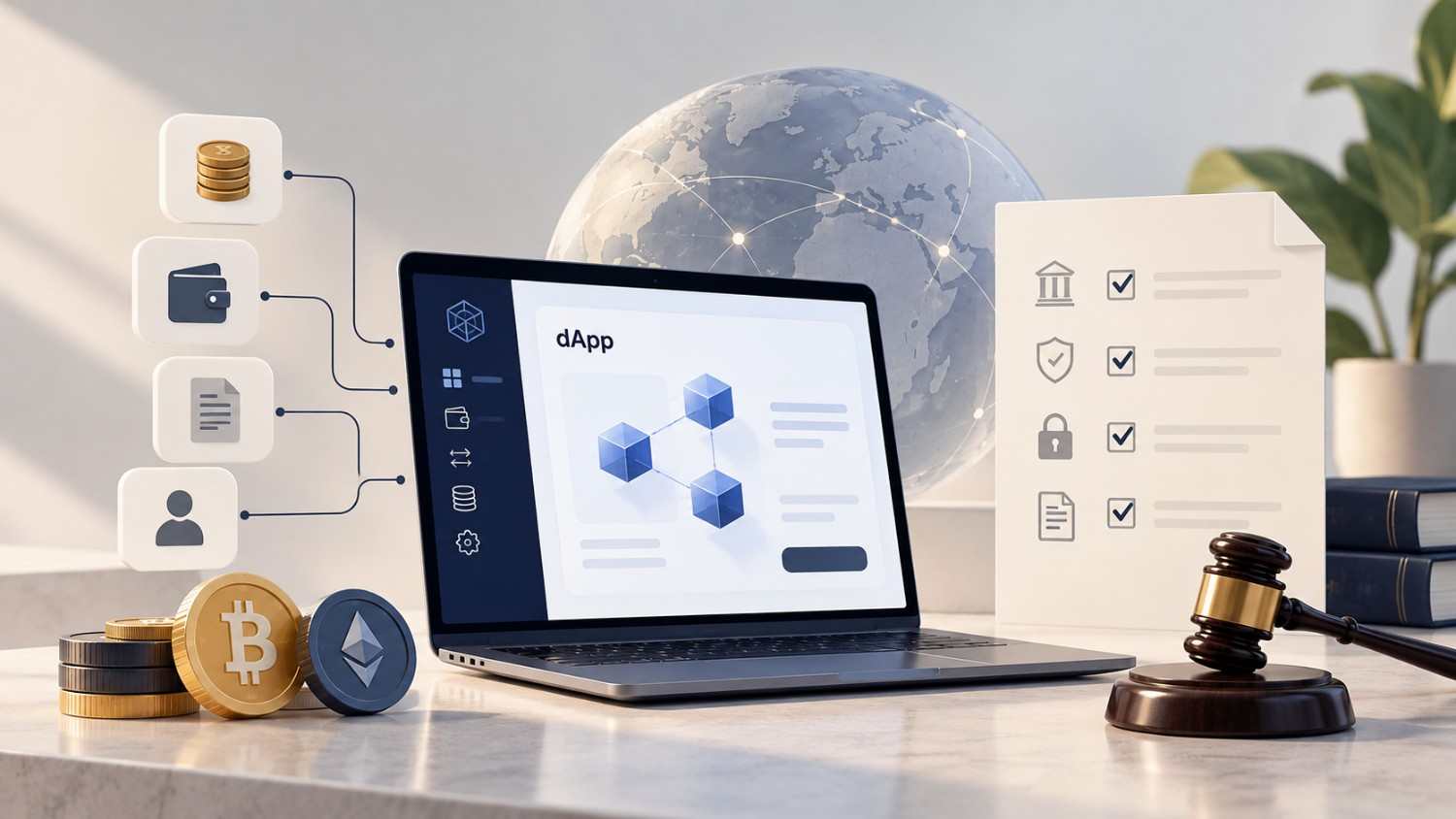
Begin with an architecture map that the product team and legal counsel can both follow. A decentralised application often combines a smart contract with a frontend. The frontend, hosting, data indexing, wallet connection and transaction routing may still depend on centralised providers. The map should show those dependencies, not just the contract deployed on-chain. [1]
Map at least seven things:
· Product function: what users can actually do, including swaps, staking, gaming, payments, minting, lending, governance or access to a service.
· Users: retail users, businesses, developers, liquidity providers, creators, minors, and users who connect from different countries.
· Money and digital assets: fiat on-ramp, token purchase, fees, rewards, NFT minting, marketplace sale, treasury allocation and withdrawal to an external wallet.
· Personal data: wallet address, email, device IDs, analytics, identity verification, support tickets, transaction metadata and off-chain profile data.
· Technology and vendors: blockchain, smart contracts, administrator keys, multisignature wallet, bridge, oracle, RPC provider, indexer, cloud host, analytics SDK, wallet provider and marketplace.
· Jurisdictions: where the entity is based, where teams operate, which countries are actively targeted and where intermediaries are located.
· Monetisation: transaction fees, subscriptions, token sales, spread, staking fees, marketplace commissions, advertising, royalties or treasury income.
Consider a game that moves from fiat payment to token, gameplay, an NFT reward, marketplace resale and withdrawal to an external wallet. That flow can raise token, wallet, consumer, gaming and privacy questions across several legal regimes.
2. Who Controls the “Decentralised” Product?
Technical decentralisation and legal accountability are different questions. A protocol can use a public network while one company controls the interface, upgrades, treasury or customer relationship. Review hosting and support arrangements. [2]
Identify who upgrades contracts, holds administrator or multisignature keys, pauses transactions, controls the treasury, changes fees and manages the brand. Compare governance documents with the code and user disclosures.
A DAO does not automatically remove liability. The answer depends on jurisdiction, structure, participants and activity. In the United States, the economic arrangement and reliance on a promoter’s efforts can matter more than a decentralised label. [3] The SEC and CFTC issued an updated interpretation in 2026. [4] SEC staff FAQs published in September 2026 are nonbinding staff views. [5]
Record who can move funds, change code, receive revenue, sign terms and handle incidents. Do not assume a DAO is a legal entity or cannot be associated with one.
3. Classify Tokens and Digital Assets by What They Do
Do not begin and end with “utility token”. Map transferability, redemption, service access, voting rights, staking or revenue exposure, secondary trading and issuer promises. Review distribution and marketing as well. Technical token standards describe interfaces, not legal classification. [6]
The Markets in Crypto-Assets Regulation (MiCA) governs specified crypto-asset offers, admissions to trading and services in the EU. It distinguishes asset-referenced tokens, e-money tokens and other crypto-assets. It does not replace the regime for financial instruments, and it does not apply identically to every NFT or blockchain application. Check the scope and exclusions in Article 2 and Article 3 before classifying an asset.
A qualifying public offer may require a white paper, notification and compliant marketing. Authorisation may be required for specified services, not every developer. The transitional period under Article 143(3) ended no later than 1 July 2026, with some Member States applying shorter periods. Any proposed EU crypto-asset service should therefore be assessed against the authorisation requirements currently applicable in the relevant Member State, including available exclusions or exemptions under Articles 4 to 15 and the authorisation requirements under Article 59.
In the United Kingdom, distinguish the rules already in force from the incoming authorisation regime. The financial-promotion regime applies to qualifying cryptoasset promotions to UK consumers, including promotions by overseas firms. A website, app, social post or advertisement can be a financial promotion. The relevant restrictions include section 21 of the Financial Services and Markets Act 2000. The FCA’s current guidance explains the permitted communication routes, risk warnings and positive friction. [7]
Separately, the FCA published final cryptoasset perimeter guidance on 16 September 2026. The new regulated-activities regime is scheduled to take effect on 25 October 2027. Applications are being accepted from 30 September 2026 through 28 February 2027. As at 15 October 2026, the new regime has not fully commenced, and existing permissions or registrations should not be assumed to convert automatically. [8]
In the United States, securities analysis depends on the asset and transaction. The question is whether the arrangement is an investment contract, assessed in light of its economic realities and the efforts on which purchasers rely. [9] The 2026 SEC and CFTC interpretation does not remove the need to examine the product, promises, distribution and market conduct. [10]
For India-facing launches, review tax treatment of virtual digital assets and whether the service falls within the reporting-entity framework under the Prevention of Money-laundering Act, 2002. Start with the current VDA tax material and FIU-IND guidance for VDA service providers. [11] Tax treatment of virtual digital assets and compliance with applicable FIU-IND requirements should not be treated as a general licence or approval to conduct every crypto-related activity in India. The legality and regulatory treatment of each service must be assessed separately.
4. Wallet Architecture: Custodial or Non-Custodial?
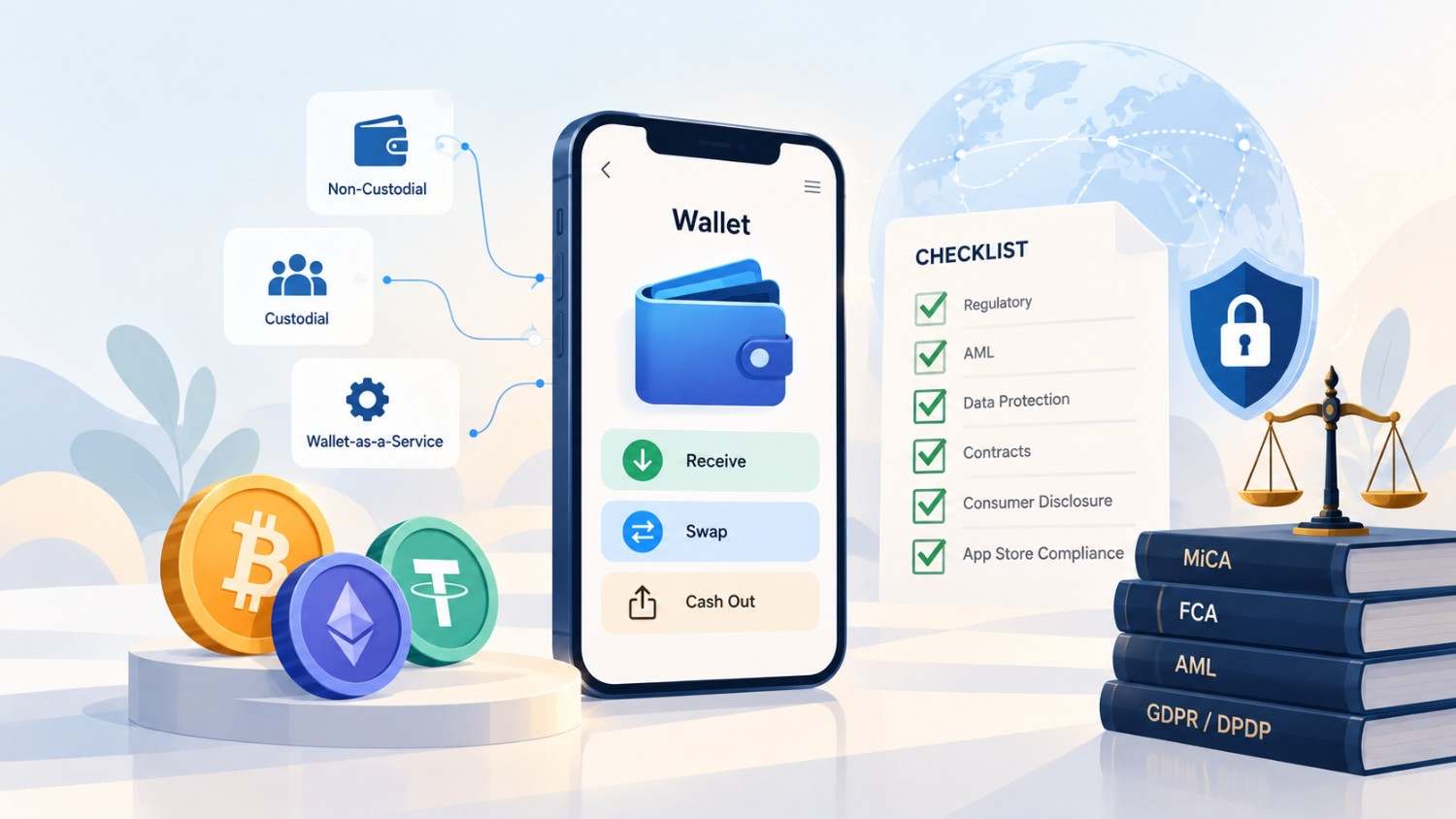
A wallet label says less than the workflow. Establish who generates and stores private keys, who can initiate or sign transactions, whether the business can freeze or block a transaction, whether recovery is available, and whether staff or vendors have access to keys. If the product supports buying, selling, swaps, bridges, staking, transfers, hosted balances or third-party payments, document each service separately.
A user may hold a key but still rely on a business to route transactions, recover access, execute trades, operate a marketplace or collect fees. Those functions can matter under custody, financial-services or AML rules. MiCA lists specified services, including custody, trading, exchange and transfer on behalf of clients. See Article 3(1)(16) and Article 59. “Non-custodial” does not resolve the question.
Prepare a wallet diagram showing key control, signing, routing, recovery, providers and intervention points. Match it to the live product and support workflow, including who can upgrade a contract, recover an account or pause transactions.
5. AML, KYC and Sanctions: Test the Activity Before Adding Controls
Not every dApp must perform identity verification. Determine whether the entity carries on an activity that triggers due diligence, monitoring, recordkeeping, reporting, registration or sanctions duties, then identify which service creates the exposure and who owns it.
In the United States, the Financial Crimes Enforcement Network distinguishes a user who obtains convertible virtual currency to buy goods or services from a business that accepts and transmits it, or exchanges it as a business. The outcome turns on the actual model and any applicable limitation or exemption. It should not be reduced to a rule that every smart-contract developer or software provider is a money transmitter. [12]
In the EU, review crypto-asset service provider duties and the Transfer of Funds Regulation (EU) 2023/1113, including its Article 14 information requirements for covered transfers. These duties are activity-specific. FATF standards operate through domestic law. Its July 2026 updates on VASP implementation and DeFi identify continuing implementation gaps and emphasise a functional assessment of control. Local rules still need checking. [13]
Sanctions need a separate assessment. US sanctions can apply to virtual-currency transactions. Screening, escalation, geographic restrictions and records may be appropriate, but controls should match the legal duties and risk profile. No specific tool is universally required. [14]
Document why each KYC or sanctions control is required, what triggers it, what data it collects, how false positives are handled and who escalates decisions. Unnecessary identity collection adds cost and privacy risk.
6. Privacy, GDPR and Blockchain
This review should begin during architecture design. Blockchain data may be replicated across nodes and difficult to alter after publication. A wallet address or public key can be personal data where it relates to an identifiable person, directly or through other information. Transaction records, metadata, IP addresses, analytics identifiers and off-chain profiles may also form part of the data picture.
Final EU guidance published on 7 July 2026 addresses blockchain architecture, accountability, data protection by design, minimisation, storage limitation, rectification, erasure, impact assessments and international transfers. It should be a primary starting point for a GDPR review of a blockchain product. [15]
Test the architecture against the General Data Protection Regulation (GDPR), including its principles in Article 5, erasure right in Article 17, privacy by design in Article 25, and DPIA requirement in Article 35. Cross-border transfers require review under Articles 44 to 49. A DPIA is required where processing is likely to result in high risk. Roles depend on what each party actually does.
Keep personal information off-chain where possible. A hash, encrypted payload or pointer does not automatically make data anonymous. Test identifiability, document alternatives, and plan for rights requests, retention and transfers. Research also identifies tension between blockchain architecture and data protection duties. [16]
For an India-facing product, review the Digital Personal Data Protection Act, 2023 and the notified Digital Personal Data Protection Rules, 2025, including the applicable commencement and enforcement timeline. Do not assume every provision commenced at the same time. Confirm which obligations are in force on the launch date and whether another data-protection regime applies because of the target market.
Ask what data must be public and persistent. If on-chain personal data is necessary, document why alternatives will not work and test rights handling before deployment.
7. Smart Contracts Are Also a Legal-Risk Surface
Smart contracts execute instructions on a blockchain. Some can be upgraded; others are designed to be immutable. Oracles supply external information, while bridges move value or messages between networks. Each dependency can fail. A transaction may rely on code and external data that the contract cannot verify on its own. [17]
Check who can upgrade the contract, change multisignature thresholds, pause operations, select oracles and respond to a bridge failure. Upgrade mechanisms can help repair defects, but also create control and governance risks. [18] The ability to pause a protocol or upgrade a smart contract does not necessarily confer the ability to transfer or seize users' assets. These permissions should be examined separately. Similarly, transaction confirmation and finality are not identical across all blockchain networks.
Security reviews should examine access control, business logic, oracle manipulation, input validation, re-entrancy and upgradeability. Current technical guidance identifies these as important risk areas. [19] Recent research maps known vulnerabilities, detection tools and gaps in available benchmarks. Automated scans and audits can still miss risks where code, incentives, governance and external services interact. [20]
Record code ownership, audit scope, open findings, deployed addresses, key holders, upgrade approvals, pause controls and incident response. An audit cannot guarantee against exploits or later changes.
The terms must match deployed logic. Explain fees, transaction finality, upgrade and pause powers, third-party dependencies, support limits and remedies. The legal position depends on governing law and the arrangement. In England and Wales, existing legal principles can support smart legal contracts, although some arrangements may raise new issues. This is not a global rule that code overrides contract law. [21]
8. Consumer Protection and the Full User Journey
Review each screen before wallet connection, transaction signing and payment. Users should understand the product, price, network fee, recurring charge, token or NFT rights, risks, cancellation and support. Disclosures should appear where they matter. Long terms may not cure a misleading or confusing screen.
A transaction may be difficult to reverse at protocol level, but the business may still have duties about the service, misleading statements, unfair terms, refunds and complaints. In the UK, the Consumer Rights Act 2015 includes digital-content rights in section 34, section 35 and section 36. Service contracts may raise separate issues under the Act. In the EU, Directive (EU) 2019/770 addresses conformity and remedies for digital content and digital services, subject to its scope and national implementation. See, for example, Article 14 on remedies.
Check subscriptions, rewards, failed mints, duplicate charges, outages and lost access. Keep the Terms consistent with screens and code. App-store and marketplace rules are contractual unless they reflect a legal obligation.
9. IP, Code and Digital Assets
Web3 products may combine employee and contractor code, open-source software, APIs, art, music, game assets, metadata, trademarks and user content. Confirm ownership, written assignments and licence obligations, including attribution or source-disclosure conditions. A token sale does not cure missing rights in linked content.
Ownership of an NFT does not, by itself, transfer copyright in the linked artwork, music, game asset or other work. The underlying rights depend on copyright law and the actual sale terms or licence. The licence should specify personal or commercial use, sublicensing, display or adaptation rights, resale consequences and third-party material. US copyright authorities have specifically distinguished ownership of a token from ownership of rights in the associated work. [22]
Keep a rights record for code, design, brand, content, music, metadata, open-source dependencies and user submissions. If users can mint or upload content, terms should explain the platform licence, retained user rights, infringement reporting and content removal.
10. Children, Gaming and Gamified Products
For games, loot boxes, virtual items or tokenised prizes, review age, purchase mechanics, randomisation, prize value, cash-out, resale and marketing. Treatment depends on mechanics and market. Do not assume every loot box is gambling or that virtual prizes can never raise that question. In the UK, assess the facts against section 6 of the Gambling Act 2005; policy has also stressed cash-out and player protection. [23]
If children may use the service, review age assurance, consent, profiling, advertising and in-game purchases. UK guidance for online services likely to be accessed by children covers privacy defaults, data sharing and nudge techniques. [24] In the United States, assess whether the Children’s Online Privacy Protection Act (COPPA) applies. Age gates and parental controls need market-specific review.
11. Marketing, Influencers and Financial Promotions
Marketing can create exposure even where the code itself is unchanged. Review the website, token page, app prompts, influencer scripts, referral scheme and investor materials together. Avoid unsupported claims about guaranteed returns, capital protection, regulatory approval or absence of risk. Tokenomics, roadmaps and founder statements should be checked against the actual product and any promises made to purchasers.
For UK consumers, verify the communication route before a qualifying cryptoasset promotion goes live. The technology-neutral regime can cover websites, apps, social media and advertising, including overseas firms. Review risk warnings, prominence, approval and the full consumer journey. [25]
In the United States, endorsements should be truthful and disclose material connections. Compensation may include money, free assets, token allocations or another benefit. A disclosure hidden in a profile may not be adequate. [26] Record the claim, evidence, audience, risk warning, compensation and approver. Re-review promotions when the product changes.
12. Cross-Border Launch: “Available Globally” Is Not a Legal Strategy
A globally accessible website does not mean every feature can lawfully be offered everywhere. Build a jurisdiction matrix covering entity, target markets, user base, asset, regulated functions, wallet control, data, marketing, consumer features and vendors.
For each market, identify regulators, authorisation triggers, AML and sanctions duties, privacy, consumer, IP and tax rules, and an owner for verification. Separate current rules from future commencement dates.
Phased launches, geoblocking and feature limits can help, but they must work technically and match the user journey. A disclaimer may not undo active targeting or a regulated service. Obtain advice from counsel qualified in each relevant market.
13. Documents and Controls to Prepare Before Launch
No document bundle fits every dApp. Select documents based on product functions, business model and target markets. Common workstreams include:
· Terms of Use or Terms of Service, with product-specific rules for accounts, wallet connection, fees, transactions, upgrades, pauses, outages, complaints and termination.
· Privacy notice, cookie and SDK disclosures, consent interfaces where required, retention rules and a record of personal-data flows.
· Data-processing and vendor agreements, including roles, security, breach reporting, assistance with rights requests and cross-border data arrangements.
· Founder, employee and contractor IP assignments; open-source inventory; code, content, art, brand and third-party licence records.
· Development, cloud, oracle, bridge, wallet, marketplace and security-audit contracts, with service levels, incident duties, IP ownership and liability allocation.
· Token or NFT disclosures, white paper or offering documents where applicable, and clear terms for redemption, transfer, governance, rewards and user rights.
· Marketing and influencer review, with evidence for claims, financial-promotion routes and material-connection disclosures.
· Smart-contract security evidence, deployed contract addresses, key-control records, upgrade approvals, unresolved audit findings and incident response procedures.
· A jurisdiction matrix, risk register, internal approval record, escalation contacts and a named owner for ongoing compliance.
Documents must match the live product. Verify pause powers, NFT licences and any “non-custodial” claim against the actual wallet and support workflow. Record unresolved assumptions and assign an owner to each one.
14. Product Counsel Does Not End at Launch
A new token feature, bridge, marketplace, analytics SDK, governance process or target country can change the risk. Review should continue throughout development.
Set review triggers for new features, markets, vendors, upgrades, key-control changes, campaigns, privacy requests, complaints, incidents and product sunset. Record the change, affected assumptions and approver.
Version the terms, disclosures and token documents. Record deployed contract versions, open audit findings and enabled markets. This links the design to the live product.
15. Founder’s Pre-Launch Checklist
Before launch, the product owner and legal reviewer should be able to answer each of these questions:
· Can we draw the complete user journey and the money, token and data flows?
· Who controls the interface, smart contracts, administrator keys, treasury and upgrades?
· What rights and economic functions does each token or digital asset carry?
· Does any wallet or asset feature involve custody, exchange, transfer, intermediation or another potentially regulated service?
· What personal data is written on-chain and off-chain? Have we assessed minimisation, erasure, international transfers and whether a DPIA is needed?
· Which countries are we actively targeting? Are specific features or promotions restricted there?
· Do the terms, privacy notice, user screens and marketing claims match the code and actual workflow?
· Do we own or validly license every material part of the code, content, brand and contractor-created IP?
· What happens if a contract, wallet, oracle, bridge, cloud provider or marketplace fails?
· Who owns compliance monitoring, incident escalation and legal review after launch?
16. Frequently Asked Questions
1. Does a decentralised app need a legal entity?
The answer depends on jurisdiction and function. Decentralisation does not remove questions about contracting, ownership, tax, accountability or governance. Identify who controls the interface, assets, fees and user or vendor contracts.
2. Is a utility token unregulated?
No blanket answer is safe. Rights, economic functions, transferability, marketing and issuer involvement matter. The EU Markets in Crypto-Assets Regulation (MiCA), US securities law, the UK financial-promotion restriction in section 21 of the Financial Services and Markets Act 2000, and local law use different tests. “Utility” is not a legal conclusion.
3. Does a non-custodial wallet avoid regulation?
Not automatically. Key control matters, but so do routing, swaps, bridges, staking, fee collection, recovery, exchange functionality and third-party roles. Assess the complete service in each target jurisdiction.
4. Can personal data be stored on a blockchain under the GDPR?
There is no universal yes or no. Test the design against the General Data Protection Regulation (GDPR) and current European data-protection guidance. Avoid on-chain personal data where it conflicts with data protection principles. Document necessity, roles, rights handling, retention and alternatives. Hashing or encryption does not automatically resolve the issue.
5. Does an NFT automatically transfer copyright?
No. Ownership of the token does not, by itself, establish ownership of copyright in the linked artwork, music, game asset or other work. The governing licence or sale terms should specify which rights are granted, who may use the work, whether commercial use is allowed and what happens on resale.
6. What legal documents does a dApp need before launch?
The list depends on the product and markets. It may include terms, privacy disclosures, vendor agreements, IP assignments, token or NFT documents, marketing approvals, security evidence and incident procedures. Regulated services may require additional steps.
7. When should a Web3 startup involve Product Counsel?
During product design, before token rights, data placement, key control or target markets are hard to change. Early review allows design changes. Late review may identify problems after they are expensive to fix.
Related SolvLegal Resources
1. Technology Law & Data Privacy: technology transactions, digital platforms, privacy and data-driven operations.
2. Advanced & Emerging Technologies: blockchain, digital assets and other emerging technology issues.
3. Data Privacy & Data Protection: privacy governance and data-protection compliance.
4. Enterprise Technology: enterprise technology, cloud, APIs and related commercial arrangements.
5. Copyright: copyright protection and licensing questions for digital content.
6. Trademark: brand protection for platforms, tokens and digital products.
Regulatory Status Note
The principal legal and regulatory materials cited here were checked on 15 October 2026. The UK cryptoasset perimeter guidance is final, but its new regulated-activities regime is scheduled for 25 October 2027. The FCA cryptoasset financial-promotion regime is already in force. The final version of the EDPB blockchain guidelines was published on 7 July 2026. Re-check dates, commencement provisions and local implementation immediately before publication.
Author:
Gaurav Saxena is the Founding Partner of SolvLegal Law Offices LLP, with over 14 years of experience advising startups, technology companies, and global businesses on commercial, technology, intellectual property, and regulatory matters. He focuses on delivering practical, business-oriented legal solutions for companies operating in fast-evolving digital and cross-border environments.
Disclaimer
This article is for general information only. It is not legal advice and does not establish a lawyer-client relationship. The position depends on product function, structure, users, marketing and jurisdiction. Obtain product-specific advice before launch; specialist local counsel may be required for regulated activities.
[1] Ethereum Foundation, Decentralized Applications (dapps), Ethereum.org (last visited Oct. 15, 2026)
[3] Report of Investigation Pursuant to Section 21(a) of the Securities Exchange Act of 1934: The DAO, Exchange Act Release No. 81,207 (July 25, 2017)
[4] Application of the Federal Securities Laws to Certain Types of Crypto Assets and Certain Transactions Involving Crypto Assets, Securities Act Release No. 33-11412, Exchange Act Release No. 34-105020 (Mar. 17, 2026)
[5] Division of Corporation Finance, U.S. Securities & Exchange Commission, Frequently Asked Questions on the Application of the Federal Securities Laws to Certain Types of Crypto Assets and Certain Transactions Involving Crypto Assets (Sept. 25, 2026)
[6] Ethereum Foundation, ERC-20 Token Standard, Ethereum.org (last visited Oct. 15, 2026); Ethereum Foundation, ERC-721 Non-Fungible Token Standard, Ethereum.org (last visited Oct. 15, 2026)
[7] Financial Conduct Authority, Cryptoasset Firms Marketing to UK Consumers (last updated Feb. 6, 2026); Financial Conduct Authority, FG23/3: Finalised Non-Handbook Guidance on Cryptoasset Financial Promotions (Nov. 2, 2023)
[8] Financial Conduct Authority, PS26/18: Cryptoasset Perimeter Guidance (Sept. 16, 2026)
[9] SEC v. W.J. Howey Co., 328 U.S. 293, 298–99 (1946)
[10] Application of the Federal Securities Laws to Certain Types of Crypto Assets and Certain Transactions Involving Crypto Assets, Securities Act Release No. 33-11412, Exchange Act Release No. 34-105020 (Mar. 17, 2026)
[11] Income Tax Department, Government of India, Taxation of Virtual Digital Asset (VDA) (last visited Oct. 15, 2026); Financial Intelligence Unit-India, AML & CFT Guidelines for Reporting Entities Providing Services Related to Virtual Digital Assets (Jan. 8, 2026)
[12] Application of FinCEN's Regulations to Certain Business Models Involving Convertible Virtual Currencies, FIN-2019-G001 (May 9, 2019)
[13] Financial Action Task Force, Seventh Targeted Update on Implementation of the FATF Standards on Virtual Assets/VASPs (July 16, 2026); Financial Action Task Force, Targeted Report on Regulatory Challenges from Decentralised Finance (July 21, 2026)
[14] U.S. Dep't of the Treasury, Office of Foreign Assets Control, Sanctions Compliance Guidance for the Virtual Currency Industry (Oct. 15, 2021)
[15] European Data Protection Board, Guidelines 02/2025 on Processing of Personal Data Through Blockchain Technologies, Version 2.0 (July 7, 2026)
[16] Oluwafemi Akanfe, Diane Lawong & H. Raghav Rao, Blockchain Technology and Privacy Regulation: Reviewing Frictions and Synthesizing Opportunities, 76 Int'l J. Info. Mgmt. 102753 (2024)
[17] Dylan Yaga et al., Blockchain Technology Overview, NIST Interagency/Internal Report 8202 (Oct. 2018)
[18] Ethereum Foundation, Updating Smart Contracts, Ethereum.org (last visited Oct. 15, 2026)
[19] OWASP Foundation, Smart Contract Top 10: 2026 (2026)
[20] Gerardo Iuliano & Dario Di Nucci, Smart Contract Vulnerabilities, Tools, and Benchmarks: An Updated Systematic Literature Review, 236 J. Syst. & Software 112788 (2026)
[21] Law Commission, Smart Legal Contracts: Advice to Government (Nov. 25, 2021)
[22] U.S. Copyright Office & U.S. Patent & Trademark Office, Non-Fungible Tokens and Intellectual Property: A Report to Congress (Mar. 12, 2024)
[23] Department for Digital, Culture, Media & Sport, Government Response to the Call for Evidence on Loot Boxes in Video Games (July 2022)
[24] Information Commissioner's Office, Age Appropriate Design: A Code of Practice for Online Services (last visited Oct. 15, 2026)
[25] Financial Conduct Authority, Cryptoasset Firms Marketing to UK Consumers (last updated Feb. 6, 2026); Financial Conduct Authority, FG23/3: Finalised Non-Handbook Guidance on Cryptoasset Financial Promotions (Nov. 2, 2023)
[26] Federal Trade Commission, Guides Concerning the Use of Endorsements and Testimonials in Advertising, 88 Fed. Reg. 48,092 (July 26, 2023)

Related Articles
Leave a Comment