Master Service Agreements for IT Services in India: 10 Clauses Technology Companies Should Review Carefully
Read More
Penalty vs Liquidated Damages Clauses: What Is Enforceable in Contracts Globally
By the SolvLegal Team
Published on: Jan. 12, 2026, 1:25 p.m.
Introduction:
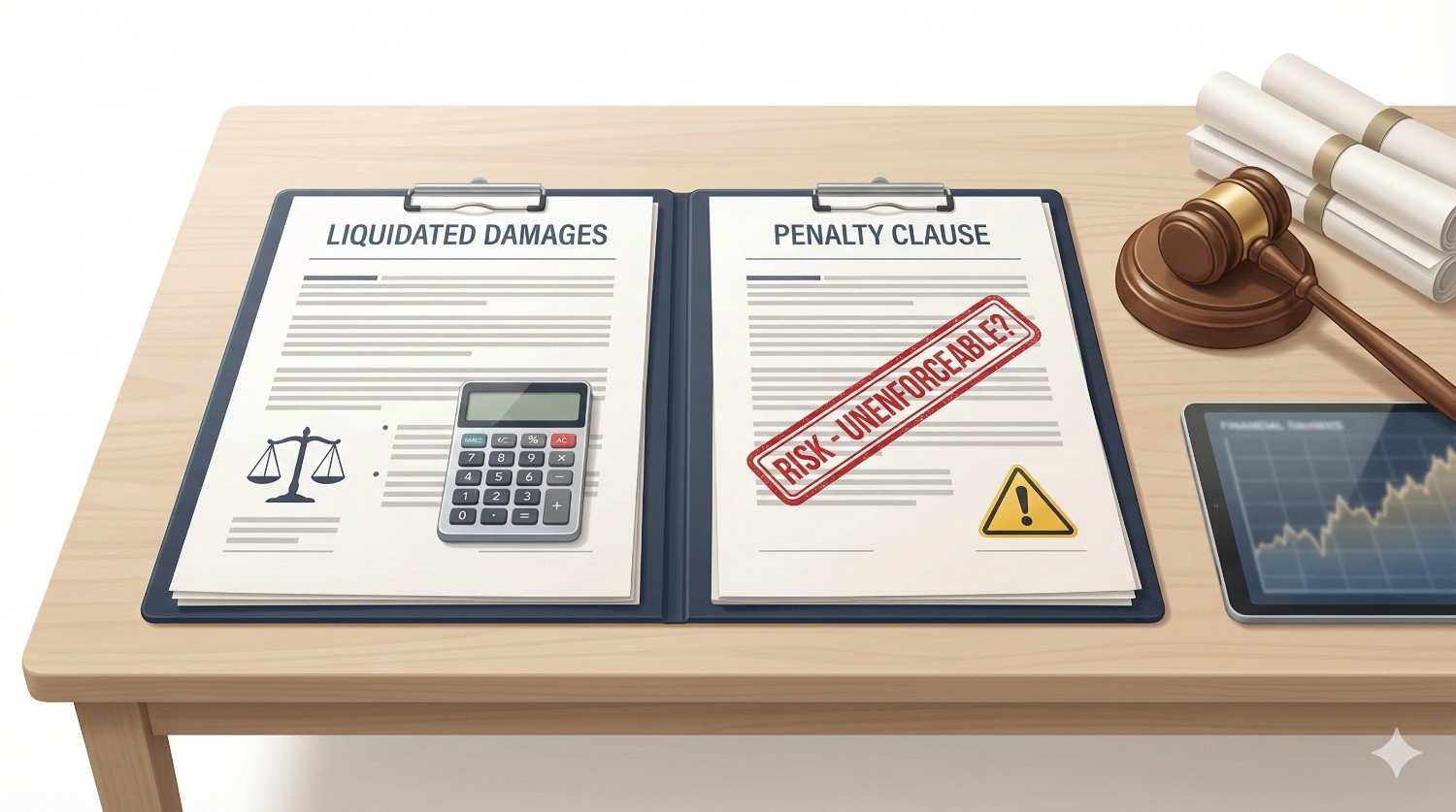
Why This Matters to Contracts Everywhere. In business contracts (construction, services, SaaS agreements, supply chains, joint venture, employment, etc.) parties usually desire to know what is to occur if a party of the deal gets into violation. Two common mechanisms are:
Liquidated Damages (LD): Compensation by agreement (in the event of breach).
Penalty Clauses: Agreed amounts which are aimed at punishing the offending party.
These two, however, are not interchangeable. The enforceability of these provisions in the world greatly differs depending on the jurisdictional laws. A wrongly drafted clause may leave your client or business without a contract or without one that is enforceable. It is an explanation of both concepts and the treatment of the two by the courts in the major jurisdictions and suggestions of the way you should write enforceable clauses in protecting contracts and minimizing disputes.
Penalty vs Liquidated Damages:
What Are Liquidated Damages?
Liquidated damages are an amount that has been agreed upon during the formation of the contract to estimate the amount of loss that a party is likely to incur if the other party violates the contract. This is not punishment, it is compensation, they are less litigious and faster. They come in handy when the real losses may prove to be difficult to determine in future. They are usually enforced by courts through reasonability and justification.
What Is a Penalty Clause?
A penalty agreement provides an amount of money that is not proportional to probable loss and is aimed at deterring violation or punishing the violating party instead of compensating. Stipulated to be punitive (in terrorem). Intended no longer as a true estimate of loss. Liquidated damages and penalty clauses are often incomparable, particularly common law.
Liquidated damages and penalty clauses serve different purposes, are not always enforceable, and are treated differently by the courts. Liquidated damages are meant to be compensatory whereas the parties in the contract are at the time agreeing over the genuine pre-estimate of loss. Since their purpose is to indemnify the non-breaching party, as opposed to punishing the breacher, courts tend to hold the clauses of liquidated damages enforceable in the case that the sum is reasonable and proportionate to the harm expected. Cases on judicial scrutiny on this matter relate to the fact that the sum is an accurate value of probable loss and whether the real damage would have been hard to estimate during the contract signing. Conversely, a penalty clause is penal in character and generally is meant to prevent or punish infringement, but it is not meant to compensate in real sense. These clauses normally lay down an out of proportion or excessive figure which has little or no connection with the damage which can be anticipated by the breach. The consequence of this is that the courts, especially in the common law World, tend to consider that penalty clauses are unenforceable, or may reduce the amount provided by the amount to a reasonable amount. Courts are prone to striking down or lessening its impact when they examine penalty clauses because they are more concerned with how to preclude unjust enrichment and that the remedies of contracts are compensatory but not coercive.
The Common Law View: UK, US, Canada, India.
United Kingdom: In English common law it will be a penalty and the clause will be struck down under the traditional English common law. The classic test was developed by Dunlop Pneumatic Tyre and subsequently developed in Cavendish v Makdessi, which is whether the clause serves a useful purpose in safeguarding a valid commercial interest or merely sanctions the breaching side.
United States: Courts of the U.S. legal system also impose liquidated damages in case: The damages were hard to determine during the contract formation, and The given amount is a decent estimation of the likely loss. On the other hand, when the clause is punitive, the courts will consider it to be a penalty and will not enforce it. State Variations: Subtle differences are instituted in some states, but the compensatory versus punitive distinction is paramount.
Canada: In Canada, there's nuance: Common law In common law provinces, it is traditionally impossible to enforce a penalty clause that is punitive. Certain provinces now permit the imposition of penalty clauses that are reasonable in the context to be enforced, and this corresponds with the principles of civil law. I
India: Indian law, Section 74 of Indian Contract Act (1872) permits a pre-estimated amount to be paid on breach, however, Compensation is safeguarded, and it is reasonable and it has to be associated with actual or anticipated loss by the courts. The Indian courts on the other hand are balanced in their approach to equity unlike the strict common law and might readjust the sum to a reasonable amount. This implies that a provision that presents itself in the form of penalty can provide decent compensation, however, its enforceability depends on reasonableness and connection to loss.
Mixed Systems, Civil Law: UAE, Europe, Asia.
Civil Code + Commercial Codes, United Arab Emirates: The UAE courts which are based on the principles of the civil law are more lenient: The freedom of parties to contract is observed. Provisions that look like penalties can however be enforced and the courts can amend or lower the sums which are considered to be very high and not a reflection of actual costs incurred. This brings in a degree of judicial discretion which is otherwise absent in hardcore common law regimes. In UAE, enforceability is enhanced by transparency in drafting and presentation of a real pre-estimate.
Continental Civil Law Jurisdictions (e.g. France, Germany, Japan) Civil law systems: Accept clause penale as binding even in the event of punishment. Give the courts ability to increase or decrease amounts in case these are grossly excessive. Freedom of contract is larger, whereas the judicial control is fair.
Global Arbitration, International Contracts
Enforcement of LD and penalty clauses in the international arbitration contexts normally relies on. The selected clause of governing law. The arbitration seat. The tribunal can use either common or civil law principles. Well drafted liquidated damages are well respected by Arbitral tribunals, particularly when it comes to construction and long term infrastructure contracts. Drafting suggestion When writing a contract, always insert a choice of law and jurisdiction clause to match expectations of the contract in the future.
The reasons why most of these penalty clauses fail.
The following are some of the pitfalls that kill enforceability:
1. No connection with the loss expected, arbitrary amounts.
2. Provisions that are tagged penalty or punitive in nature.
3. No pre-estimate methodology specified. ⁻ Not to consider the jurisdictional tests (e.g., proportionality).
4. Labels are not important- it is the substance.
5. Courts in common and civil systems do not regard the label but focus on intent, context and proportionality.
Have an airtight liquidated damages or penalty clauses to be drafted or examined? Regardless of whether you are in India or the US, UAE or the UK or any other cross-border, a single ill-written clause can put you in the path of lawsuits, unenforceability, and loss. Obsess professional contract drafting, reviewing, and consulting services to suit your industry and jurisdictions.
Writing up Best Practices (Checklist for Enforceability)
The following are how draft enforceable clauses are made: State Personally the Trigger Event. Identify precisely what breach attracts the clause. Do not use abstract words or personal requirements. Assure a Real Pre-Estimate. Justify and give supporting calculations. Connect the amount with the expected loss of finances or the operation. Defend Difficulty of Damages Estimation. Demonstrate that actual damages are not calculable in the future or are speculative. Avoid Punitive Language Be compensatory but not preventive. Terms such as penalty, punish, forfeit or fine evoke eyebrows. Align with Governing Law Understand the test in your jurisdiction of choice (e.g. proportionality in UK, reasonableness in India). Cap Liability If Needed The clause can be rendered more realistic and enforceable with the help of caps. Document Your Process Keep negotiation drafts and justification to justify the clause in case of criticism.
Reality of Enforcement, Court Realities.
When a clause is challenged: Common Law (UK/US/Canada) Questions asked by the courts are: Is it a real pre-estimation of loss? If yes enforce. Punitive clauses are struck down, and actual damages must be proved by the party that has been injured.
In India reasonable compensation is looked at by the courts and can be varied on pre-estimated compensation. UAE Where there may be excess agreed damages, the courts may adjust such damages to correspond to the injury.
Lessons Learned related to Counsel and Contract Professionals.
Liquidated damages are the finest prediction tools of breaches- remedies, provided that they are drafted. Penalty clauses are dangerous--they are not usually enforceable in the common law system, and can in the civil law system. The issue of jurisdiction is critical- be aware of the principles of your contract, be they common or civil law. Specificity prevails in litigation, with clarity of language, sound estimation and law choice all ensuring enforceability.
Conclusion
Knowing the distinction between penalty and liquidated damages language is critical to any contract professional, be it the one preparing commercial deals, or bargaining international acquisitions, or the one telling a client how to lessen the risk exposure. Regardless of the jurisdiction, reasonableness, proportionality, and clear estimation are the pillars of enforceability that are universal worldwide. Adjust your clauses to these principles and make them appropriate under the governing law to reduce the risk of litigation and the maximum of the contractual certainty.
Frequently Asked Questions
Q1 What is the most important legal to identify a clause as a penalty or liquidated damages? The main things that are looked into by the courts are whether the sum stated is a true pre-estimate of loss during the time of the contract or whether it is unreasonable and punitive. The common law jurisdictions such as UK, US, and India concentrate on the reasonableness and proportionality and legitimate commercial interest, but not on the term used by the parties.
Q 2 Do penalty clauses in all countries work totally?
No. Although the penalty clauses are not legally binding in common law countries like the UK, US and India, these may be imposed in civil law countries like the UAE, France and Germany, at the discretion of the courts. In these types of jurisdictions, the court tends to cut or modify exorbitant sums of money instead of striking down the provision.
Q 3 Does a clause that is referred to as liquidated damages qualify as a penalty before a court?
Yes. Courts do not just look at the label and provide judgment on the substance and the effect of the clause. Although a clause has a name such as liquidated damages, it can be invalidated or changed to reflect that it specifies a sum that is either excessive, arbitrary or is aimed at punishing and not compensation of loss.
Q 4 What happens under the Indian law to liquidated damages and penalty clauses?
The Indian court under the Indian Contract Act, 1872, Section 74 of the Act does not invalidate penalty clauses strictly but the court gives reasonable compensation that is not more than the amount mentioned in the contract. Not every claimant should prove actual loss but the compensation applicable should, nevertheless, be justifiable and related to the expected damage.
Q 5 What are the best practices when writing enforceable liquidated damages clauses on cross-border contracts?
To make such breach enforceable, parties must articulate breach, explain why damages are hard to measure, tie such amount to a reasonable pre-estimate of loss, have no punitive terms, and harmonize the clause with the law and jurisdiction. When handling multi-jurisdictional agreements, the professional drafting or review of the contracts is particularly important in order to prevent the risk of being unenforceable.
Reference
2. SCC Online Blog – Legitimate Interest Test & Implications for Indian Law
3. Mondaq – Liquidated Damages and the Law on Penalties (UK Perspective)
4. HZ Legal – Liquidated Damages vs Penalties in UAE Contracts
https://hzlegal.ae/liquidated-damages-vs-penalties-drafting-enforceable-clauses-in-the-uae/
5. Key2Law – Penalty vs Liquidated Damages in Cross-Border Contracts
6. Restatement (Second) of Contracts – Section 356 (Liquidated Damages and Penalties)
7. Indian Contract Act, 1872 – Section 74 A187209.pdf
ABOUT THE AUTHOR
This blog is authored by Navya Mishra, a fourth-year law student at the School of law, Bennett University, Greater Noida. This blog was contributed by Gaurav Saxena, a corporate lawyer focusing on company law, commercial agreements, and compliance strategy. He is the Founder of SolvLegal and a dual-degree professional with expertise in Law and Engineering. A graduate of the University of Lucknow, he has a deep understanding of Contract Law, Corporate Law, Intellectual Property Rights, Information Technology Law, and Data Privacy.
REVIEWED BY
This article was reviewed by Prakhar Rai, a seasoned corporate lawyer. He advises extensively on intellectual property, contracts, mergers and acquisitions, and private equity and venture capital. His work also includes data protection and privacy, regulatory and compliance advisory, white-collar crime, technology and startup law, and commercial dispute resolution.
DISCLAIMER
The information provided in this article is for general educational purposes and does not constitute legal advice. Readers are encouraged to seek professional counsel before acting on any information herein. SolvLegal and the author disclaims any liability arising from reliance on this content.

Related Articles


Leave a Comment