CROSS-BORDER INHERITANCE & WILLS: HOW TO CLAIM ASSETS IN MULTIPLE COUNTRIES
Read More
Annulment vs. Divorce in India: What Is the Difference and Which One Applies to Your Situation?
By the SolvLegal Team
Published on: June 1, 2026, 4:17 p.m.
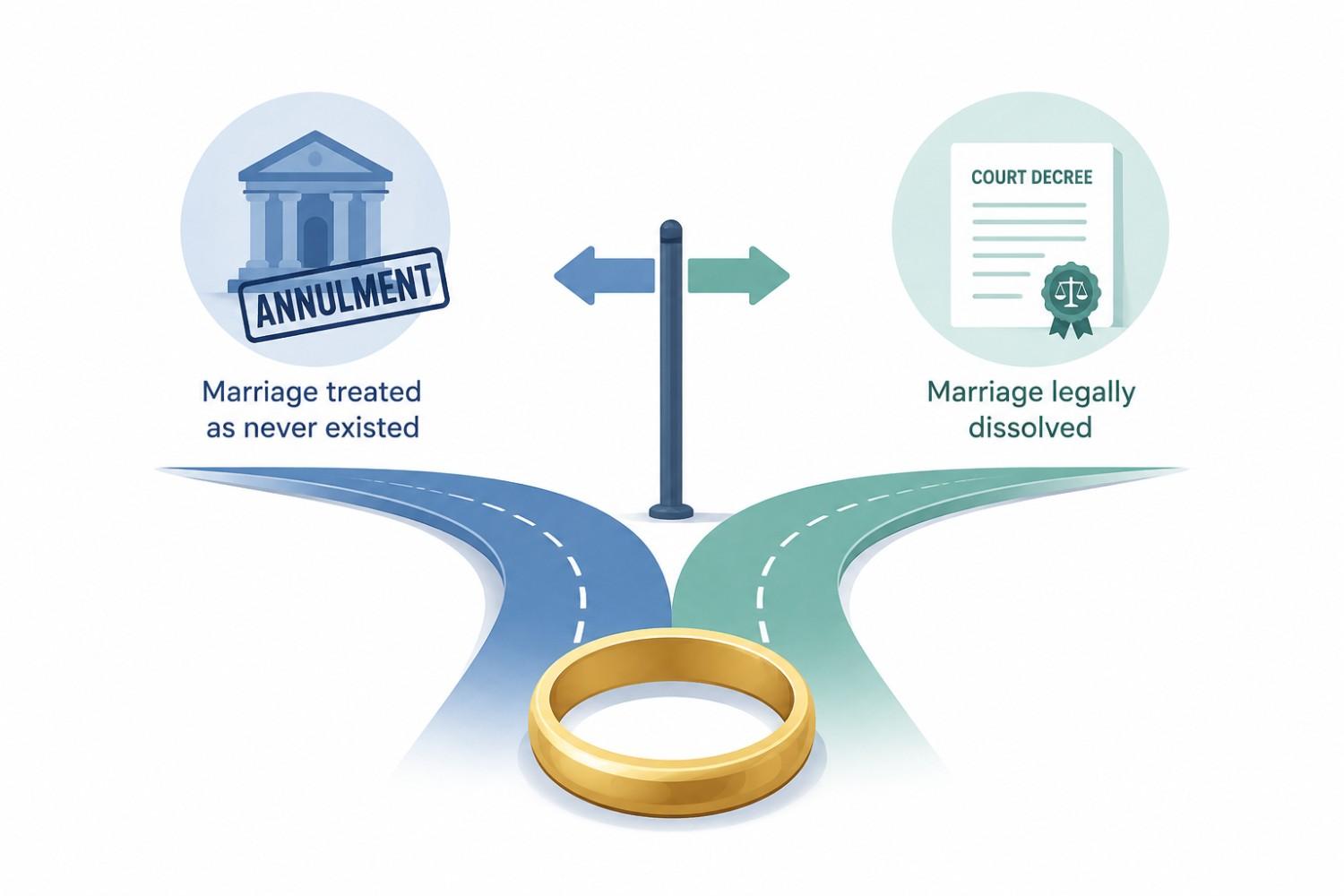
Marriage disputes can be emotionally and legally complex. When a relationship breaks down, many people assume divorce is the only legal option available. However, under Indian law, certain marriages may qualify for annulment instead of divorce.
Understanding the difference between annulment and divorce is important because both remedies have different legal consequences, procedures, timelines, and effects on marital status. Choosing the correct legal remedy can significantly impact your future rights relating to maintenance, property, remarriage, and child custody.
This guide explains annulment vs. divorce under Indian law, the legal grounds for each, procedural differences, and how to determine which option may apply to your situation.
What Is an Annulment Under Indian Law?
An annulment is a judicial declaration that a marriage is null and void. Once a court grants an annulment, the marriage is treated as though it never legally existed. Unlike divorce, which acknowledges that a valid marriage existed before its dissolution, annulment establishes that the marriage suffered from a legal defect from the very beginning.
Under Indian law, annulment provisions are primarily contained in the Hindu Marriage Act, 1955, the Special Marriage Act, 1954, and the Indian Divorce Act, 1869. Depending on the nature of the defect, a marriage may be categorized as either void or voidable.
A void marriage is automatically invalid from its inception. Examples include marriages where one spouse already had a living spouse at the time of marriage, or marriages falling within prohibited degrees of relationship. On the other hand, a voidable marriage remains valid unless and until a court annuls it. Such marriages may involve fraud, coercion, impotence, mental incapacity, or concealment of material facts affecting consent.
The Delhi High Court's decision in Anurag Anand v. Sunita Anand (1996) remains one of the most frequently cited cases on matrimonial fraud. The Court held that material misrepresentations regarding financial status and other significant facts affecting consent could constitute fraud sufficient to seek annulment under Section 12 of the Hindu Marriage Act. The judgment emphasized that consent obtained through deception is not valid consent in the eyes of law.
What Makes a Marriage Eligible for Annulment in India?
Under Indian law, marriages may be classified as either:
- Void marriages
- Voidable marriages
The distinction is important because the legal treatment differs in each case.
1. Void Marriages (Automatically Invalid)
A void marriage is considered invalid from the very beginning. Legally, it never existed.
Common grounds include:
- One spouse was already legally married at the time of marriage (bigamy)
- Marriage between prohibited blood relatives
- Marriage violating essential legal requirements under personal laws
- In certain situations, lack of valid marriage ceremonies
Under the Hindu Marriage Act, 1955, bigamous marriages are automatically void.
2. Voidable Marriages (Valid Until Cancelled by Court)
A voidable marriage remains legally valid unless and until a court passes a decree of annulment.
Common grounds include:
- Marriage obtained through fraud or concealment
- Consent obtained through force or coercion
- Mental incapacity preventing valid consent
- Impotency or inability to consummate the marriage
- Pregnancy by another person at the time of marriage (under certain laws)
Unlike void marriages, voidable marriages require court intervention to become legally invalid.
What Is Divorce Under Indian Law?
Divorce is the legal dissolution of a valid marriage through a decree of a competent court. Unlike annulment, divorce recognizes that a lawful marriage existed but has subsequently broken down due to circumstances arising during the marital relationship.
Indian matrimonial laws provide various grounds for divorce, including cruelty, adultery, and desertion, conversion of religion, mental disorder, and mutual consent. Depending on the facts of the case, spouses may either pursue a mutual consent divorce or a contested divorce.
Mutual consent divorce has become increasingly common because it allows parties to separate amicably while resolving issues relating to maintenance, child custody, and property division through mutual agreement. Contested divorce, however, involves litigation where one spouse seeks divorce against the wishes of the other or where disputes remain unresolved.
Landmark Supreme Court Judgment on Mutual Consent Divorce
One of the most significant judgments in modern Indian matrimonial law is Amardeep Singh v. Harveen Kaur (2017) 8 SCC 746. In this case, the Supreme Court addressed whether the six-month cooling-off period under Section 13 B (2) of the Hindu Marriage Act was mandatory.
The Court held that the six-month waiting period is directory rather than mandatory and may be waived where the marriage has irretrievably broken down, reconciliation is impossible, and all disputes have been settled between the parties. This judgment substantially reduced delays in mutual consent divorce proceedings and provided much-needed flexibility to Family Courts.
Annulment vs. Divorce: The Fundamental Difference
The most important distinction lies in the legal status of the marriage. An annulled marriage is treated as though it never existed, whereas a divorced marriage is recognized as a valid marriage that has been legally terminated.
This difference becomes particularly important when considering social status, religious implications, and legal rights. In an annulment, the law effectively erases the marital relationship from its inception. In a divorce, the marriage remains part of the parties' legal history even after dissolution.
Another major distinction relates to the grounds on which relief can be sought. Annulment focuses on defects that existed at the time of marriage, such as fraud, force, impotence, or lack of valid consent. Divorce, by contrast, generally arises from events occurring after the marriage, such as cruelty, adultery, desertion, or irretrievable breakdown of the relationship.
Limitation Periods and Time Restrictions for Annulment and Divorce
One of the most important factors when considering legal action is understanding the time limits prescribed by law. The availability of annulment or divorce may depend not only on the facts of the case but also on when the petition is filed.
In the case of annulment, certain grounds are subject to statutory limitations. For example, under Section 12 of the Hindu Marriage Act, 1955, a petition based on fraud or force must generally be filed within one year of the discovery of the fraud or the cessation of force. Additionally, the petitioner should not have voluntarily lived with the other spouse after discovering the fraud or after the force ceased.
Void marriages, such as those involving bigamy or prohibited relationships, stand on a different footing. Since such marriages are considered invalid from the outset, a declaration of nullity may generally be sought even after a significant period has elapsed.
For divorce, most matrimonial laws require that at least one year must have passed from the date of marriage before a divorce petition can ordinarily be filed. However, courts may permit earlier filing in exceptional circumstances involving extreme hardship to the petitioner or exceptional depravity on the part of the respondent.
Because limitation periods vary depending on the legal ground relied upon and the statute governing the marriage, parties should carefully assess their rights before initiating proceedings. Delay in approaching the court may, in some cases, affect the availability of certain remedies.
This section fits naturally because readers first learn the differences between annulment and divorce, then learn when they must file, and only after that move to the actual court procedure.
Legal Procedure for Divorce
The divorce process begins with the filing of a divorce petition before the Family Court having jurisdiction over the matter. The petition must specify the legal grounds for divorce, such as cruelty, adultery, desertion, conversion, mental disorder, or mutual consent.
After the petition is filed, the court issues notice to the other spouse. In many cases, courts initially encourage mediation or reconciliation efforts, particularly where there is a possibility of preserving the marriage.
If reconciliation fails, the matter proceeds to hearings where both parties present evidence, witness testimony, and legal arguments. In contested divorce proceedings, the court examines whether the statutory grounds for divorce have been established.
Where the divorce is sought by mutual consent, both spouses jointly file a petition stating that they have been living separately and mutually agree that the marriage should be dissolved. The court reviews the settlement terms relating to maintenance, child custody, and property before granting the decree.
In addition to determining whether divorce should be granted, the court may also decide issues relating to alimony, maintenance, child custody, visitation rights, and financial settlements. Once satisfied that the legal requirements have been met, the court passes a final decree of divorce, formally dissolving the marriage.
Where Can You File an Annulment or Divorce Petition?
Under Indian law, petitions for annulment and divorce are generally filed before the Family Court having jurisdiction over the matter. Jurisdiction is typically determined based on factors such as the place where the marriage was solemnized, where the spouses last resided together, or where the respondent currently resides. In certain circumstances, the petitioner may also file the case in the jurisdiction where they reside, subject to the provisions of the applicable matrimonial law.
Family Courts are empowered to hear and decide disputes relating to marriage, divorce, annulment, maintenance, child custody, and other family-related matters.
Impact on Maintenance, Property Rights, and Children
Many people mistakenly believe that annulment eliminates all financial obligations. This is not entirely correct. Indian courts have consistently recognized the need to protect vulnerable spouses and children, even when a marriage is declared void or voidable.
Courts may grant maintenance, direct the return of dowry articles or gifts, and provide other equitable relief where justice requires. Similarly, children born from annulled marriages continue to enjoy legal protection under Indian law.
The Supreme Court in Parayankandiyal Eravath Kanapravan Kalliani Amma v. K. Devi (1996) clarified that children born from void marriages are entitled to legitimacy and legal protection. The Court emphasized that innocent children should not suffer because of defects in their parents' marriage. This judgment significantly strengthened the rights of children born from marriages later declared void.
In divorce proceedings, issues relating to permanent alimony, maintenance, child custody, visitation rights, and financial support from an integral part of the litigation process.
When Should You Choose Annulment Instead of Divorce?
Annulment may be the more appropriate remedy where the marriage itself was fundamentally flawed from the outset. Examples include situations involving fraudulent concealment of material facts, coercion, mental incapacity, prohibited relationships, or non-consummation due to impotence.
In contrast, divorce is generally the suitable option where a valid marriage later deteriorates due to incompatibility, cruelty, abandonment, adultery, or irretrievable breakdown.
The distinction is important because filing the wrong type of proceeding may result in unnecessary delays, increased litigation costs, and even dismissal of the case.
Why Choosing the Right Legal Remedy Matters
The decision between annulment and divorce is not merely technical. It directly affects:
- Legal marital status
- Financial obligations
- Property rights
- Maintenance claims
- Child custody
- Future remarriage rights
Filing the wrong type of case may result in:
- Delays
- Additional litigation
- Increased costs
- Rejection of the petition
Important Legal Questions people Commonly Ask
While understanding the procedural differences between annulment and divorce is important, many individuals remain uncertain about whether their specific circumstances qualify for either remedy. Matrimonial disputes often involve complex factual situations that raise important legal questions regarding the validity of the marriage, the rights of the spouses, and the remedies available under Indian law.
For example, can a marriage be annulled years after it was solemnized? Does the concealment of a serious medical condition before marriage amount to fraud? Can a spouse seek annulment if important facts were intentionally hidden during matrimonial negotiations? What happens to maintenance, property rights, and child custody when a marriage is annulled rather than dissolved through divorce?
The answers depend on the facts of each case, the applicable personal law, and the judicial principles developed by Indian courts over the years. Understanding these issues can help individuals determine whether annulment or divorce is the more appropriate legal remedy for their situation.
The following sections address some of the most frequently asked questions relating to annulment and divorce under Indian law.
Can a Marriage Be Annulled After Many Years?
One of the most common misconceptions is that annulment can be sought at any time. The answer depends on whether the marriage is void or voidable. A void marriage, such as one involving bigamy, can generally be challenged whenever the issue comes to light because it was never legally valid. However, voidable marriages are subject to statutory limitations. For example, a spouse alleging fraud or coercion must usually approach the court within the prescribed time after discovering the deception.
Courts often examine whether the petitioner continued to live with the spouse after discovering the alleged defect. Continued cohabitation may weaken an annulment claim because it can indicate acceptance of the marriage despite the defect.
Does Annulment Affect a Woman's Right to Maintenance?
Many individuals assume that because an annulled marriage is treated as though it never existed, the financially weaker spouse automatically loses all rights. Indian courts have repeatedly rejected this simplistic approach.
The Supreme Court in Badshah v. Urmila Badshah Godse (2014) 1 SCC 188 adopted a socially beneficial interpretation of maintenance laws and emphasized that women should not be denied protection merely because of technical defects in the marriage. Courts increasingly focus on preventing injustice rather than allowing an innocent spouse to suffer because of another person's wrongdoing.
As a result, maintenance claims may still be available depending on the facts and applicable law.
Can Concealment of Medical Conditions Lead to Annulment?
Concealment of serious medical conditions is one of the most litigated grounds in annulment proceedings. However, not every undisclosed medical issue automatically entitles a spouse to annulment.
Courts generally examine whether the concealed fact was material enough to affect the decision to marry. Cases involving severe mental illness, impotence, or conditions affecting marital life have often been considered relevant.
The Supreme Court in R. Lakshmi Narayan v. Santhi (2001) 4 SCC 688 discussed the importance of mental capacity and the ability to give valid consent in matrimonial relationships. The judgment remains an important reference point in cases involving mental health and matrimonial validity.
Annulment Based on Fraud: What Qualifies as Fraud?
Not every lie told before marriage amounts to legal fraud. Indian courts distinguish between ordinary misrepresentations and concealment of facts that strike at the very foundation of marriage.
Examples that may potentially support an annulment petition include:
- Concealing an existing marriage
- Concealing impotence
- Concealing serious mental illness
- Providing false information regarding identity
- Concealing criminal history in certain circumstances
Minor exaggerations regarding income, social status, or lifestyle may not always satisfy the legal threshold required for annulment.
Can You Remarry After Annulment or Divorce?
Once a final decree of annulment or divorce has been granted and any appeal period has expired, the parties are generally free to remarry.
The key distinction is historical. After a divorce, the law recognizes that a valid marriage existed and was subsequently dissolved. After annulment, the marriage is treated as having never legally existed.
From a practical perspective, both remedies ultimately restore the parties' ability to enter a new marriage.
The Growing Recognition of Irretrievable Breakdown
Although "irretrievable breakdown of marriage" is not yet a statutory ground for divorce under the Hindu Marriage Act, the Supreme Court has increasingly relied on its constitutional powers to dissolve marriages that have completely failed.
In Naveen Kohli v. Neelu Kohli (2006) 4 SCC 558, the Supreme Court observed that where a marriage has broken down beyond repair and the parties can no longer live together, continuing the legal bond serves no useful purpose. The Court recommended legislative recognition of irretrievable breakdown as a ground for divorce, a principle that continues to influence matrimonial jurisprudence today.
Recent Trends in Indian Matrimonial Law
Indian family law has evolved significantly over the past decade. Courts have increasingly focused on individual dignity, personal autonomy, and practical justice rather than rigid technicalities.
A notable example is Shilpa Sailesh v. Varun Sreenivasan (2023) 14 SCC 1, where the Supreme Court clarified its powers under Article 142 of the Constitution to dissolve marriages that have irretrievably broken down. The judgment reflects the judiciary's growing recognition that forcing parties to remain in dead marriages often serves no meaningful purpose.
This evolving approach continues to influence family courts across India.
When Should You Seek Legal Advice?
Determining whether a case qualifies for annulment or divorce often requires a careful assessment of the facts, the applicable personal law, available evidence, and the procedural requirements prescribed by law. In many situations, the distinction between a void marriage, a voidable marriage, and a valid marriage that has broken down may not be immediately apparent. As a result, choosing the wrong legal remedy can lead to unnecessary delays, additional costs, and procedural complications.
Seeking legal advice at an early stage can help individuals understand their rights and obligations, evaluate the strength of their case, and ensure compliance with statutory timelines and court procedures. Early guidance can also be particularly important where issues relating to maintenance, child custody, property rights, fraud, coercion, or concealment of material facts are involved.
Conclusion
Annulment and divorce are distinct legal remedies that serve different purposes under Indian matrimonial law. While annulment addresses marriages that were legally defective from the outset, divorce provides a mechanism for dissolving a valid marriage that has subsequently broken down. The choice between the two depends on the specific facts of each case, the legal grounds available, and the applicable statutory framework.
Understanding the differences between annulment and divorce is essential for protecting legal rights and making informed decisions. From questions relating to validity of consent and matrimonial fraud to issues involving maintenance, custody, and property, each case presents unique legal considerations that must be evaluated carefully. A clear understanding of the available remedies and the legal principles governing them can help individuals navigate matrimonial disputes with greater certainty and awareness of their rights under the law.
ABOUT THE AUTHOR
Setika Priyam is a corporate lawyer with experience in contract drafting, trademark law, business advisory, and regulatory compliance. She works closely with startups, SMEs, and established businesses to develop practical legal solutions that support growth and mitigate risk. Through her articles and legal resources, she shares clear, actionable guidance to help businesses understand the law and make well-informed commercial decisions.
DISCLAIMER
This article is intended solely for general informational and educational purposes and does not constitute legal advice. Readers are encouraged to seek professional legal counsel before acting on any information discussed herein. Neither the author nor SolvLegal assumes liability for reliance placed on this content.

Related Articles


Leave a Comment