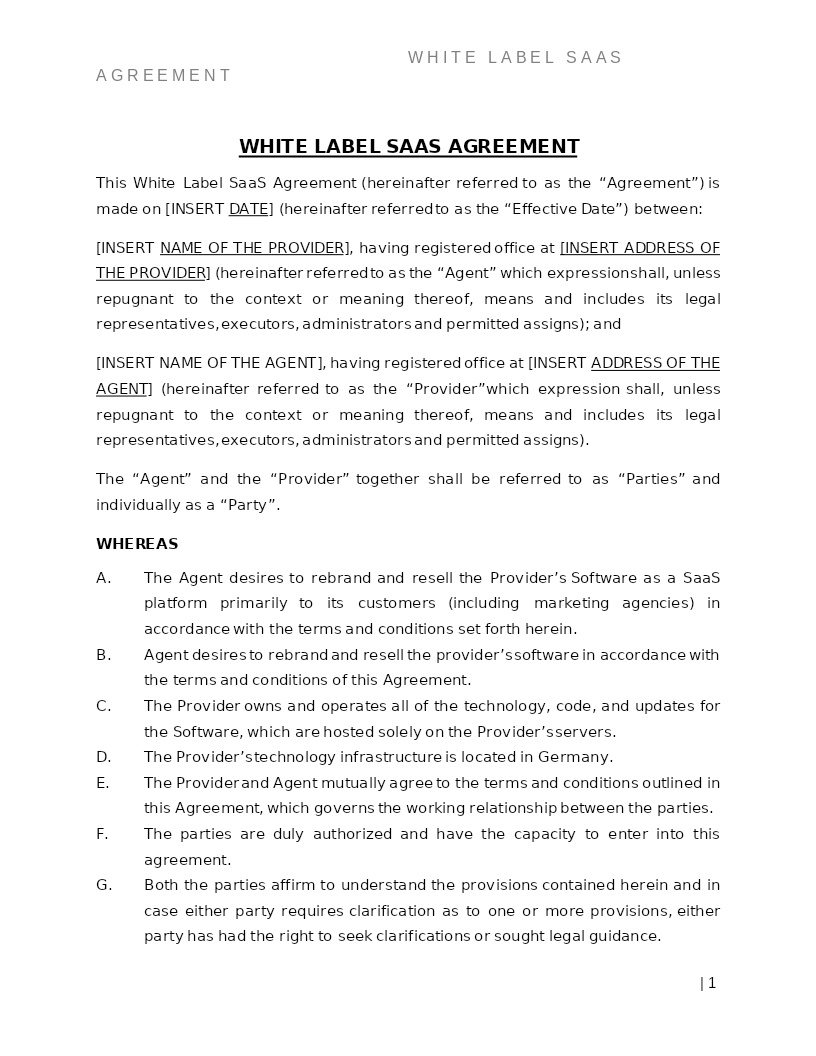
WHITE LABEL SAAS AGREEMENT
How does it work?
1. Choose this template
Start by clicking on "Fill out the template"
2. Complete the document
Answer a few questions and your document is created automatically.
3. Save - Print
Your document is ready! You will receive it in Word and PDF formats. You will be able to modify it.
Lawyer-Drafted | Globally Compliant | Customizable in Word/PDF
Before allowing another business to rebrand, market, and sell your software as their own, protect your intellectual property, service obligations, and commercial rights with a comprehensive White Label SaaS Agreement.
What is a White Label SaaS Agreement?
A White Label SaaS Agreement is a legally binding contract that enables one company (the Provider) to supply cloud-based software to another company (the Reseller) for rebranding and resale under the reseller’s own name.
It outlines licensing rights, rebranding permissions, service levels, payment terms, customer support obligations, data protection, intellectual property ownership, and termination rights.
This agreement ensures both parties maintain clarity, protect their business interests, and operate within mutually agreed boundaries.
Types of White Label SaaS Agreements
· Full White Label Agreement: The reseller fully rebrands and sells the software as their own product.
· Partial White Label Agreement: The reseller uses limited branding features while the provider retains some visibility.
· Industry-Specific White Label SaaS: Tailored for fintech, healthcare, marketing, HR, or CRM solutions.
· API-Based White Label Agreement: Allows integration into the reseller’s existing platforms for white-label delivery.
· Multi-Tenant White Label Agreement: Ideal for resellers serving multiple end clients under a single SaaS backend.
Global Legal Recognition of White Label SaaS Agreements
These agreements are widely enforceable internationally when drafted with robust IP protections, service levels, and data compliance:
· United States: Governed by contract law, copyright law, and cloud-service standards.
· United Kingdom & European Union: Must comply with contract law, GDPR, consumer protection laws, and SaaS regulations.
· United Arab Emirates (UAE) & Saudi Arabia: Regulated under modern IT, electronic transactions, and commercial contract frameworks.
· Australia & Canada: Enforced under contract, privacy, and technology-service legislation.
· Hong Kong: Governed by contract law and IT regulations under PDPO.
Clear drafting ensures enforceability, platform security, and brand protection across global markets.
Why You Should Consult a Lawyer Before Using This Template
White label SaaS relationships include critical issues such as uptime guarantees, data security, branding rights, and regulatory compliance.
A lawyer can tailor the agreement to your specific SaaS model, industry requirements, and target jurisdictions.
At SolvLegal, our legal team can review and customize this document within 48 hours to ensure complete compliance and commercial protection.
Who Should Use This Template
· SaaS companies offering rebrandable software
· Agencies reselling third-party platforms under their own brand
· Startups expanding through white-label partnerships
· Technology firms offering multi-tenant or API-based SaaS
· Enterprises licensing internal software for external resale
How to Download This Template
1. Click Fill out the Template
2. Enter party details, licensing rights, and rebranding scope
3. Define service levels, data protection terms, and payment structure
4. (Recommended) Review with your legal advisor
5. Download in Word or PDF format
6. Sign electronically or execute physically
Frequently Asked Questions (FAQs)
1. Is this White Label SaaS Agreement valid internationally?
Yes. It is based on universal SaaS and IP licensing principles and can be adapted for most jurisdictions.
2. Who can use this Agreement?
Software companies, resellers, digital agencies, platform providers, and technology service firms.
3. Does the Agreement cover branding and customization rights?
Yes. It includes detailed provisions for logos, colors, domains, and UI/UX branding.
4. Are electronic signatures legally recognized?
Yes. E-signatures are accepted under U.S., EU, UAE, and global digital transaction laws.
5. What happens if the reseller misrepresents the software?
The provider may terminate the agreement, suspend access, or pursue damages depending on severity.
6. Does the Agreement include intellectual property protections?
Yes. It clearly states that all source code, software, and backend systems remain the provider’s IP.
7. Can this Agreement include minimum sales or performance targets?
Yes. You may set KPIs, sales quotas, or usage thresholds.
8. Does the Agreement cover data protection and privacy compliance?
Yes. It includes GDPR, CCPA, and global data-security obligations.
9. Can the reseller offer customer support to end-users?
Yes. The agreement allows either shared support or reseller-led support.
10. Does the Agreement include SLAs or uptime guarantees?
Yes. Service levels, uptime commitments, and response times are included.
11. Can the reseller set its own pricing?
Yes. The agreement allows full pricing flexibility unless otherwise restricted.
12. Is API access included?
Optional API licensing terms are provided for integration-based white labeling.
13. Does the agreement allow sub-resellers?
Only if explicitly permitted. You may enable or block sub-distribution.
14. Are software updates and feature releases covered?
Yes. The provider may offer updates automatically or by agreement.
15. Can the reseller request custom feature development?
Yes. The document allows custom development under separate fees.
16. Does it include termination and transition terms?
Yes. It outlines termination rights, offboarding processes, and access removal.
Related Templates You May Need
· SaaS Licensing Agreement – For providing software access without white-label rights.
· Reseller Agreement – For non-exclusive or simplified reseller partnerships.
· Service Level Agreement (SLA) – To define uptime, performance metrics, and support obligations.
