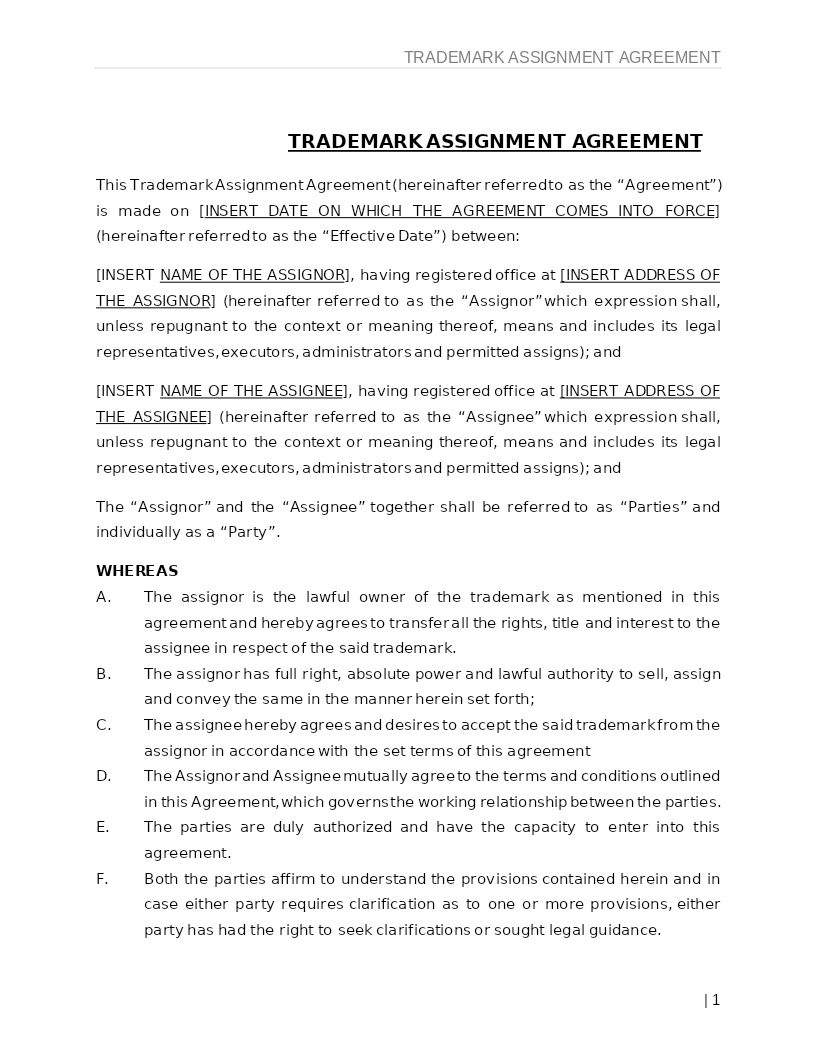
TRADEMARK ASSIGNMENT AGREEMENT
How does it work?
1. Choose this template
Start by clicking on "Fill out the template"
2. Complete the document
Answer a few questions and your document is created automatically.
3. Save - Print
Your document is ready! You will receive it in Word and PDF formats. You will be able to modify it.
Lawyer-Drafted | Globally Compliant | Customizable in Word/PDF
Before transferring ownership of your brand assets, trademarks, or intellectual property rights, protect your interests with a clear and enforceable Trademark Assignment Agreement.
What is a Trademark Assignment Agreement?
A Trademark Assignment Agreement is a legally binding contract that transfers ownership of a trademark from one party (the Assignor) to another (the Assignee).
It outlines the rights being transferred, the assignment price, goodwill attached to the mark, registration details, warranties, and future obligations required to complete the transfer.
This agreement ensures a clean, transparent transfer of trademark ownership and protects both parties from future disputes or claims.
Types of Trademark Assignment Agreements
· Registered Trademark Assignment: For transferring trademarks that are already registered with the relevant trademark office.
· Pending Application Assignment: For marks that are still in the application or examination stage.
· Assignment with Goodwill: Transfers both the trademark and the associated business reputation.
· Assignment without Goodwill: Transfers the mark only, without the related business operations.
· Partial Assignment: For transferring rights to specific goods, services, or classes.
Global Legal Recognition of Trademark Assignment Agreements
Trademark assignments are recognized internationally when properly documented and filed with the appropriate authorities:
· United States: Governed by the Lanham Act. Assignments must be recorded with the USPTO to be fully effective.
· United Kingdom & European Union: Recognized under IP and trademark laws; assignments must be recorded with the UK IPO or EUIPO.
· United Arab Emirates (UAE) & Saudi Arabia: Regulated by local IP laws and require formal registration with trademark authorities.
· Australia & Canada: Governed by national IP legislation requiring timely recording to maintain enforceability.
· Hong Kong: Regulated by the Trade Marks Ordinance, requiring registration of the assignment for full legal effect.
Clear drafting, accurate mark details, and proper filing ensure global validity and enforceability.
Why You Should Consult a Lawyer Before Using This Template
Although this agreement is professionally drafted and ready to use, trademark transfers often involve jurisdiction-specific requirements, filing deadlines, and compliance with IP office procedures.
A lawyer can verify registration numbers, confirm eligibility for assignment, and ensure full legal compliance.
At SolvLegal, our experts can review and customize this document within 48 hours for complete accuracy and protection.
Who Should Use This Template
· Businesses transferring brand ownership
· Sellers assigning trademarks during mergers or acquisitions
· Creators or startups selling their brand names or logos
· Companies re-structuring or transferring trademarks within a corporate group
· IP owners transferring rights to licensees or successors
How to Download This Template
1. Click Fill out the Template
2. Enter party details, trademark information, assignment terms, and compensation
3. Select the governing law and jurisdiction
4. (Recommended) Have your lawyer review the document
5. Download in Word or PDF format
6. Sign digitally or notarize if required by your country
Frequently Asked Questions (FAQs)
1. Is this Trademark Assignment Agreement valid internationally?
Yes. It follows global IP standards and can be used in most jurisdictions with minimal adjustments.
2. Who can use this Agreement?
Suitable for businesses, brand owners, creators, licensors, and buyers of trademarks.
3. Can the Agreement transfer multiple trademarks at once?
Yes. The template allows assignment of one or several trademarks in a single agreement.
4. Are electronic signatures accepted?
In many jurisdictions, yes. However, some trademark offices may require physical signatures for filing.
5. What happens if the Assignor does not own the trademark outright?
The agreement becomes invalid. The Assignor must have legal ownership or authority to transfer the rights.
6. Does the Agreement include goodwill transfer language?
Yes. You may select assignment with or without goodwill depending on your business transaction.
7. Does this Agreement need to be filed with a trademark office?
Yes. Most jurisdictions require formal recordation for the assignment to take legal effect.
8. Can it be used for unregistered trademarks (common law marks)?
Yes. The agreement supports both registered and unregistered marks, with provisions for future registration.
9. Does the Agreement include representations and warranties?
Yes. It includes assurances about ownership, validity, and non-infringement.
10. Can payment be structured as installments?
Yes. The template allows lump-sum, staged payments, or assignment in exchange for equity or royalties.
11. Are there clauses for future cooperation in trademark filings?
Yes. The document includes obligations for both parties to sign and submit documents required by IP offices.
12. Can the Agreement include international classes or multiple jurisdictions?
Yes. It can cover multiple classes, countries, or regions in one transfer.
13. Does it address the transfer of associated domain names or logos?
Optional clauses can include domain names, branding assets, and design copyrights.
14. Is notarization or legalization required?
Some countries (e.g., UAE, Saudi Arabia, China) may require notarization or legalization. This varies by jurisdiction.
15. Can the Assignee sublicense or license the trademark after assignment?
Yes. Once the transfer is complete, the Assignee gains full ownership and may license the mark unless otherwise restricted.
16. Does the template provide guidance for handling ongoing infringement cases?
Yes. Optional clauses allow assignment of pending disputes, enforcement rights, and past damages.
Related Templates You May Need
· Trademark Licensing Agreement – For allowing third parties to use your trademark while retaining ownership.
· Intellectual Property Assignment Agreement – For transferring copyrights, patents, or other IP assets.
· Non-Disclosure Agreement (NDA) – To protect confidential brand and business information during negotiations.