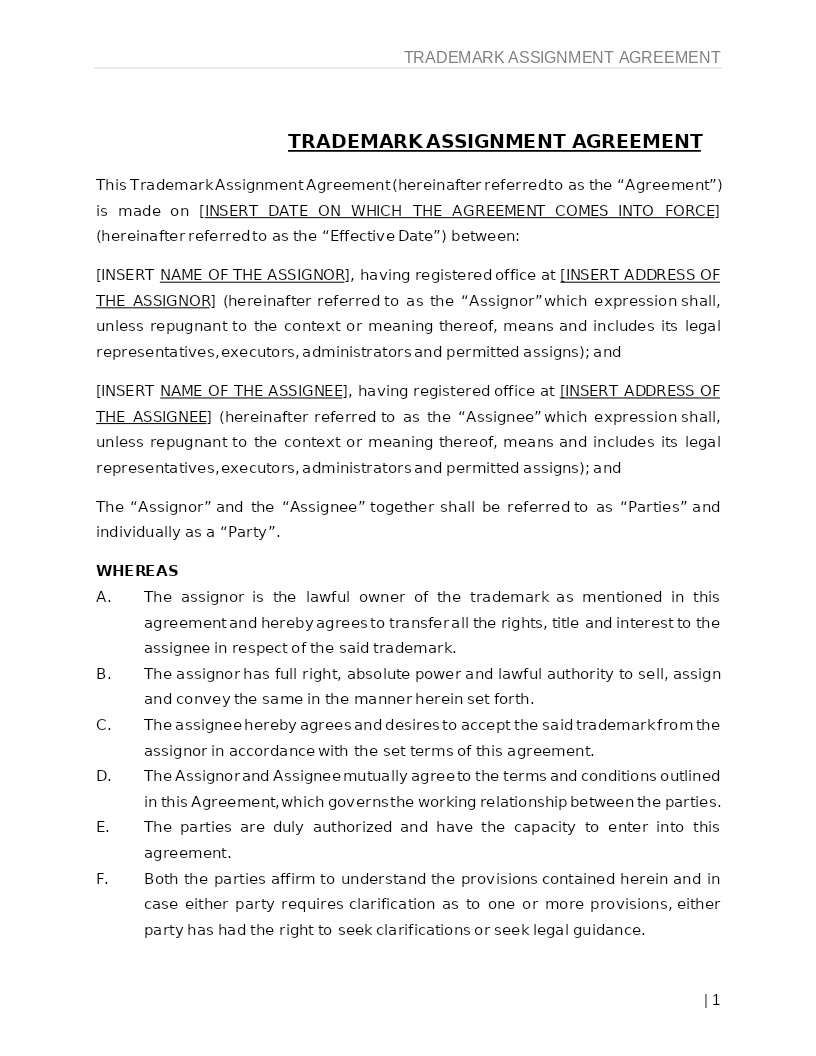
TRADEMARK ASSIGNMENT AGREEMENT
How does it work?
1. Choose this template
Start by clicking on "Fill out the template"
2. Complete the document
Answer a few questions and your document is created automatically.
3. Save - Print
Your document is ready! You will receive it in Word and PDF formats. You will be able to modify it.
What Is a Trademark Assignment Agreement?
A Trademark Assignment Agreement is a legally binding contract through which one party (the Assignor) transfers ownership of a trademark — including all associated goodwill — to another party (the Assignee). Unlike trademark licenses (which allow use without transfer of ownership), an assignment permanently moves rights, title, and interest in the mark from one party to another.
At its core, a trademark assignment agreement specifies:
- What trademark is being transferred
- Whether the associated goodwill is included
- The scope of rights conveyed
- Representations and warranties about ownership and non-infringement
- What obligations survive after transfer
- What happens if one party breaches the agreement
Common Types of Trademark Assignments
1. Full Assignment
Transfers complete ownership of a trademark and associated goodwill.
- Example: A company selling a brand line to another business.
2. Partial Assignment
Transfers ownership for only certain goods or services within a trademark’s registration.
- Example: Assigning rights for “clothing” while retaining rights for “accessories.”
3. Assignment with Goodwill
The most common and legally preferred structure. Trademark rights transfer together with the reputation, customer recognition, and business goodwill associated with the mark.
4. Assignment Between Related Entities
Transfers ownership between parent/subsidiary companies, joint-venture partners, or merged/acquired entities.
How Trademark Assignments Are Treated in Major Global Jurisdictions
Trademark assignment rules are recognized worldwide but must comply with specific statutory and administrative requirements.
United States
Trademark assignments are governed by:
- Lanham Act (15 U.S.C. § 1060)
- USPTO regulations
Key requirements:
- Assignments must include goodwill to avoid being deemed invalid.
- Written assignment is required.
- The assignee must record the assignment with the USPTO to perfect ownership.
- Assignments cannot mislead consumers or create “naked trademarks.”
United Kingdom & European Union
Trademark assignments must comply with:
- UK Trade Marks Act 1994 / EU Trade Mark Regulation
- National IP office procedural rules (UKIPO, EUIPO)
Key principles:
- Assignments may be with or without goodwill, but goodwill considerations affect enforceability.
- Written form recommended and often required.
- Recordal with UKIPO or EUIPO is essential for public notice and enforceability.
- Data protection rules (UK GDPR / EU GDPR) apply when personal data is exchanged.
United Arab Emirates (UAE)
- Governed by the UAE Trademarks Law (Federal Decree-Law No. 36 of 2021).
- Assignments must be in writing and notarized.
- Recording with the Ministry of Economy is mandatory.
- DIFC/ADGM entities may follow more common-law–oriented principles.
Saudi Arabia
- Governed by the Trademark Law of the GCC as adopted by KSA.
- Assignments must be in writing and recorded with the Saudi IP Authority (SAIP).
- Sharia-based public policy restricts ambiguous or deceptive transfers.
India
- Governed by the Trade Marks Act, 1999 and related rules.
- Assignments can be with or without goodwill.
- Certain assignments (e.g., creating multiple exclusive owners in overlapping markets) are restricted.
- Assignment must be in writing and recorded with the Trade Marks Registry within statutory timelines.
Australia
- Governed by the Trade Marks Act 1995.
- Assignment must be in writing.
- Must include identified goods/services.
- Recording the assignment with IP Australia is strongly recommended.
Canada
- Governed by the Trademarks Act and common-law principles of goodwill.
- Assignment may be with or without goodwill, but goodwill supports enforceability.
- Recording the transfer at CIPO is advisable to maintain clear chain of title.
Hong Kong
- Governed by the Trade Marks Ordinance (Cap. 559).
- Assignments must be in writing.
- Both full and partial assignments are allowed.
- Registration of the assignment with the Hong Kong IP Department is recommended for legal certainty.
Important Legal Limits on Trademark Assignments Worldwide
Regardless of the jurisdiction, trademark assignments generally cannot:
- Transfer a trademark without the goodwill in a way that misleads consumers.
- Assign rights that the assignor does not legally own.
- Circumvent competition, antitrust, or consumer-protection laws.
- Misrepresent the origin or quality of goods in a way that causes consumer confusion.
- Assign rights for prohibited or deceptive marks.
Assignments that violate public policy or mislead consumers may be invalidated.
Why You Should Consult a Lawyer Before Using This Template
While templates help structure your agreement, trademark assignment validity depends heavily on:
- Proper definition of the trademark
- Correct handling of goodwill
- Clear description of goods/services
- Statutory requirements for notarization or legalization (UAE, KSA, etc.)
- Recordal deadlines for different IP offices
- Competition or antitrust implications (especially in the EU)
- Cross-border tax and valuation considerations
- Chain-of-title issues in mergers, acquisitions, or restructurings
Errors such as failing to include goodwill or to specify the correct registration numbers — can render the assignment unenforceable or void.
Who Should Use This Trademark Assignment Template
This template is suitable for:
- Businesses selling a brand, product line, or trademark portfolio
- Startups transferring branding rights after acquisition
- Companies reorganizing internal IP ownership (parent/subsidiary assignments)
- Freelancers, creators, or agencies transferring brand names or logos to clients
- Manufacturers or sellers acquiring the rights to a legacy or dormant brand
- Any organization consolidating trademarks for licensing or franchising purposes
How to Use and Download This Template
1. Click “Fill Out the Template”
You will be guided through the essential clauses required for a valid assignment.
2. Enter full legal names and contact details
Accurate identification prevents ownership disputes.
3. List each trademark being assigned
Specify:
- Registration numbers
- Jurisdiction(s)
- Classes of goods/services
- Pending applications (if applicable)
4. Confirm whether goodwill is included
A crucial step, especially in the US, Canada, and other goodwill-based jurisdictions.
5. Define representations and warranties
Including ownership, non-infringement, and absence of disputes.
6. Choose governing law and dispute-resolution method
Important for cross-border or multinational transfers.
7. Consult with a qualified trademark lawyer
To handle:
- Recordal requirements
- Tax implications
- Assignment of international registrations (Madrid Protocol)
8. Download the final document in Word or PDF format
9. Sign digitally or physically
E-signatures are valid under major global laws including ESIGN, eIDAS, IT Act 2000 (India), and UAE e-transaction regulations.
FAQs
1. Is this Trademark Assignment valid internationally?
Yes, it follows global best practices in trademark transfer.
However, enforceability depends on:
- National trademark laws
- Proper execution and notarization (UAE, KSA, some Asian jurisdictions)
- Recordal requirements with each national IP office
For international marks under WIPO’s Madrid System, separate recordal rules apply.
2. Do I need to assign goodwill with the trademark?
In many jurisdictions (e.g., US), an assignment must include goodwill to remain valid.
Some countries allow assignment without goodwill but may impose restrictions.
3. Should small businesses or freelancers use this agreement?
Yes. It is suitable when:
- A designer transfers a brand name or logo
- A startup sells a product name to another company
- A business rebrands and sells old marks
Legal review is still advisable.
4. Are e-signatures valid?
Yes. Electronic signatures are widely recognized under:
- ESIGN Act (US)
- UETA (US state law)
- eIDAS (EU)
- IT Act 2000 (India)
- UAE and GCC electronic transaction laws
As long as identity and intent are clear, e-signatures are enforceable.
5. What happens if the Assignor breaches the agreement?
The Assignee may seek:
- Contractual damages
- Injunctions to stop continued use of the trademark
- Cancellation of conflicting registrations
- Specific performance (in some regions)
- Arbitration or litigation, depending on the agreement
Misrepresenting ownership can also lead to civil or criminal penalties in some jurisdictions.
