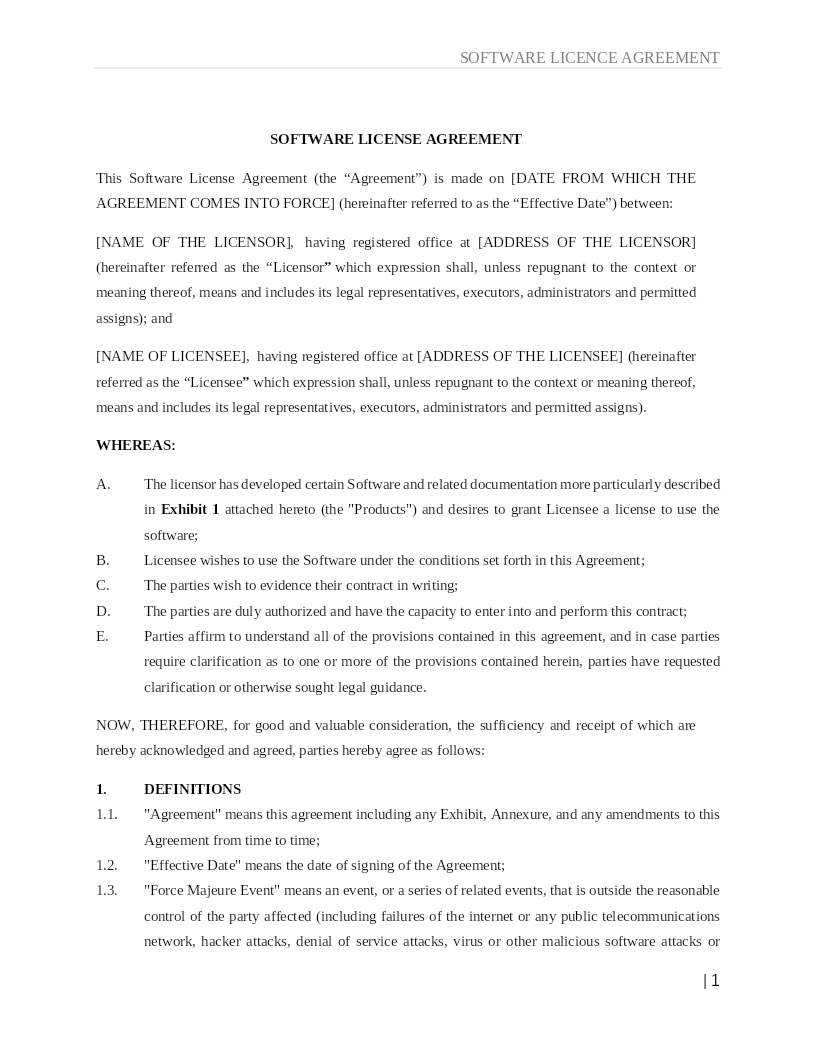
SOFTWARE LICENSE AGREEMENT
How does it work?
1. Choose this template
Start by clicking on "Fill out the template"
2. Complete the document
Answer a few questions and your document is created automatically.
3. Save - Print
Your document is ready! You will receive it in Word and PDF formats. You will be able to modify it.
Lawyer-Drafted | Globally Compliant | Customizable in Word/PDF
Before allowing users, businesses, or partners to access, install, or use your software, protect your intellectual property and define clear usage rights with a legally sound Software License Agreement.
What is a Software License Agreement?
A Software License Agreement is a legally binding contract that outlines the terms under which a user is permitted to access or use a software application.
It defines license type, usage restrictions, payment terms, intellectual property rights, warranties, data protection obligations, security standards, and consequences of misuse.
This agreement ensures the software owner retains full control over their product while providing users with lawful, clearly defined access and usage rights.
Why a Software License Agreement Matters?
- Protects your source code and intellectual property
- Prevents unauthorized resale, copying, or reverse engineering
- Establishes clear conditions for installation, access, and usage
- Reduces legal risks through disclaimers and liability limits
- Supports compliance across global markets, including SaaS, desktop, and mobile software
Who Should Use This Template
- Software developers and SaaS companies
- Tech startups offering web, desktop, or mobile applications
- Enterprises licensing proprietary technology to clients or partners
- Agencies and consultants distributing customized software
- Businesses selling subscription or downloadable software
How to Download This Template
- Click Fill out the Template
- Enter details about the software, licensing model, and restrictions
- Select governing law and payment or subscription terms
- (Recommended) Have your lawyer review the final draft
- Download in Word or PDF format
- Publish with your software or send to licensees
Frequently Asked Questions (FAQs)
1. Is this Software License Agreement valid internationally?
Yes. It follows globally recognized software licensing principles and can be adapted for most jurisdictions.
2. Who can use this Agreement?
Companies, developers, SaaS providers, and anyone offering software to users or clients.
3. Does it protect my source code?
Yes. It includes strict prohibitions against copying, reverse engineering, or modifying the software.
4. Are electronic signatures acceptable?
Yes. E-signatures are legally valid under U.S., EU, UAE, and most global regulations.
5. Does the Agreement cover subscription-based (SaaS) software?
Yes. It supports one-time purchases, subscriptions, hosted services, and multi-tenant SaaS models.
6. What happens if a user violates the license?
The owner may suspend access, terminate the license, or pursue legal action.
7. Can I choose between perpetual and term-based licenses?
Yes. The template supports both licensing models.
8. Does the Agreement cover maintenance and updates?
Yes. Optional clauses define update rights, version upgrades, and support services.
9. Can the license be exclusive or non-exclusive?
Yes. Both options are included and customizable.
10. Does the Agreement address data protection and privacy?
Yes. It includes privacy and data-processing obligations when applicable.
11. Are API rights included?
Yes. Optional API usage terms can be added for integration-based products.
12. Can I restrict the number of users or devices?
Yes. You can limit seats, installations, or concurrent users.
13. Are liability limitations included?
Yes. The agreement includes standard disclaimers and liability caps.
14. Does it address third-party components?
Yes. It discloses third-party libraries and their licensing conditions.
15. Can the license include territory restrictions?
Yes. You may limit usage by region, industry, or customer type.
16. Does it include termination and offboarding terms?
Yes. It specifies termination rights and post-termination obligations.
Related Templates You May Need
- End User License Agreement (EULA) – For consumer-facing desktop or mobile software.
- SaaS Agreement – For cloud-based software and subscription models.
- Software Development Agreement – For building custom software prior to licensing.
- Non-Disclosure Agreement (NDA) – To protect proprietary information and code.
