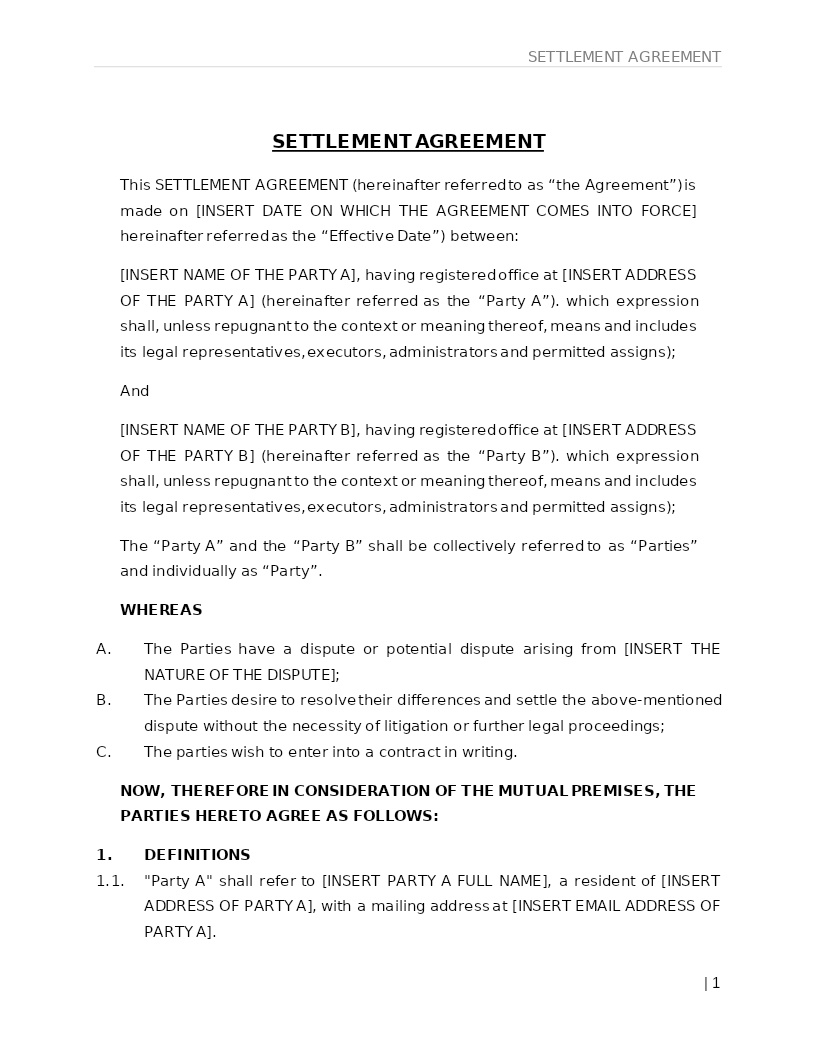
SETTLEMENT AGREEMENT TEMPLATE
How does it work?
1. Choose this template
Start by clicking on "Fill out the template"
2. Complete the document
Answer a few questions and your document is created automatically.
3. Save - Print
Your document is ready! You will receive it in Word and PDF formats. You will be able to modify it.
Settlement Agreement Template - Free, Lawyer - Drafted & Globally Compliant
If you are settling a dispute, you are probably worried about one thing above all: Will this agreement actually protect me legally, or will the issue resurface later?
A Settlement Agreement is generally recognised as legally binding when properly drafted and executed in accordance with applicable law. It allows parties to resolve existing or potential disputes amicably without prolonged litigation while aiming for certainty, finality, and legal closure.
This free Settlement Agreement template provides a strong general framework for documenting settlement terms, obligations, releases, waivers, confidentiality, and compliance requirements. It is commonly used across jurisdictions when adapted to local contract law, dispute resolution rules, and execution formalities.
Quick Legal Summary (At a Glance)
• A Settlement Agreement is legally binding when properly drafted and executed
• This template provides a clear, structured framework to record settlement terms
• Enforceability depends on valid consent, lawful consideration, and governing law
• For disputes involving financial risk, reputation, or cross-border elements, legal review is strongly advisable
What Is a Settlement Agreement and When Do You Need One?
A Settlement Agreement is a legal contract through which two or more parties agree to resolve an existing or potential dispute without continuing court proceedings or further legal action. It records mutually agreed terms such as payments, obligations, releases, confidentiality, and timelines for compliance.
You typically need a Settlement Agreement if you:
• Are resolving a commercial, civil, employment, or financial dispute
• Want to avoid the cost, time, and uncertainty of litigation
• Need written proof that the matter has been conclusively settled
• Want to prevent the same claims from being raised again
• Are formalising a negotiated resolution before or during a case
In practice, Settlement Agreements are commonly used in employment exits, unpaid invoice disputes, founder or partner fallouts, property or monetary disputes, and negotiated civil settlements.
Types of Settlement Agreements
This Settlement Agreement template can be adapted depending on the nature of the dispute and the relationship between the parties.
Commercial Settlement Agreement: Used to resolve business disputes such as unpaid invoices, contract breaches, or vendor disagreements.
Employment Settlement Agreement: Commonly used in termination settlements, workplace disputes, or employment-related claims.
Civil Dispute Settlement Agreement: Applied to property disputes, recovery matters, or personal civil claims.
Partnership or Shareholder Settlement Agreement: Used when founders, partners, or shareholders agree to resolve internal conflicts and exit issues.
Pre-Litigation Settlement Agreement: Executed before filing a lawsuit to avoid court proceedings entirely.
Post-Litigation Settlement Agreement: Used to settle disputes during or after ongoing legal proceedings.
Are Settlement Agreements Legally Enforceable Internationally?
Settlement Agreements are widely recognised and enforced under contract law across many jurisdictions. Enforceability depends on:
• Free and informed consent of all parties
• Lawful consideration
• Clear and unambiguous settlement terms
• Proper execution
• Compliance with applicable local laws
Courts generally uphold Settlement Agreements that clearly record mutual intent and release of claims, particularly when used to resolve employment exits, commercial disputes, and civil recovery matters.
Why a Lawyer-Drafted Settlement Agreement Template Offers Better Protection
While generic settlement formats are available online, a lawyer-drafted Settlement Agreement template significantly reduces ambiguity and legal risk.
Clear drafting ensures that settlement scope, release and waiver clauses, confidentiality obligations, and enforcement mechanisms are aligned with contract law principles. In higher-risk disputes, professional review can help prevent future challenges, partial settlements, or enforcement failures.
When You Should Definitely Consult a Lawyer
This template is suitable for many standard settlements. However, legal advice is strongly recommended where the dispute involves:
• High-value monetary or commercial claims
• Employment disputes involving statutory rights
• Multiple parties or layered obligations
• Confidentiality or reputation-sensitive issues
• Tax, regulatory, or compliance implications
Professional review helps ensure enforceability, completeness, and long-term finality.
When This Settlement Agreement Template May Not Be Enough
This template may be insufficient where structural or legal risks exist, such as:
• Cross-border or international disputes
• Matters requiring court approval or statutory compliance
• Government or regulated entities
• Complex enforcement or penalty mechanisms
• Anticipated breach or non-compliance risks
In such cases, customised drafting is often necessary.
Want this template reviewed or customised by a lawyer?
Where a dispute involves significant financial exposure, sensitive rights, or jurisdiction-specific requirements, a SolvLegal lawyer can tailor this Settlement Agreement to ensure clarity, enforceability, and finality.
Common Mistakes People Make with Settlement Agreements
Many disputes resurface due to avoidable mistakes, including:
• Vague or incomplete settlement scope
• Missing or weak release and waiver clauses
• Ignoring confidentiality or non-disparagement
• No enforcement or breach consequences
• Relying on verbal or informal settlements
• Using templates without understanding legal implications
Who Should Use This Free Settlement Agreement Template?
This template is commonly used by businesses, employers, employees, founders, partners, professionals, and individuals seeking efficient and amicable dispute resolution without litigation. It is suitable for domestic and international settlements when adapted to governing law.
How to Use This Settlement Agreement Template
- Click “Fill Out the Template”
- Enter party details and dispute background
- Define settlement terms, payments, and obligations
- Include releases, waivers, and confidentiality clauses
- Select governing law and dispute resolution mechanism
- Review carefully for clarity and completeness
- Execute the agreement as required by law
The template is available in Word and PDF formats and must be executed in accordance with applicable contract law to be legally binding.
Frequently Asked Questions (FAQs)
Is a free Settlement Agreement template legally sufficient in all cases?
A template helps document settlement intent, but legal sufficiency depends on execution, governing law, and dispute complexity.
Does a Settlement Agreement prevent future claims automatically?
A Settlement Agreement prevents future claims only to the extent that it expressly includes clear and enforceable release and waiver provisions covering the claims being settled. If the agreement is narrowly drafted, ambiguous, or excludes certain claims or parties, related or new claims may still be raised.
Can confidentiality clauses be included?
Yes. Confidentiality provisions can be customised to protect sensitive information and reputations.
What happens if a party breaches the Settlement Agreement?
The non-breaching party may enforce the agreement through remedies specified in the document or available under law.
Can Settlement Agreements be used before a lawsuit is filed?
Yes. They can be used before, during, or after litigation.
What should I check before signing a Settlement Agreement?
Settlement scope, release language, payment terms, timelines, confidentiality, governing law, and enforcement provisions should all be reviewed carefully.
Download the Settlement Agreement Template
Download the free, lawyer-drafted Settlement Agreement template designed to help you resolve disputes efficiently and document settlement terms clearly.
If your matter involves financial risk, reputation, or legal exposure, consider speaking to a SolvLegal lawyer before signing.
Related Templates You May Need
• Non-Disclosure Agreement (NDA)
