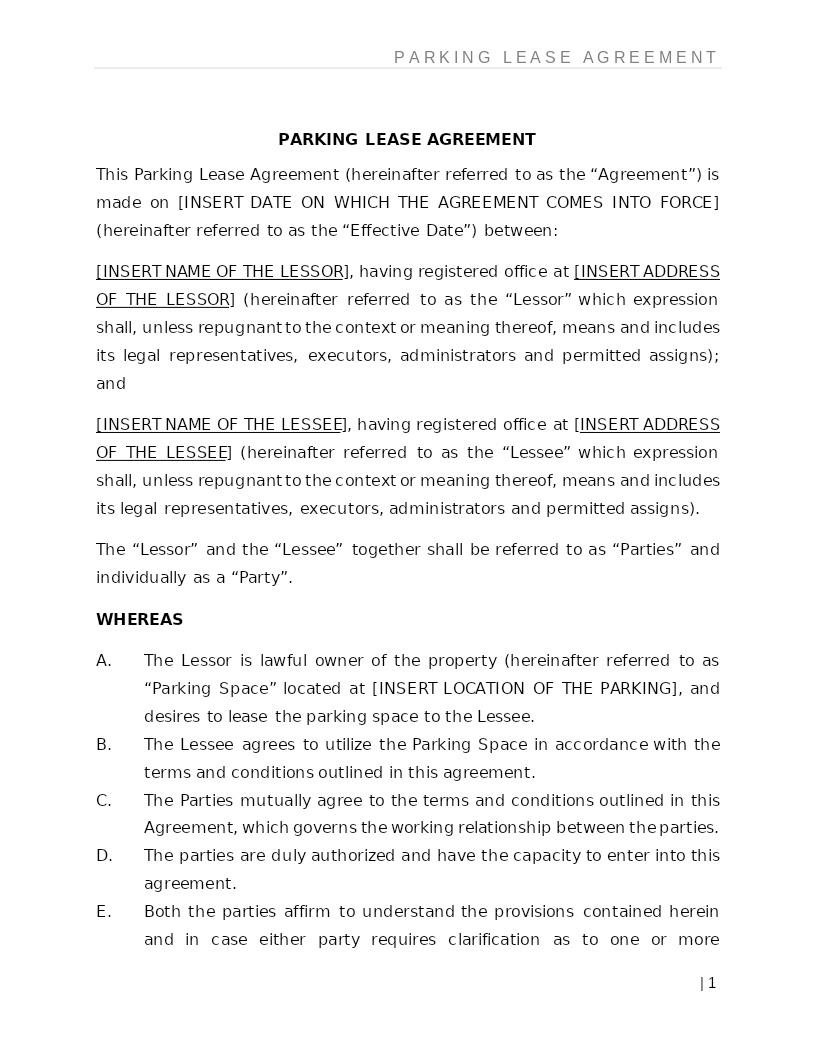
PARKING LEASE AGREEMENT
How does it work?
1. Choose this template
Start by clicking on "Fill out the template"
2. Complete the document
Answer a few questions and your document is created automatically.
3. Save - Print
Your document is ready! You will receive it in Word and PDF formats. You will be able to modify it.
What Is a Parking Lease Agreement?
A Parking Lease Agreement is a legally binding contract that grants an individual or business the right to use a designated parking space for a specified period. It outlines key terms such as the location of the space, permitted use, access rights, rent amount, payment schedule, maintenance responsibilities, security rules, and what happens if either party violates the agreement.
These agreements help prevent disputes, clarify responsibilities, and protect both the property owner and the tenant, especially in high-demand areas like commercial buildings, residential complexes, and shared parking facilities.
Types of Parking Lease Agreements
1. Residential Parking Lease
Used by tenants or homeowners who rent a parking spot within a residential building, gated community, or private driveway.
2. Commercial Parking Lease
Common for businesses leasing dedicated parking spaces for employees, customers, or fleet vehicles.
3. Long-Term or Monthly Parking Agreement
Ideal for individuals or companies needing continuous access to a reserved space.
4. Short-Term or Event-Based Parking Agreement
Used for temporary needs such as events, seasonal use, or visitor parking.
5. Shared or Assigned Parking Arrangement
Allows multiple parties to share allotted spaces based on rotation or time-based schedules.
Global Legal Position on Parking Lease Agreements
Parking Lease Agreements are recognized in most jurisdictions, but enforceability depends on local property, tenancy, and municipal regulations. Below are key frameworks by region:
United States
Parking leases fall under state property and contract laws. Depending on the arrangement, relevant laws may include:
• State landlord-tenant statutes
• Local zoning and parking ordinances
• ADA accessibility requirements
• Standard contract enforcement principles
Courts look for clear terms, lawful use of premises, and fair consideration.
United Kingdom & European Union
Parking agreements are governed by:
• General contract law
• Property and leasehold regulations
• Consumer Rights Act 2015 (if one party is a consumer)
• Local council parking and land-use rules
Operators must also comply with signage and enforcement standards for private parking.
United Arab Emirates (UAE)
Parking leases are subject to:
• UAE Civil Code (Federal Law No. 5/1985)
• Emirate-specific property regulations
• Free-zone real estate rules (e.g., DIFC, ADGM)
Commercial buildings may require permits under municipal parking guidelines.
Saudi Arabia
Parking contracts fall under commercial and civil law principles, guided by:
• Saudi Civil Transactions Law
• Municipal parking regulations
• Sharia-based rules on fairness, transparency, and unjust enrichment
India
Parking leases are enforceable under:
• Indian Contract Act, 1872
• Easements Act, 1882 (where applicable)
• Municipal parking bylaws
• Apartment Ownership Acts for residential societies
Australia & Canada
Governed by:
• General property and contract law
• Local council parking regulations
• Consumer-protection and fair-use rules
Misrepresenting parking availability or safety may breach consumer laws.
Hong Kong
Recognized under:
• Common-law contract principles
• Conveyancing and Property Ordinance
• Building Management Ordinance
• Government lease restrictions
Parking operators must follow truthful disclosure and access rules.
Across all jurisdictions, the core requirements are: clarity, lawful use, fair consideration, safety compliance, and adherence to local property and parking regulations.
Why You Should Consult a Lawyer Before Using This Template
Parking leases may appear simple but can involve significant legal risks, including liability for theft or damage, unauthorized vehicle use, access disputes, and unclear maintenance obligations. A lawyer can help you:
• define exact boundaries and permitted use of the parking space
• draft liability and indemnity clauses
• clarify who is responsible for security, repairs, and compliance
• include rules on vehicle type, parking behavior, and access hours
• ensure local property and municipal requirements are met
• protect you from disputes over towing, damage, or non-payment
Legal review ensures your agreement is enforceable and tailored to your property.
Who Should Use This Template?
• Residential landlords leasing parking spaces
• Property managers and commercial building owners
• Homeowners renting out private driveways or garages
• Businesses securing parking for employees or fleets
• Individuals seeking long-term or monthly reserved parking
• Facility operators managing shared or multi-level parking areas
How to Download and Use This Template
- Click “Fill Out the Template.”
- Enter the parties’ details, parking location, and permitted vehicle type.
- Specify rent, payment schedule, and access rules.
- Add safety, liability, and maintenance clauses.
- Select governing law for your jurisdiction.
- Review with a property lawyer (recommended).
- Download as PDF or Word.
- Sign digitally or physically—both formats are legally valid.
Frequently Asked Questions (FAQs)
1. Is this Parking Lease Agreement valid internationally?
Yes. The template follows widely accepted contract standards and can be adapted to most countries. Enforceability depends on local property and parking regulations.
2. Can homeowners or small property managers use this template?
Absolutely. It suits individual landlords, residential societies, parking operators, and businesses.
3. What clauses protect me from liability?
The agreement includes:
• liability disclaimers
• vehicle-owner responsibility for damages
• indemnity clauses
• access and conduct rules
• insurance requirements (optional)
These help shield the property owner from unnecessary risk.
4. Can this agreement be signed electronically?
Yes. E-signatures are generally valid under:
• ESIGN Act & UETA (U.S.)
• eIDAS Regulation (EU)
• Electronic Transactions Laws (UAE, Australia, etc.)
• IT Act, 2000 (India)
5. What happens if the tenant breaches the contract?
Possible remedies include:
• termination of the parking lease
• towing or removal procedures (where legally allowed)
• recovery of unpaid rent or damages
• legal action or arbitration
• revocation of access rights
Local laws may impose additional compliance requirements.
