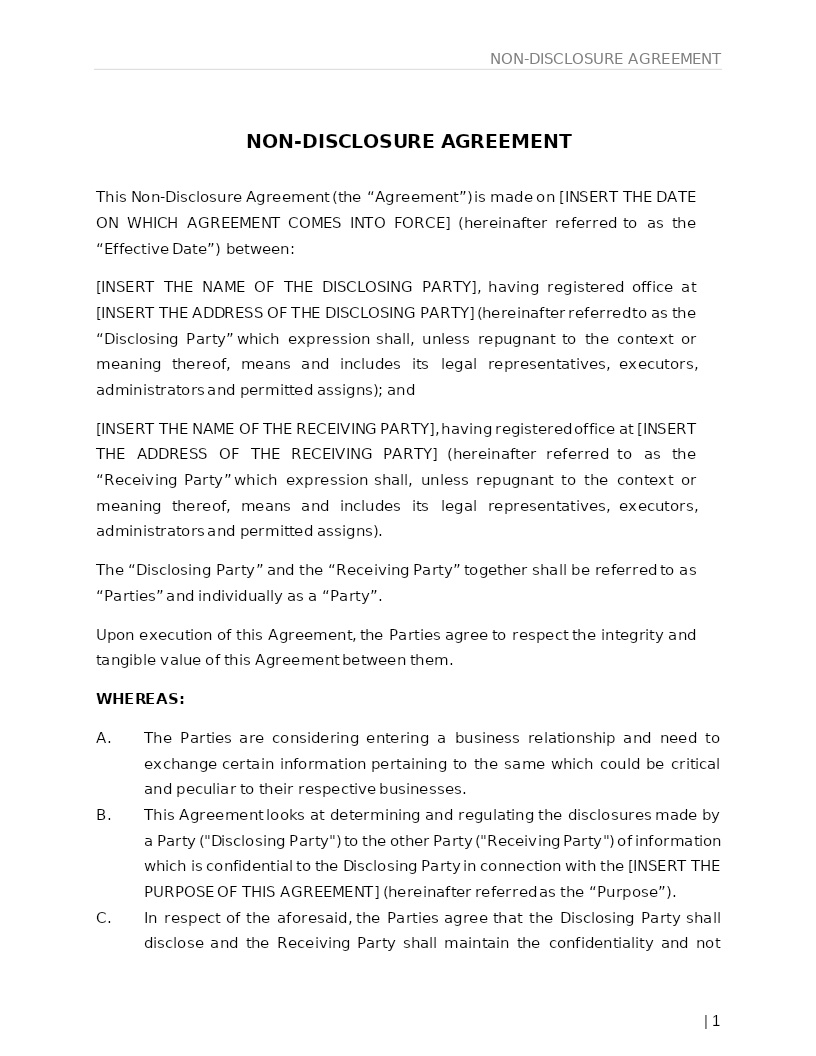
NON-DISCLOSURE AGREEMENT (NDA) TEMPLATE
How does it work?
1. Choose this template
Start by clicking on "Fill out the template"
2. Complete the document
Answer a few questions and your document is created automatically.
3. Save - Print
Your document is ready! You will receive it in Word and PDF formats. You will be able to modify it.
Non-Disclosure Agreement (NDA) Template – Free Lawyer-Drafted Confidentiality Agreement
A Non-Disclosure Agreement (NDA) exists precisely for these moments. It helps set clear confidentiality expectations before information is shared and reduces the risk of misuse or unauthorised disclosure.
This free NDA template provides a strong general framework for protecting confidential information and is commonly used across jurisdictions when adapted with appropriate governing law and local legal requirements.
If you’re preparing to discuss your idea with potential investors, it’s worth understanding why having an NDA in place before disclosing funding-related ideas matters, especially in early-stage conversations.
Quick Legal Summary (At a Glance)
- NDAs are legally binding when properly drafted and signed
- This template offers a clear, structured confidentiality framework
- Enforceability depends on clarity, governing law, and correct execution
- For higher-risk or cross-border matters, legal review is strongly advisable
What Is a Non-Disclosure Agreement (NDA) and When Do You Need One?
A Non-Disclosure Agreement (NDA), also known as a confidentiality agreement template,is a legal contract that obligates one or more parties to keep specified information confidential.
You typically need an NDA when sharing:
- Business ideas or concepts
- Client or customer data
- Financial or commercial information
- Software, processes, or know-how
- Trade secrets or internal documents
A well-structured NDA template clearly outlines:
- What information is considered confidential
- How that information may (and may not) be used
- Who it may be disclosed to, if at all
- What happens if confidentiality is breached
NDAs protect confidential information, not abstract ideas themselves, but they play a critical role in reducing legal and commercial risk.
Types of NDAs: Unilateral, Mutual and Multilateral
This NDA template can be used in different formats depending on how information is shared.
- Unilateral Non-Disclosure Agreement: Used when only one party discloses confidential information, such as a company sharing data with a freelancer, consultant, or service provider.
- Mutual NDA Agreement: A mutual NDA agreement applies when both parties exchange confidential information. This is common in partnerships, joint ventures, and early-stage negotiations.
- Multilateral Non-Disclosure Agreement: Used when three or more parties share confidential information for a defined purpose, reducing the need for multiple bilateral NDAs.
Each format is designed to support clarity and practical business use when adapted correctly.
Are NDAs Legally Enforceable Internationally?
Non-Disclosure Agreements are commonly recognised under contract law in many jurisdictions. Their enforceability depends on proper drafting, lawful purpose, clarity of obligations, governing law, and compliance with local legal requirements.
This NDA template is designed for cross-border use and is commonly adapted across jurisdictions with appropriate governing law and local legal considerations.
- United States: In the United States, NDAs are generally enforced under state contract laws. Enforceability varies by state and depends on factors such as reasonableness, public policy, and how confidential information is defined.
- United Kingdom & European Union: In the UK and EU, NDAs are governed by contract law and equitable confidentiality principles. Where personal data is involved, compliance with data protection regulations such as GDPR is also required.
- United Arab Emirates & Saudi Arabia: NDAs are recognized under civil and commercial laws. Enforceability may depend on local legal principles, public policy considerations, and, in certain cases, Sharia-based interpretations.
- Australia & Canada: NDAs are generally enforceable under contract law, provided the agreement is reasonable in scope, clearly drafted, and supported by lawful consideration.
- Hong Kong: In Hong Kong, NDAs are governed by common-law confidentiality obligations and contractual principles, with courts focusing on clarity, fairness, and legitimate business purpose.
Courts across jurisdictions typically assess NDAs based on lawful purpose, defined scope, fairness, and clarity, rather than broad claims of universal enforceability.
Why a Lawyer-Drafted NDA Offers Better Protection
- While generic online templates exist, a lawyer-drafted NDA provides clearer protections and reduces ambiguity.
- Clear Definitions & Reduced Risk: Professionally drafted clauses help avoid vague language that weakens enforceability.
- Data Protection & Regulatory Awareness: The template can be adapted to align with GDPR, CCPA, DIFC, and other data-related obligations.
- Better Enforcement Structure: Proper governing law and dispute resolution clauses improve predictability if disputes arise.
If your situation involves higher legal or commercial risk, reviewing or customising the NDA with a lawyer can significantly reduce future disputes.
When This NDA Template May Not Be Enough
This template works well for many standard confidentiality situations.
However, legal review is strongly advisable if your situation involves:
- Investment or fundraising discussions
- High-value commercial transactions
- Transfer or assignment of intellectual property
- Regulated industries (fintech, health, data-heavy businesses)
- Cross-border or multi-jurisdictional agreements
- Highly sensitive trade secrets
In such cases, a tailored NDA ensures that confidentiality obligations are properly aligned with the underlying transaction.
Common Mistakes People Make With NDAs
Many confidentiality issues arise not from bad intentions, but from simple mistakes, such as:
- Signing the NDA after sharing confidential information
- Using the same NDA for every situation
- Failing to clearly define what is “confidential”
- Omitting a governing law clause
- Assuming an NDA automatically protects ideas
- Copy-pasting random online templates without review
Understanding these risks helps you use NDAs more effectively and responsibly.
Who Should Use This NDA Template?
This free NDA template is commonly used by:
- Startups sharing ideas with vendors or collaborators
- Freelancers and consultants handling client information
- Businesses outsourcing services
- Companies entering preliminary partnerships
- Professionals exchanging internal or proprietary documents
It provides a practical starting point for confidentiality protection.
How to Use This NDA Template Safely
Step-by-Step
- Click Fill Out the Template
- Enter party details and the purpose of disclosure
- Define confidentiality scope and duration
- Select the governing law
- Review carefully before signing
- Download the NDA in Word or PDF format
Electronic and physical signatures are commonly accepted, provided consent and document integrity are clear.
Frequently Asked Questions (FAQs)
Can I use the same NDA for every situation?
Not always. Different contexts, such as employment, consulting, partnerships, or investment discussions, often require tailored clauses.
Do NDAs protect business ideas?
NDAs protect confidential information, not abstract ideas. Protection depends on how clearly the information is defined and documented.
Is this NDA template valid internationally?
This template is designed for cross-border use, but enforceability depends on local law, governing law selection, and proper execution.
Do NDAs expire?
Yes. Most NDAs specify a confidentiality period, commonly between 1 and 5 years, depending on the nature of the information.
Download the NDA Template
Protect your confidential information with a free, lawyer-drafted Non-Disclosure Agreement template that provides a clear, adaptable confidentiality framework for everyday business use.
Related Templates You May Need
• Consulting Services Agreement
