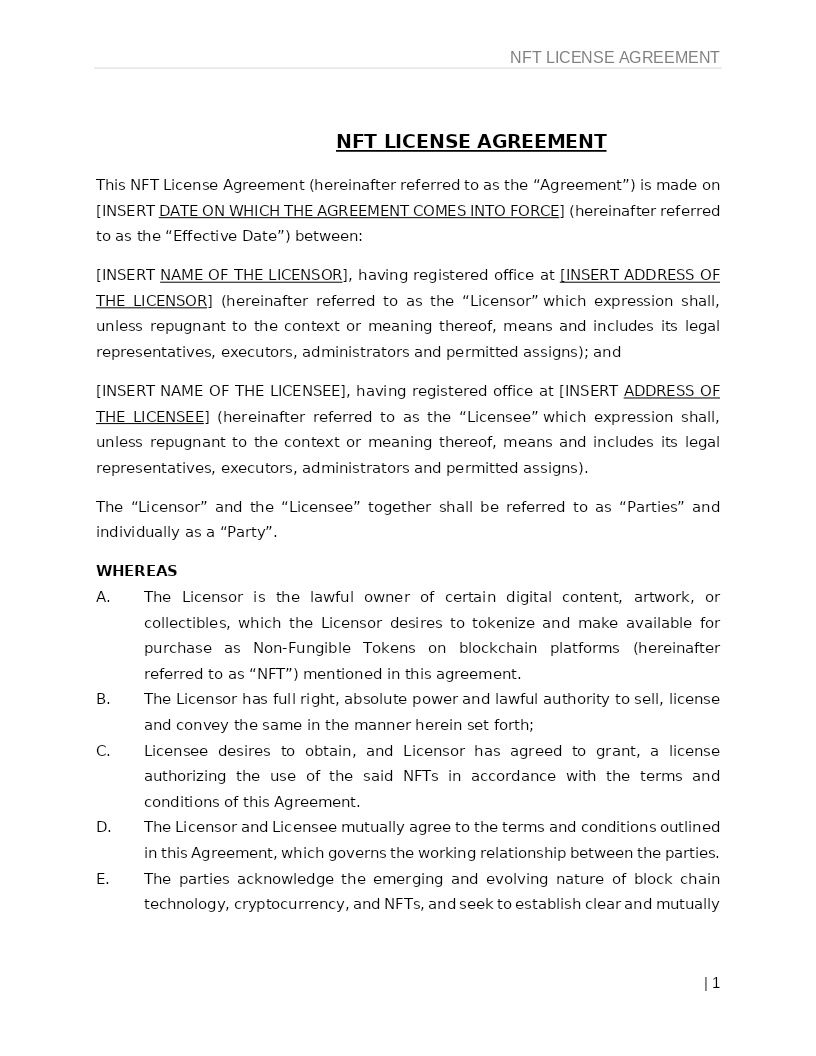
NFT LICENSE AGREEMENT
How does it work?
1. Choose this template
Start by clicking on "Fill out the template"
2. Complete the document
Answer a few questions and your document is created automatically.
3. Save - Print
Your document is ready! You will receive it in Word and PDF formats. You will be able to modify it.
Lawyer-Drafted | Web3-Compliant | Customizable in Word/PDF
Before selling, minting, or transferring NFTs, protect your intellectual property and define clear usage rights for buyers with a comprehensive NFT License Agreement.
What is an NFT License Agreement?
An NFT License Agreement is a legally binding contract that outlines the rights granted to the buyer of a non-fungible token (NFT), such as ownership of the token itself, permitted use of the associated digital asset, resale rights, and commercial usage limitations.
It defines copyright ownership, usage boundaries, royalty structures, intellectual property protections, and responsibilities of creators and buyers.
This agreement ensures both creators and collectors understand what is and is not included in the NFT transaction, preventing misuse, disputes, and unauthorized commercial exploitation.
Types of NFT License Agreements
- Personal Use License: Allows the buyer to display and use the digital asset for personal purposes.
- Limited Commercial License: Grants controlled commercial usage, often with revenue caps or attribution requirements.
- Full Commercial License: Allows the NFT holder to monetize the associated artwork or asset freely.
- Exclusive License: Only one buyer receives usage rights, typically linked to high-value NFTs.
- Creator-Retained Rights License: Creator keeps copyright and grants limited rights to the NFT buyer.
Global Legal Recognition of NFT License Agreements
NFT License Agreements are widely recognized across jurisdictions when drafted with clear IP ownership, usage rights, and digital asset details:
- United States: Governed by copyright law, contract law, and emerging digital-asset regulations.
- United Kingdom & European Union: Must comply with copyright directives, consumer laws, and data protection rules.
- United Arab Emirates (UAE) & Saudi Arabia: Supported under digital commerce laws and IP protection frameworks.
- Australia & Canada: IP and contract laws strongly enforce clear licensing terms for digital assets.
- Hong Kong: Governed by contract law and copyright regulations applicable to digital works.
A clear licensing structure ensures legal enforceability across platforms and global markets.
Why You Should Consult a Lawyer Before Using This Template
NFTs involve complex issues such as copyright ownership, commercial use, blockchain authenticity, and secondary-market royalties.
A lawyer can help tailor the agreement to your project’s structure, marketplace requirements, and regional regulations.
At SolvLegal, our experts can review and customize your agreement within 48 hours to ensure full compliance and protection.
Who Should Use This Template
- NFT creators, artists, and designers
- Web3 projects launching NFT collections
- Marketplaces offering NFT minting or sales
- Collectors seeking clear rights upon purchase
- Businesses licensing digital art, avatars, or tokenized assets
How to Download This Template
- Click Fill out the Template
- Enter creator details, NFT metadata, and licensing terms
- Choose governing law and royalty structure
- (Recommended) Review with legal counsel
- Download in Word or PDF
- Publish alongside your NFT collection or marketplace listing
Frequently Asked Questions (FAQs)
1. Is this NFT License Agreement valid internationally?
Yes. It uses globally accepted IP licensing principles adaptable to most jurisdictions.
2. Who can use this Agreement?
Creators, NFT marketplaces, Web3 startups, collectors, and digital asset businesses.
3. Does buying an NFT automatically transfer copyright?
No. Copyright remains with the creator unless explicitly assigned in the agreement.
4. Are electronic signatures accepted?
Yes. E-signatures are valid under U.S., EU, UAE, and most digital commerce laws.
5. What happens if the NFT buyer misuses the asset?
The creator may revoke the license, pursue damages, or take legal action depending on the violation.
6. Does the Agreement cover commercial usage rights?
Yes. It includes personal, limited commercial, and full commercial licensing options.
7. Can royalties be defined for secondary sales?
Yes. The agreement includes optional royalty terms for marketplace resales.
8. Does it support utility-driven NFTs (e.g., membership or access)?
Yes. Utility terms, access rights, and service benefits can be added.
9. Can multiple NFTs reference one underlying asset?
Yes. The agreement can specify usage limits, shared rights, or non-exclusive licensing.
10. Does it cover blockchain authenticity and metadata?
Yes. The contract references token IDs, smart contract addresses, and metadata links.
11. Can buyers modify or remix the artwork?
Only if allowed. You may grant or restrict derivative work permissions.
12. Does the Agreement include moral rights disclaimers?
Yes. It addresses creator credits, attribution, and moral rights where applicable.
13. Can license rights expire?
Yes. You can set duration limits or tie rights to token ownership.
14. Does it cover marketplace terms and smart contract requirements?
Yes. It includes references to platform policies and on-chain execution.
15. Is the agreement suitable for avatar, gaming, or metaverse assets?
Yes. It fits digital characters, in-game items, skins, and virtual property.
16. Can the agreement restrict offensive or harmful use of the NFT?
Yes. It includes content and usage restrictions to protect creator reputation.
Related Templates You May Need
- Copyright License Agreement – For licensing creative assets outside NFTs.
- Intellectual Property Assignment Agreement – For transferring full ownership to a buyer.
- Commercial Use License – For brands or businesses monetizing digital art.
- Terms of Sale – Digital Assets – For NFT drops, minting pages, and marketplace listings.
