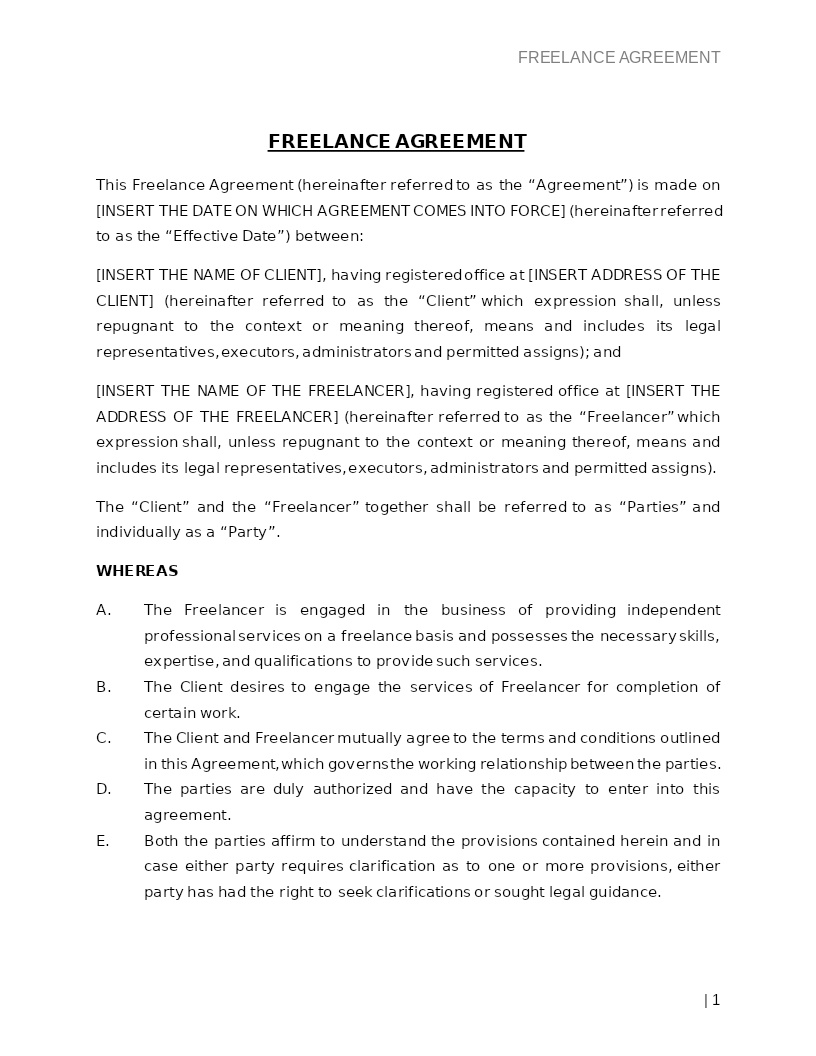
FREELANCE AGREEMENT
How does it work?
1. Choose this template
Start by clicking on "Fill out the template"
2. Complete the document
Answer a few questions and your document is created automatically.
3. Save - Print
Your document is ready! You will receive it in Word and PDF formats. You will be able to modify it.
Freelance Agreement Template – Free, Lawyer-Drafted & Globally Compliant
Most freelance disputes arise because key issues, such as ownership of work, payment timelines, confidentiality, or independent contractor status, are never clearly agreed upfront.
Disputes often arise later, over payment, scope of work, ownership of deliverables, confidentiality, or whether the freelancer was actually an employee in disguise.
A Freelance Agreement exists precisely to reduce this uncertainty. It defines the relationship upfront, preserves independent contractor status, and provides a clear reference point if disagreements arise.
This free Freelance Agreement template provides a general legal framework for documenting freelance and independent contractor engagements, and can be adapted for use across jurisdictions with appropriate governing law, tax considerations, and local legal review.
Quick Legal Summary (At a Glance)
- Freelance Agreements are legally binding when properly drafted and signed
- This template establishes an independent contractor (non-employment) relationship
- Clear scope, payment, and IP clauses reduce misclassification and ownership risks
- Enforceability depends on contract law, tax compliance, and real-world working arrangements
- For cross-border work, sensitive IP, or high-value projects, legal review is strongly recommended
What Is a Freelance Agreement and When Do You Need One?
A Freelance Agreement is a legal contract between a Client and a Freelancer (Independent Contractor) that governs the provision of specific services or deliverables on a project, milestone, or ongoing basis.
You typically need a Freelance Agreement when:
- Hiring freelancers, consultants, or gig workers
- Outsourcing design, development, marketing, writing, or professional services
- Engaging talent for short-term or project-based work
- Protecting intellectual property, confidential information, or business processes
- Avoiding employee misclassification risks
A well-structured Freelance Agreement clearly outlines:
- Scope of services and deliverables
- Timelines, milestones, and payment terms
- Independent contractor status
- Intellectual property ownership
- Confidentiality and data protection obligations
- Termination rights and remedies
Freelance agreements help align expectations, protect business interests, and reduce costly disputes.
Types of Freelance & Independent Contractor Arrangements
This Freelance Agreement template can be adapted for different engagement structures, subject to applicable law:
- Project-Based Engagements: Fixed deliverables with defined timelines and fees
- Milestone-Based Work: Payments linked to project stages or outputs
- Ongoing Retainer Arrangements: Recurring services without employment status
- Creative & Content Services: Design, writing, video, media, and branding work
- Technology & Software Projects: Development, testing, maintenance, and consulting
- Cross-Border Freelance Engagements: International contractors working remotely
Each arrangement may require jurisdiction-specific customization to remain enforceable.
Are Freelance Agreements Legally Enforceable Internationally?
Freelance Agreements are widely recognized under contract law across jurisdictions, provided they clearly establish independent contractor status and comply with tax and labour regulations.
This Freelance Agreement template follows commonly accepted contract law principles and can be adapted for cross-border use with appropriate governing law clauses and jurisdiction-specific legal review. Businesses engaging in remote and international freelance work should also understand evolving compliance requirements for different jurisdictions, particularly in the US, Australia, and India.
- United States: Governed by contract law and independent contractor regulations; classification clauses are critical to avoid misclassification penalties.
- United Kingdom & European Union: Enforceable under contract law, with heightened scrutiny on worker classification and IP ownership, particularly in creative and digital sectors.
- United Arab Emirates & Saudi Arabia: Freelance engagements are permitted under commercial and labour frameworks, often requiring proper licensing and documentation.
- Australia & Canada: Enforced under contract law, with emphasis on distinguishing contractors from employees and clearly defining IP rights.
- India & Southeast Asia: Recognized under contract law; written freelance agreements are strongly recommended to define scope, payment, confidentiality, and tax responsibility.
Across jurisdictions, clear scope definition, contractor classification, and IP ownership are central to enforceability.
Why a Lawyer-Drafted Freelance Agreement Offers Better Protection
While many generic templates exist online, templates drafted by legal professionals generally provide stronger structural protection and clearer risk allocation.
- Clear Scope & Deliverables: Prevents disputes over what work is included (and what is not).
- Independent Contractor Protection: Reduces the risk of accidental employment classification.
- Stronger IP & Confidentiality Clauses: Ensures ownership and data protection align with business needs.
- Balanced Termination & Liability Provisions: Improves predictability if the relationship ends early.
If your freelance engagement involves valuable IP, regulatory exposure, or international parties, professional review can prevent costly mistakes.
When You Should Definitely Consult a Lawyer
This Freelance Agreement template is suitable for many standard freelance and independent contractor engagements. However, legal advice is strongly recommended if your freelance arrangement involves:
- High-value projects or significant financial exposure
- Long-term, exclusive, or ongoing freelance relationships
- Sensitive intellectual property, trade secrets, or proprietary technology
- Cross-border or international freelance engagements
- Complex payment structures, milestones, royalties, or revenue-sharing models
- Regulatory, data protection, or industry-specific compliance requirements
- Increased risk of employee misclassification or labour law scrutiny
In such cases, professional legal review helps reduce the risk of disputes, misclassification penalties, intellectual property conflicts, and unintended legal or tax consequences.
When This Freelance Agreement Template May Not Be Enough
This template works well for many standard freelance situations.
However, legal review is strongly recommended if the engagement involves:
- High-value or mission-critical projects
- Exclusive or long-term contractor relationships
- Sensitive intellectual property or trade secrets
- Cross-border tax or regulatory exposure
- Equity, royalties, or revenue-sharing arrangements
- Highly regulated industries (fintech, healthcare, data-driven services)
In such cases, tailoring the agreement ensures legal compliance and commercial clarity.
Want this Freelance Agreement reviewed or customised by a lawyer?
If your freelance engagement involves high-value work, sensitive intellectual property, long-term relationships, or cross-border contractors, a SolvLegal lawyer can review and customise this Freelance Agreement to align with your business model, compliance obligations, and risk exposure.
Common Mistakes People Make With Freelance Agreements
Many disputes arise from avoidable errors, including:
- Treating freelancers like employees in practice
- Using vague or open-ended scope descriptions
- Failing to address IP ownership clearly
- Ignoring tax and withholding responsibilities
- Missing governing law and jurisdiction clauses
- Copy-pasting generic online templates without review
Understanding these risks helps ensure freelance agreements are used correctly and safely.
Who Should Use This Freelance Agreement Template?
This template is commonly used by:
- Businesses engaging freelancers or consultants
- Startups and agencies outsourcing specialized work
- Creative professionals (designers, writers, videographers)
- Technology and software development teams
- Marketing, digital, and professional service providers
- Companies hiring remote or international freelancers
How to Use This Freelance Agreement Template Safely
Step-by-Step
- Click Fill Out the Template
- Enter client and freelancer details
- Define scope of work, timelines, and payment structure
- Customize IP ownership, confidentiality, and governing law
- Review the agreement for jurisdiction-specific compliance
- Download in Word or PDF format
- Sign electronically or in person, as permitted by law
Electronic signatures are widely recognized under global e-signature laws.
Frequently Asked Questions (FAQs)
Is a Freelance Agreement legally binding?
Yes. A Freelance Agreement is legally binding once it is properly drafted and signed by both the Client and the Freelancer. It creates enforceable rights and obligations under contract law, provided the terms are lawful and the parties have agreed voluntarily.
Does a Freelance Agreement create an employment relationship?
No. A Freelance Agreement is designed to establish an independent contractor relationship, not employment. The freelancer remains self-employed and is not entitled to employee benefits, provided the agreement and the actual working arrangement reflect independent contractor status.
Who owns the intellectual property created by a freelancer?
In most freelance arrangements, intellectual property ownership transfers to the Client after full payment is made, unless the agreement states otherwise. This template allows the parties to clearly define who owns the work product, helping avoid future disputes over IP rights.
Can this Freelance Agreement be used for short-term or recurring work?
Yes. This Freelance Agreement can be customized for one-time projects, milestone-based assignments, or ongoing freelance engagements. The scope, duration, and payment structure can be adjusted to match the nature of the work.
Are electronic signatures valid for a Freelance Agreement?
Yes. Electronic signatures are widely recognized and legally valid in most jurisdictions under electronic signature laws, as long as the intent to sign and the integrity of the document are clear.
What happens if either party breaches the Freelance Agreement?
If either party breaches the agreement, the non-breaching party may have the right to terminate the contract and seek legal remedies, such as damages or other relief, as permitted under the applicable law and the terms of the agreement.
Download the Freelance Agreement Template
Protect your business, clarify expectations, and reduce legal risk with a free, lawyer-drafted Freelance Agreement template designed for real-world freelance engagements.
Related Templates You May Need
- Independent Contractor Agreement
- Non-Disclosure Agreement (NDA)
- Intellectual Property (IP) Assignment Agreement
