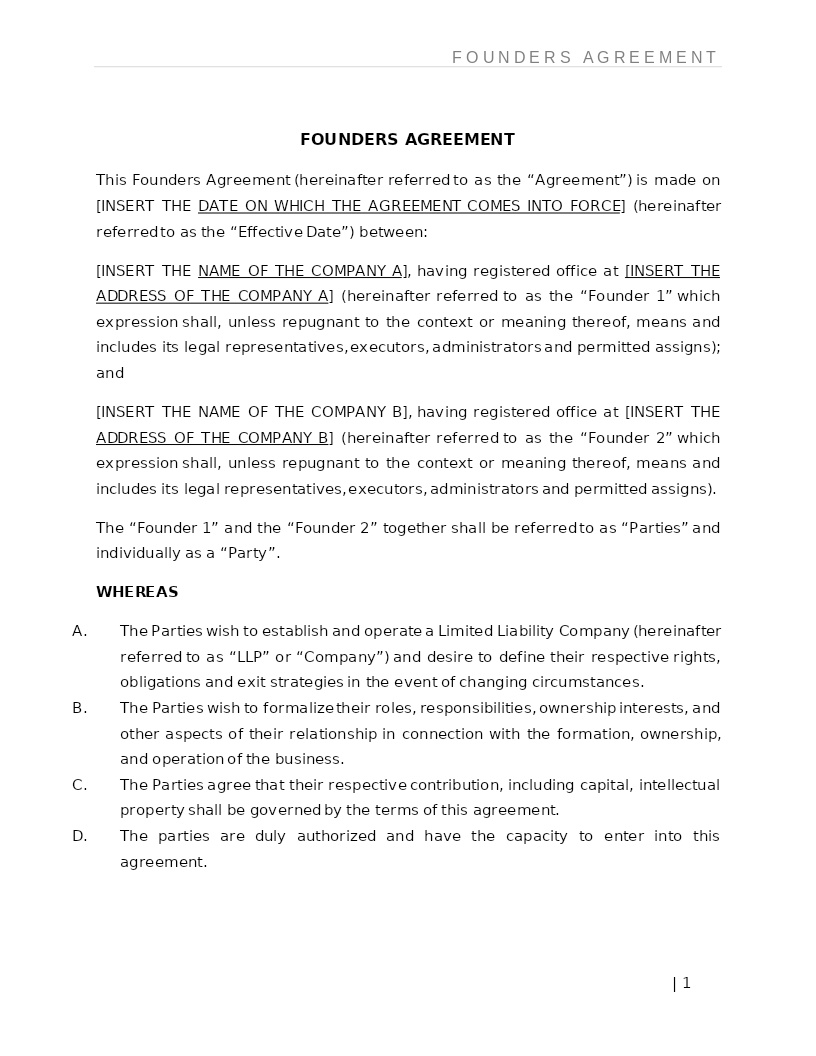
FOUNDERS AGREEMENT
How does it work?
1. Choose this template
Start by clicking on "Fill out the template"
2. Complete the document
Answer a few questions and your document is created automatically.
3. Save - Print
Your document is ready! You will receive it in Word and PDF formats. You will be able to modify it.
What is a Founders Agreement?
Most startup disputes don’t start in court, they start when founders never clearly agreed who owns the product, who controls decisions, or what happens if someone walks away.
Equity splits postponed until “later,” unclear roles, verbal promises, or assumptions about IP ownership often turn into serious conflicts once money, traction, or investors enter the picture.
Disputes commonly arise over ownership percentages, decision-making authority, intellectual property, exits, or what happens when a founder stops contributing.
A Founders Agreement exists to prevent these issues before they arise. It defines expectations upfront, aligns founders legally and commercially, and provides a clear reference point if disagreements occur.
This Founders Agreement template provides a general legal framework for documenting founder relationships and may be adapted across jurisdictions with appropriate governing law and local legal review.
Quick Legal Summary (At a Glance)
- Founders Agreements are legally binding when properly drafted and signed
- Defines ownership, roles, vesting, and decision-making from day one
- Protects company intellectual property from founder disputes
- Helps prevent deadlocks, exits without clarity, and equity conflicts
- Strongly recommended before or during early-stage formation
What Is a Founders Agreement and When Do You Need One?
A Founders Agreement is a legal contract executed among the co-founders of a business or startup that governs their relationship during the formation and early growth of the venture.
You typically need a Founders Agreement when:
- Starting a business with two or more founders
- Building a startup before formal incorporation
- Contributing ideas, capital, technology, or effort jointly
- Planning to raise investment in the future
- Wanting clarity on ownership, roles, and exits
A well-structured Founders Agreement clearly outlines:
- Equity ownership and capital contributions
- Roles, responsibilities, and authority
- Vesting schedules and founder commitment
- Intellectual property ownership
- Exit, transfer, and buy-back rights
- Dispute resolution mechanisms
Founders Agreements reduce uncertainty, align incentives, and protect both the founders and the business itself.
Types of Founder & Startup Arrangements
This Founders Agreement template can be adapted for different founder and early-stage business structures, subject to applicable law:
- Equal Co-Founder Structures: Founders holding equal equity and shared decision-making authority
- Unequal Equity Arrangements: Founders contributing different levels of capital, expertise, or time
- Active & Passive Founder Setups: Some founders involved in daily operations, others in advisory or strategic roles
- Technology-Driven Startups: Founders contributing software, IP, platforms, or technical know-how
- Service or Product-Based Ventures: Businesses focused on professional services, physical products, or digital offerings
- Cross-Border Founder Teams: Founders located in different jurisdictions collaborating remotely
Each arrangement may require jurisdiction-specific customization to remain enforceable.
Are Founders Agreements Legally Enforceable Internationally?
Yes. Founders Agreements are generally enforceable under contract law, provided they are properly drafted, signed, and comply with applicable local laws.
This template follows widely accepted legal principles and can be adapted for use in multiple jurisdictions with appropriate governing law clauses.
Enforceability typically depends on:
- Valid consent of all founders
- Lawful subject matter
- Clear obligations and consideration
- Compliance with local company and contract laws
Once the company is incorporated, certain provisions may be migrated into shareholders’ agreements or constitutional documents.
Why a Lawyer-Drafted Founders Agreement Offers Better Protection
Generic online templates often fail to address real founder risks.
Founders Agreement templates drafted by legal professionals generally provide:
- Clear equity and vesting logic to avoid disputes
- Strong IP assignment to protect the company
- Balanced exit and buy-back mechanisms
- Legally compliant restrictions and confidentiality clauses
- Investor-ready governance structure
For startups planning growth or funding, proper founder documentation is critical.
When You Should Definitely Consult a Lawyer
This template is suitable for many early-stage founder arrangements.
However, legal advice is strongly recommended if:
- The startup involves significant IP or technology
- Founders contribute unequal capital or effort
- Vesting, cliffs, or performance conditions are complex
- Cross-border founders are involved
- External investors are expected
- There is a risk of founder deadlock
Early legal clarity is far cheaper than resolving disputes later.
When This Founders Agreement Template May Not Be Enough
This template works well for early-stage alignment.
However, legal review is strongly recommended if the venture involves:
- Fundraising or venture capital investment
- Complex share classes or ESOPs
- Regulated industries (fintech, healthcare, crypto)
- Multiple jurisdictions
- Mergers, acquisitions, or spin-offs
In such cases, legal customisation helps address compliance requirements and investor expectations more effectively.
Want This Founders Agreement Reviewed or Customised by a Lawyer?
If your startup involves high-value intellectual property, multiple founders, planned investment rounds, or cross-border operations, a SolvLegal lawyer can review and customise this Founders Agreement to reflect your business model, governance needs, and risk profile.
Common Mistakes People Make With Founders Agreements
Many founder disputes arise from avoidable errors, including:
- Splitting equity equally without considering roles or contribution
- Delaying vesting discussions
- Failing to assign IP to the company
- Relying on verbal understandings
- Ignoring exit and deadlock scenarios
- Copy-pasting generic templates without review
Many of these mistakes stem from founders signing standard contracts without fully understanding their implications. Certain clauses in standard or generic agreements may create unintended risks later, as discussed in Why Startups Fail After Signing Standard Contracts: Hidden Clauses Founders Ignore.
Understanding these risks helps founders protect both relationships and the business.
How to Use This Founders Agreement Template Safely
Step-by-Step
- Click Fill Out the Template
- Enter details of all founders and the proposed business
- Define equity ownership, roles, responsibilities, and vesting terms
- Customize intellectual property ownership, confidentiality, and decision-making provisions
- Review the agreement for compliance with applicable company and contract laws
- Download the document in Word or PDF format
- Sign the agreement physically or electronically, as permitted by law
Electronic signatures are generally recognized under modern contract and e-signature laws in most jurisdictions.
Frequently Asked Questions (FAQs)
Is a Founders Agreement legally binding?
Yes. Once all founders sign it, a Founders Agreement becomes a legally enforceable contract under applicable contract law. It clearly sets out rights, responsibilities, and expectations, and can be relied upon if disputes arise later.
Is a Founders Agreement the same as a Shareholders Agreement?
No. A Founders Agreement governs the relationship between founders at the idea or early formation stage, often before incorporation. A Shareholders Agreement applies after the company is incorporated and regulates shareholder rights within the company.
Can a Founders Agreement be amended later?
Yes. Founders Agreements are not static and can evolve as the business grows. Any amendment usually requires the written consent of all founders to ensure changes are transparent and mutually agreed.
Does a Founders Agreement require registration?
In most cases, no formal registration is required for a Founders Agreement to be valid. However, once the company is incorporated, key provisions may be reflected in the Articles of Association or a Shareholders Agreement.
Should a Founders Agreement include IP and confidentiality clauses?
Absolutely. IP assignment and confidentiality clauses ensure that ideas, code, designs, and business information belong to the company and not individual founders, which is critical for growth and investor confidence.
Download the Founders Agreement Template
Protect your startup, align founder expectations, and reduce legal risk with a free, lawyer-drafted Founders Agreement template designed for real-world startup and early-stage business formation.
