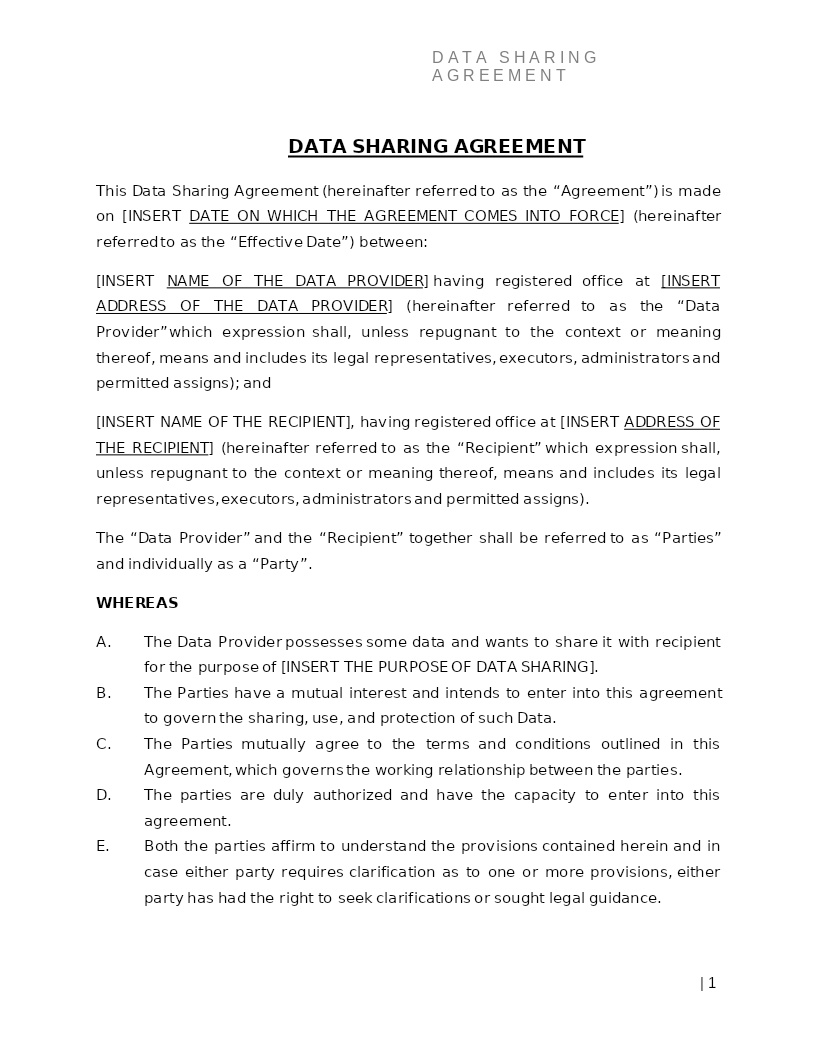
DATA SHARING AGREEMENT
How does it work?
1. Choose this template
Start by clicking on "Fill out the template"
2. Complete the document
Answer a few questions and your document is created automatically.
3. Save - Print
Your document is ready! You will receive it in Word and PDF formats. You will be able to modify it.
Lawyer-Drafted | Privacy-Compliant | Customizable in Word/PDF
Before transferring or exchanging any personal, sensitive, or business data, protect your organization’s legal obligations and data security responsibilities with a comprehensive Data Sharing Agreement.
What is a Data Sharing Agreement?
A Data Sharing Agreement is a legally binding contract that outlines the terms under which two or more parties share data with one another.
It defines the type of data being shared, the purpose of sharing, security requirements, data protection responsibilities, access controls, retention periods, and compliance obligations under privacy laws such as GDPR, CCPA, and global data protection frameworks.
This agreement ensures transparency, accountability, and lawful processing of shared data, safeguarding all parties involved and protecting individuals’ privacy rights.
Why a Data Sharing Agreement Matters
- Ensures full compliance with global data protection laws
- Clarifies each party’s responsibilities regarding storage, security, and usage
- Reduces legal and operational risks
- Protects individuals’ rights and sensitive information
- Establishes a professional and accountable framework for data handling
Who Should Use This Template
- Businesses sharing customer, employee, or partner data
- SaaS companies integrating with third-party platforms
- Healthcare providers exchanging patient information
- Research institutions collaborating on data-driven studies
- Agencies, vendors, or partners exchanging operational or analytical data
How to Download This Template
- Click Fill out the Template
- Enter details about the data, parties, purpose, and security requirements
- Select governing law and compliance frameworks (e.g., GDPR, CCPA)
- (Recommended) Review with legal counsel
- Download in Word or PDF format
- Sign digitally or execute physically
Frequently Asked Questions (FAQs)
1. Is this Data Sharing Agreement valid internationally?
Yes. It is based on global standards for data protection and can be adapted for specific jurisdictions.
2. Who can use this Agreement?
Any organization or individual sharing personal, sensitive, or operational data with another party.
3. Does this Agreement comply with GDPR and CCPA?
Yes. It includes obligations for GDPR, CCPA, and other major privacy laws.
4. Are electronic signatures allowed?
Yes. Digital signatures are legally valid under most global e-transaction laws.
5. What happens if data is mishandled or breached?
The agreement includes breach notifications, liability terms, and obligations for corrective action.
6. Does the Agreement specify what data can be shared?
Yes. It defines the categories, purpose, and lawful basis for sharing data.
7. Can this Agreement cover sensitive or medical data?
Yes. It includes special provisions for protected or highly sensitive data categories.
8. Does it include data security standards?
Yes. Encryption, access control, and technical security obligations are included.
9. Can the parties restrict how the data is used?
Yes. Usage limitations and purpose restrictions are clearly outlined.
10. Does the Agreement address subcontractors or processors?
Yes. It regulates how third parties may access and handle shared data.
11. Are retention and deletion terms covered?
Yes. The agreement defines how long data may be stored and how it must be deleted.
12. Can audit rights be included?
Yes. You can include audit and inspection rights to ensure compliance.
13. Does it allow cross-border data transfers?
Yes. The agreement includes safeguards for international transfers where permitted.
14. Can data be anonymized under this Agreement?
Yes. Clauses allow for anonymization or pseudonymization if required.
15. Does it include liability and indemnification terms?
Yes. It covers risk allocation and legal protections for all parties.
16. Can this Agreement be used for multi-party data sharing?
Yes. It can be adapted for consortiums, networks, or multi-stakeholder projects.
Related Templates You May Need
- Data Processing Agreement (DPA) – Required when a processor handles data on behalf of a controller.
- Privacy Policy – For explaining how data is collected, used, and protected.
- Non-Disclosure Agreement (NDA) – To secure confidential information during collaboration.
- Information Security Policy – For outlining internal security practices and compliance standards.
