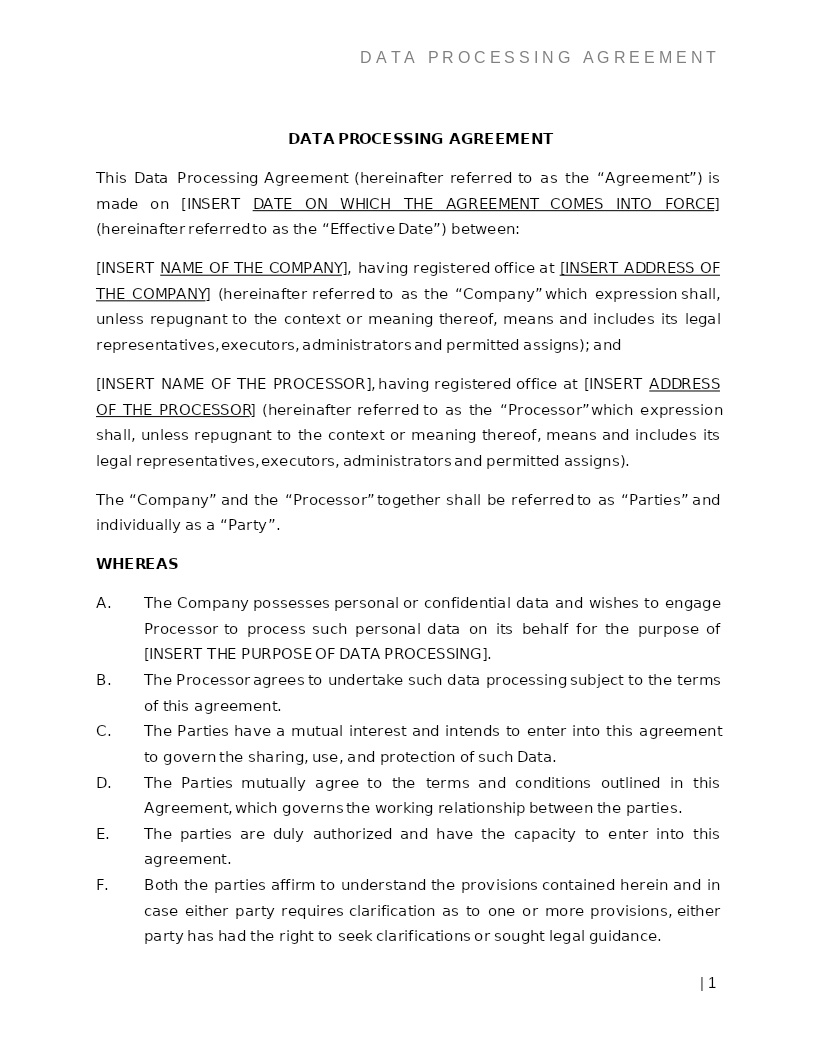
DATA PROCESSING AGREEMENT
How does it work?
1. Choose this template
Start by clicking on "Fill out the template"
2. Complete the document
Answer a few questions and your document is created automatically.
3. Save - Print
Your document is ready! You will receive it in Word and PDF formats. You will be able to modify it.
Lawyer-Drafted | GDPR-Compliant | Customizable in Word/PDF
Before sharing, handling, or outsourcing the processing of personal data, protect your business and comply with global privacy laws using a clear and enforceable Data Processing Agreement (DPA).
What is a Data Processing Agreement?
A Data Processing Agreement (DPA) is a legally binding contract required whenever one party (the Data Controller) engages another party (the Data Processor) to handle or process personal data on its behalf.
It defines how personal data will be collected, stored, accessed, transferred, secured, and eventually deleted—all in compliance with privacy regulations such as GDPR, CCPA, UK Data Protection Act, and other international laws.
A DPA establishes accountability, ensures secure data handling, and protects individuals’ privacy rights while reducing risk for both parties involved in the data processing activity.
Types of Data Processing Agreements
· Controller-to-Processor DPA: The most common form, used when a business hires a vendor to process data.
· Processor-to-Subprocessor DPA: Used when a processor outsources processing tasks to another service provider.
· Joint Controller Agreement: When two or more organizations jointly determine the purpose and means of data processing.
· Cross-Border Data Processing Agreement: For international data transfers, including Standard Contractual Clauses (SCCs).
Global Legal Recognition of Data Processing Agreements
DPAs are recognized and required in major jurisdictions worldwide:
· United States: Required under several state privacy laws, including CCPA/CPRA.
· United Kingdom & European Union: Mandatory under GDPR, with strict requirements for lawful processing and security measures.
· United Arab Emirates (UAE) & Saudi Arabia: Required under new data protection laws regulating cross-border transfers and security controls.
· Australia & Canada: Governed by national privacy and data security legislation (PIPEDA, Privacy Act 1988).
· Hong Kong: Recognized under PDPO, with contractual safeguards required for data processors.
A properly structured DPA helps businesses comply with global privacy standards and avoid penalties.
Why You Should Consult a Lawyer Before Using This Template
Data processing regulations vary across jurisdictions and often require precise legal language to ensure compliance, especially regarding cross-border transfers, sub-processing, and technical security measures.
A lawyer can tailor your DPA to your industry, platform, and risk profile.
At SolvLegal, our privacy experts can review and customize this agreement within 48 hours to ensure it meets global regulatory requirements.
Who Should Use This Template
· SaaS companies processing customer or user data
· Businesses outsourcing data storage, analytics, or support services
· Companies using cloud platforms, CRM systems, or marketing tools
· Organizations working with agencies, developers, or service providers
· Any business sharing personal data with third parties
How to Download This Template
1. Click Fill out the Template
2. Enter the nature of data processed, roles of each party, and security measures
3. Choose governing privacy laws (GDPR, CCPA, etc.)
4. (Recommended) Have your legal advisor review the final document
5. Download in Word or PDF format
6. Sign electronically or execute physically
Frequently Asked Questions (FAQs)
1. Is this Data Processing Agreement valid internationally?
Yes. It is drafted based on GDPR and widely recognized global data protection standards.
2. Who needs a DPA?
Any business that outsources personal data processing to a vendor, contractor, or service provider.
3. Does the DPA ensure GDPR compliance?
Yes. It includes all required GDPR provisions, including Article 28 obligations.
4. Are electronic signatures accepted?
Yes. Digital signatures are legally recognized for DPAs globally.
5. Does the DPA specify the types of data being processed?
Yes. You can define data categories (personal, sensitive, financial, health, etc.).
6. What happens if a processor breaches the agreement?
The controller may suspend access, terminate the contract, or seek legal remedies.
7. Can this Agreement cover sensitive health or financial data?
Yes. It includes additional protections for sensitive and special-category data.
8. Does it include breach notification obligations?
Yes. It specifies timelines and procedures for reporting data breaches.
9. Can the processor hire subcontractors?
Only if allowed. The DPA regulates subprocessor approvals and obligations.
10. Does the DPA include cross-border transfer rules?
Yes. It supports SCCs, privacy frameworks, and international transfer requirements.
11. Does it define how long data can be stored?
Yes. It sets clear retention and deletion timelines.
12. Are technical and organizational security measures included?
Yes. Encryption, access controls, audits, and risk safeguards are provided.
13. Can the controller audit the processor?
Yes. Optional audit and inspection rights are included.
14. Does it include confidentiality obligations?
Yes. Staff and subcontractors must maintain strict confidentiality.
15. Is liability for misuse or negligence addressed?
Yes. The DPA includes liability limitations and indemnity clauses.
16. Does it specify deletion or return of data after termination?
Yes. Complete deletion or secure return of data is required at contract end.
Related Templates You May Need
· Data Sharing Agreement – For exchanging personal data between organizations.
· Privacy Policy – To inform users how their data is collected and used.
· Information Security Policy – To set internal security standards.
· Non-Disclosure Agreement (NDA) – To protect confidential information shared with vendors.
