Master Service Agreements for IT Services in India: 10 Clauses Technology Companies Should Review Carefully
Read More
Why Every Software OEM Needs a Strong Limitation of Liability Clause in Its Software Reseller Agreement
By the SolvLegal Team
Published on: Aug. 2, 2026, 12:10 p.m.
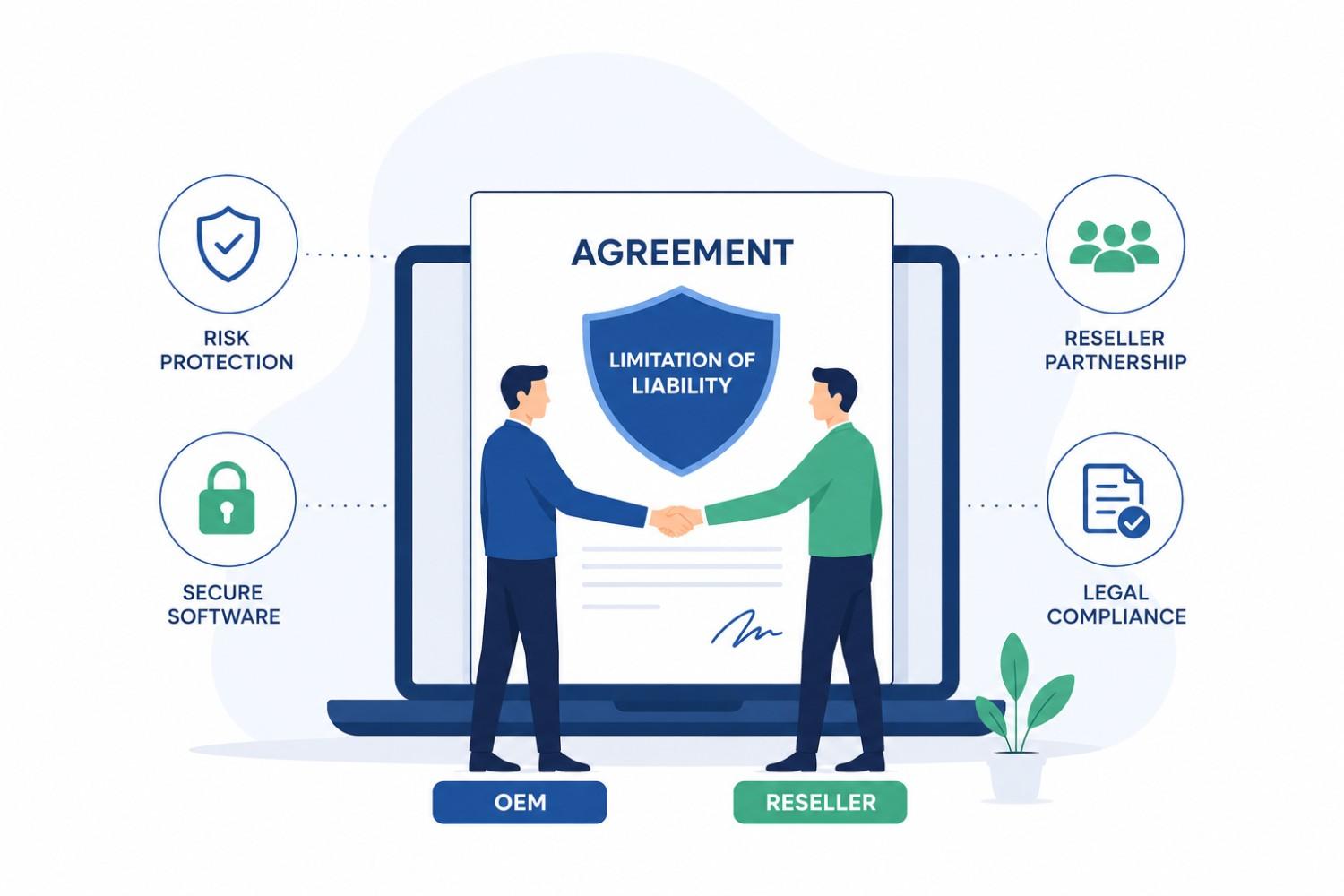
A reseller promises a customer something your software cannot deliver.
The customer’s business is disrupted. Data goes missing. Revenue is lost.
The customer sues. Not the reseller who made the promise. You, the software OEM whose name is on the licence.
This scenario plays out more often than most software vendors realise, and it is precisely why a well-drafted limitation of liability clause is one of the most valuable pieces of legal protection in any software reseller agreement.
If you are a software OEM, SaaS company, or technology vendor selling through resellers, distributors, or channel partners, your exposure to legal and financial risk grows every time a new partner signs on. A limitation of liability clause does not eliminate that risk. It manages it, allocates it fairly, and keeps your business commercially sustainable. This article explains why the clause matters, what it should contain, and how to draft one that actually protects your business rather than sitting in the contract as boilerplate nobody reads.
The OEM Challenge: Growing Through Resellers Means Losing Direct Control
Selling software through a reseller network is one of the fastest ways for a software OEM to scale. Resellers bring local market knowledge, existing customer relationships, and sales capacity that would take years to build internally. For most software vendors, a channel partner agreement is not optional. It is the growth engine.
But that growth comes with a trade-off. The moment a reseller sits between you and the end customer, you lose a degree of control over how your product is presented, sold, implemented, and supported.
Consider what can go wrong in a typical software distribution agreement structure:
• A reseller oversells the software’s capabilities to close a deal, promising features or integrations the product does not actually have.
• A reseller mishandles implementation, causing downtime or data loss that the end customer attributes to your software.
• A reseller’s support team gives the customer incorrect guidance, leading to a licence misuse issue or a security misconfiguration.
• A customer experiences a business interruption and looks for the deepest pocket to recover their losses, which is usually the OEM, not the reseller.
None of these events need to involve any fault on the OEM’s part. Yet without a properly drafted software reseller agreement, the OEM can still end up carrying the financial and reputational consequences.
This is the core commercial reality every software vendor needs to accept: reseller agreements create indirect exposure. Your legal agreements need to account for risks you do not directly control. This is precisely where the limitation of liability clause becomes essential, not as a defensive afterthought, but as a foundational risk management tool.
What Is a Limitation of Liability Clause?
In plain English, a limitation of liability clause is a contract provision that sets boundaries on how much a party can be required to pay, and for what types of losses, if something goes wrong.
It is important to understand what this clause is not. It is not a way of avoiding responsibility altogether. A limitation of liability clause does not let an OEM walk away from genuine failures or ignore its obligations under a software licensing agreement. What it does is define, in advance, the outer limits of financial exposure and the categories of loss that fall outside the contract’s scope.
Think of it as a risk allocation tool. Every commercial contract involves some level of uncertainty. A limitation of liability clause is how two sophisticated parties agree, in advance, on who bears which portion of that uncertainty. This is standard practice across commercial contracts and technology contracts generally, but it carries particular weight in software agreements because of how software risk behaves.
Why This Clause Matters More in Software Reseller Agreements
Software is not like other products. When a reseller sells a physical product, the risks are relatively contained. When a reseller sells software, especially through a SaaS agreement or subscription licence, the potential for cascading loss is much higher.
Here is why limitation of liability deserves special attention in a software distribution agreement.
Downtime and Business Interruption
If the software goes down, even briefly, the end customer may claim significant business interruption losses. A retailer might claim lost sales. A logistics company might claim missed deliveries. These losses can dwarf the actual value of the software licence itself.
Cybersecurity and Data Loss
Software vendors increasingly face claims related to data breaches, data loss, or security vulnerabilities. If a reseller implements the software poorly, or if the end customer’s data is compromised, the OEM can be pulled into disputes about who was responsible for what layer of security.
Implementation Failures
Resellers often handle onboarding, configuration, and implementation. When implementation goes wrong, whether due to reseller error, customer environment issues, or genuine product limitations, the resulting dispute frequently ends up at the OEM’s door because the reseller may lack the financial resources to satisfy a claim.
Integration Issues
Modern software rarely operates in isolation. It integrates with other platforms, APIs, and third-party systems. When an integration fails, the root cause can be genuinely difficult to pin down, and customers often assume the core software provider is responsible.
Reseller Misrepresentation
This is one of the most common and most dangerous risks. A reseller, eager to close a sale, may promise capabilities the software does not have or make commitments about support levels the OEM never agreed to. When those promises are not met, the end customer’s frustration is directed at the OEM.
Support and Service Failures
Even where the OEM is not directly providing support, customers often perceive first-line and second-line support as part of the “software company’s” responsibility. Gaps in reseller support can generate liability exposure for the OEM by association.
Licence Misuse
Resellers sometimes sub-license, bundle, or use the software in ways that were never authorised. This creates both intellectual property risk and liability risk if the misuse causes downstream harm to an end customer.
Each of these risks is amplified because software reseller agreements typically involve three parties: the OEM, the reseller, and the end customer, but only two formal contracts (OEM-reseller and reseller-end customer). This structural gap is exactly where disputes get messy, and exactly why the limitation of liability clause in the OEM-reseller agreement needs to be airtight.
Key Components Every OEM Should Include
A generic, copy-paste limitation of liability clause is not good enough for a software reseller agreement. The clause needs to be built around the specific risks of software distribution. Here are the components that matter most, and why each one matters.
1. The Liability Cap
A liability cap sets the maximum financial exposure the OEM will accept under the agreement. Without a cap, an OEM’s liability is theoretically unlimited, meaning a single dispute could threaten the entire business regardless of the value of the underlying contract.
Caps are commonly tied to a multiple of fees paid under the agreement (for example, fees paid in the preceding 12 months), rather than a fixed sum, because this scales the cap to the actual commercial relationship.
2. Exclusion of Indirect Damages
Indirect damages are losses that do not flow directly from the breach itself but arise as a secondary consequence. Excluding indirect damages prevents an OEM from being drawn into speculative or hard-to-quantify claims that were never contemplated when the contract was signed.
3. Consequential Losses
Consequential loss is a closely related but distinct concept from indirect loss, and the two terms are often used together (or confused) in contracts. Explicitly excluding consequential losses closes a common gap that claimants try to exploit when direct loss exclusions alone are not broad enough.
4. Loss of Profits
Loss of profits claims can be enormous and are notoriously difficult to calculate with precision. An end customer might argue that a software failure cost them a specific amount of projected revenue. Excluding loss of profits (subject to any carve-outs the parties agree) keeps the OEM’s exposure tied to real, demonstrable losses rather than speculative business projections.
5. Loss of Goodwill
Reputational harm is real but almost impossible to value objectively. Without an exclusion, a party could attempt to claim substantial damages for vague reputational impact. Express exclusion removes this ambiguity.
6. Business Interruption
As discussed above, business interruption losses can be significant and largely outside the OEM’s control, particularly where the interruption stems from the reseller’s implementation or the customer’s own infrastructure. This exclusion should be considered alongside, and clearly distinguished from, any uptime or service level commitments the OEM has separately made.
7. Data Loss
Data loss claims are increasingly common and can be extremely expensive, particularly where regulatory notification obligations or customer compensation are involved. The clause should clarify the OEM’s position on data loss liability, while working in tandem with data protection clauses and any data processing terms elsewhere in the agreement.
8. Confidentiality Breaches
Confidentiality breaches often carry their own liability treatment, sometimes excluded from the general cap altogether, because the harm from a confidentiality breach can be disproportionate to the contract value. OEMs should decide deliberately whether confidentiality breaches sit inside or outside the general liability cap.
9. Intellectual Property Infringement
IP claims are a distinct risk category. Software OEMs typically need to consider whether to offer IP indemnities to resellers (protecting the reseller against third-party IP claims relating to the software) and how that indemnity interacts with the overall liability cap. This is a technical area where jurisdiction-specific advice is valuable.
10. Fraud
Limitation of liability clauses cannot, and should not attempt to, exclude liability for fraud. Most legal systems will not enforce a liability limitation that shields a party from its own fraudulent conduct. Carving fraud out explicitly avoids uncertainty and keeps the rest of the clause enforceable.
11. Wilful Misconduct
Similar to fraud, wilful misconduct (deliberate wrongdoing, as opposed to negligence) is typically excluded from liability caps. Attempting to cap liability for wilful misconduct can undermine the enforceability of the clause as a whole, so it is safer to carve it out expressly.
12. Payment Obligations
Limitation of liability clauses generally should not restrict a party’s obligation to pay sums properly due under the agreement, such as licence fees or royalties. Confirming this carve-out avoids disputes about whether payment claims are subject to the liability cap.
13. Third-Party Claims
Because reseller agreements sit between the OEM and the end customer, third-party claims (claims brought by the end customer or another third party against the reseller, which the reseller then seeks to pass on to the OEM) need specific treatment. The agreement should clarify how such claims are handled, including notification obligations, cooperation requirements, and how they interact with the liability cap.
Common Mistakes OEMs Make
Even experienced software vendors get this wrong. Here are the mistakes that show up repeatedly in software reseller agreements, along with the consequences and better alternatives.
Mistake 1: Using a generic template without adapting it to software risk. A liability clause borrowed from a general commercial contract often fails to address software-specific risks like data loss, downtime, or licence misuse. The consequence is gaps that leave the OEM exposed exactly where the real risk lies. The better alternative is drafting (or reviewing) the clause with software distribution risks specifically in mind.
Mistake 2: Setting the liability cap too high, or leaving it undefined. An undefined or excessively high cap defeats the purpose of having one. It should be a genuine ceiling, calibrated to the value of the relationship, not a number that offers no real protection.
Mistake 3: Failing to exclude indirect and consequential losses separately. Treating these as interchangeable, or excluding only one, leaves room for claimants to argue their loss falls into the category that was not excluded. Precision in drafting closes this gap.
Mistake 4: Not addressing reseller misrepresentation. Many reseller agreements are silent on what happens when a reseller makes promises beyond the authorised marketing materials or product documentation. Without a clause addressing this, the OEM has limited contractual basis to push responsibility back onto the reseller.
Mistake 5: Ignoring the interaction between indemnities and liability caps. Indemnities (for example, IP indemnities or confidentiality indemnities) can sometimes sit outside the general cap. If this is not addressed clearly, the parties may end up in disputes about whether an indemnity claim is subject to the cap or not.
Mistake 6: Assuming the clause is “standard” and not reviewing it against the specific commercial relationship. Every reseller relationship is different. A high-volume, low-touch distribution arrangement carries different risks than a white-label OEM partnership with deep implementation involvement. The clause should reflect the actual risk profile of the relationship.
Practical Example: How the Clause Changes the Outcome
Consider a software OEM that licenses a workflow automation platform to a reseller, who in turn sells and implements it for an end customer, a mid-sized logistics company.
During implementation, the reseller misconfigures a critical integration between the software and the customer’s warehouse management system. The misconfiguration causes a two-day outage. The logistics company claims it lost a six-figure sum in delayed shipments and cancelled contracts, and threatens legal action.
The logistics company’s contract is with the reseller, not the OEM. But the reseller is a small business without the financial capacity to cover a claim of this size. The reseller, facing a very large customer claim, turns to the OEM under the reseller agreement, arguing that a defect in the underlying software contributed to the misconfiguration.
Without a limitation of liability clause, the OEM’s exposure under the reseller agreement is effectively open-ended. The reseller (or the end customer, depending on how the dispute unfolds) could argue for the full extent of the claimed business interruption losses, including lost profits and consequential damages, with no contractual ceiling.
With a properly drafted limitation of liability clause, several things change:
• The OEM’s total liability is capped, for example, at a multiple of fees paid under the reseller agreement in the preceding 12 months.
• Loss of profits, business interruption losses, and consequential losses are expressly excluded, sharply narrowing what can actually be claimed.
• Because the outage stemmed from an implementation error, not a defect in the software itself, the agreement’s provisions on reseller responsibility for implementation help clarify where responsibility genuinely sits.
• The overall financial exposure to the OEM becomes predictable, quantifiable, and proportionate to the actual value of the commercial relationship.
The clause does not make the dispute disappear. It changes the OEM’s exposure from potentially catastrophic to commercially manageable, and it gives the OEM a clear, enforceable basis to push back on inflated claims.
Drafting Best Practices for OEMs
Move beyond generic advice with these practical, risk-focused recommendations.
Tie the cap to a defined, auditable figure. Fees paid in the preceding 12 months (rather than the life of the contract) is a common and defensible approach because it scales with the ongoing relationship rather than locking in a stale historical figure.
Separate the treatment of different loss categories. Do not lump indirect losses, consequential losses, and loss of profits into a single vague phrase. Address them individually so there is no room for interpretation disputes.
Decide deliberately what sits outside the cap. Confidentiality breaches, IP infringement, fraud, and wilful misconduct are commonly excluded from the general cap. Make this a deliberate drafting decision, not an oversight.
Build in a clear mechanism for reseller misrepresentation. Require resellers to market and sell the software strictly in line with OEM-approved materials, and make clear that liability for unauthorised promises sits with the reseller, not the OEM.
Align the liability clause with your indemnity provisions. Liability caps and indemnities need to work together, not against each other. Review both provisions as a single risk allocation package rather than drafting them in isolation.
Coordinate with your service levels and support obligations. If you offer uptime guarantees or service level commitments elsewhere in the software licensing agreement, make sure the limitation of liability clause does not inadvertently conflict with those commitments.
Review the clause against local enforceability rules. Limitation of liability clauses are subject to different enforceability standards depending on jurisdiction. Provisions that attempt to exclude liability for fraud or wilful misconduct, for example, are unlikely to be enforceable almost anywhere. Have the clause reviewed against the specific jurisdictions in which you operate.
Revisit the clause as the relationship evolves. A reseller agreement signed for a small pilot deployment may need a different liability structure once the relationship scales into a much larger commercial arrangement. Treat the clause as something to review periodically, not something to set once and forget.
Frequently Asked Questions
What is a limitation of liability clause?
A limitation of liability clause is a contract provision that sets a maximum financial exposure a party can face, and defines which categories of loss are excluded from a claim. In a software reseller agreement, it allocates risk between the OEM, the reseller, and by extension, the end customer.
Can liability be unlimited?
Technically, yes, if the parties do not include a limitation clause, but this is rarely commercially sensible for a software OEM. Unlimited liability exposes the business to potentially catastrophic claims that bear no relationship to the actual value of the contract. Most sophisticated commercial contracts include some form of liability cap.
What losses are usually excluded?
Common exclusions include indirect losses, consequential losses, loss of profits, loss of goodwill, and business interruption losses. Fraud and wilful misconduct are typically carved out and cannot usually be excluded, regardless of how the clause is drafted.
Why should software companies limit liability?
Software carries unique risks, including downtime, data loss, and integration failures, that can generate losses far exceeding the value of the software licence itself. A limitation of liability clause keeps this risk proportionate and predictable, protecting the OEM’s financial stability.
Do SaaS agreements need liability caps?
Yes. SaaS agreements are particularly exposed to claims around downtime, data security, and service availability. A liability cap is a standard and expected feature of a well-drafted SaaS agreement.
What is consequential loss?
Consequential loss refers to losses that arise indirectly from a breach, rather than flowing naturally and directly from it. It is often excluded alongside indirect losses in commercial contracts, though the precise legal meaning can vary by jurisdiction, which is why clear drafting matters.
Who benefits from this clause?
Primarily the OEM, since it caps exposure to claims arising from the reseller relationship. However, a well-balanced clause also benefits the reseller by providing clarity and predictability, and can indirectly benefit end customers by keeping the OEM commercially stable enough to continue providing support and updates.
Can a reseller make the OEM liable?
A reseller cannot unilaterally impose liability on the OEM through promises made to end customers unless the reseller agreement allows it. This is why reseller agreements should clearly state that resellers have no authority to make representations beyond OEM-approved materials, and that liability for unauthorised promises rests with the reseller.
Is a liability cap the same as an indemnity?
No. A liability cap sets an overall ceiling on damages recoverable under the contract. An indemnity is a specific promise to cover another party’s losses arising from a defined event, such as an IP infringement claim. The two provisions need to be drafted so they work together consistently.
Should the liability cap be mutual or one-sided?
This depends on the negotiating dynamics and risk profile of the relationship. In many OEM-reseller agreements, the cap is mutual in structure but calibrated differently in practice, reflecting each party’s actual exposure. This is a point worth negotiating carefully rather than accepting a standard template position.
How often should a reseller agreement’s liability clause be reviewed?
Ideally whenever the commercial relationship changes materially, such as expansion into new markets, a significant increase in deal volume, or the introduction of new product features that carry different risk profiles.
Does a limitation of liability clause cover data protection obligations?
Not entirely. Data protection and confidentiality obligations are often addressed separately, and liability arising from certain data protection breaches may be excluded from the general cap or subject to different treatment. This should be coordinated with the agreement’s data protection clauses.
Conclusion
Software reseller agreements create real commercial value, but they also create real exposure. Every OEM that grows through resellers, distributors, and channel partners is, by definition, accepting some level of risk it cannot directly control.
A limitation of liability clause does not remove that risk. What it does is turn open-ended, unpredictable exposure into something measurable, negotiated, and proportionate to the value of the relationship. It addresses the specific risks that make software distribution different from other forms of commercial partnership, from downtime and data loss to reseller misrepresentation and implementation failure.
Getting this clause right requires more than dropping in a standard template. It requires thinking through how the reseller relationship actually operates, where the real risks sit, and how the different provisions in the agreement (liability, indemnity, confidentiality, intellectual property) work together as a coherent risk allocation strategy.
For software OEMs building out their channel partner network, this clause deserves the same level of attention as the commercial terms of the deal itself. It is not paperwork. It is the difference between a single dispute being a manageable cost of doing business, or a threat to the company’s survival.
Quick FAQ Recap
What is a limitation of liability clause?
A limitation of liability clause is a contract provision that sets a maximum financial exposure a party can face and defines which categories of loss are excluded from a claim. In a software reseller agreement, it allocates risk between the OEM, the reseller, and the end customer.
Why do software reseller agreements need a limitation of liability clause?
Software carries unique risks, including downtime, data loss, and integration failures, that can generate losses far exceeding the value of the software licence itself. Because resellers sit between the OEM and the end customer, a liability clause keeps the OEM’s exposure to reseller-driven disputes proportionate and predictable.
What losses are usually excluded under a limitation of liability clause?
Common exclusions include indirect losses, consequential losses, loss of profits, loss of goodwill, and business interruption losses. Fraud and wilful misconduct are typically carved out and cannot usually be excluded, regardless of how the clause is drafted.
Can a reseller make the software OEM liable to the end customer?
A reseller cannot unilaterally impose liability on the OEM through promises made to end customers unless the reseller agreement allows it. Well-drafted agreements state that resellers have no authority to make representations beyond OEM-approved materials, keeping liability for unauthorised promises with the reseller.
Is a liability cap the same as an indemnity?
No. A liability cap sets an overall ceiling on damages recoverable under the contract, while an indemnity is a specific promise to cover another party’s losses arising from a defined event, such as an IP infringement claim. Both provisions need to be drafted so they work together consistently.
ABOUT AUTHOR
This blog was written by Yashvardhan Singh, a legal professional focusing on legal research, contract analysis, and regulatory compliance. He works closely with corporate and technology-driven legal frameworks, with particular exposure to data protection, commercial documentation, and legal process optimisation. His work supports businesses in strengthening compliance structures and ensuring legally sound operations.
DISCLAIMER
The information provided in this article is for general educational purposes and does not constitute a legal advice. Readers are encouraged to seek professional counsel before acting on any information herein. SolvLegal and the author disclaim any liability arising from reliance on this content.

Related Articles
Leave a Comment