When an AI Agent Causes a Data Breach: Who Bears the Legal and Contractual Risk?
Read More
IP Ownership in SaaS Agreements: What Businesses Often Overlook
By the SolvLegal Team
Published on: April 15, 2026, 1:57 p.m.
Introduction
Software-as-a-Service (SaaS) has restructured the commercial relationship between technology providers and enterprise customers. Unlike traditional software licensing, where ownership and deployment rights are relatively straightforward, SaaS operates through a cloud-based, subscription-driven model where legal entitlements are distributed across multiple layers, platform access, data rights, deliverables, and embedded technology. At the centre of this arrangement lies a question that businesses consistently underestimate: who actually owns what?
Intellectual Property Rights (IPR) in SaaS agreements are not a peripheral concern. They determine the enforceability of a business's core technology, the integrity of its data governance, and the continuity of operations post-termination. Despite this, many contracting parties on both sides of the table enter into SaaS relationships with poorly defined IP terms that create significant downstream risk.
This blog examines the most commonly overlooked dimensions of IP ownership in SaaS agreements and offers a structured legal perspective for organization seeking to protect their interests.
The Provider–Customer IP Divide: A Structural Tension
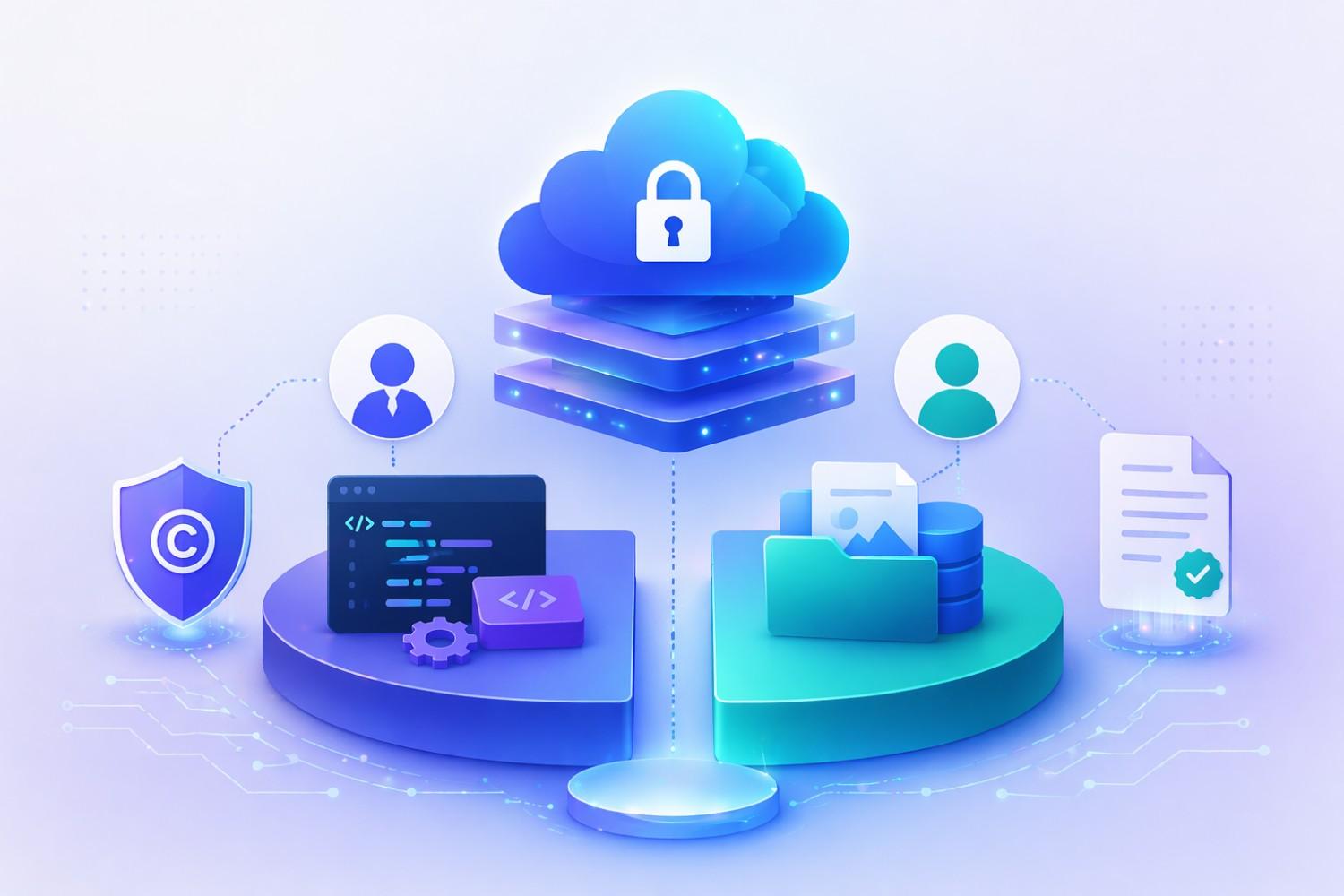
The fundamental challenge in SaaS IP negotiations arises from structurally opposed commercial interests. The providers are concerned about protecting their basic product infrastructure that includes the source code, architecture, proprietary technology used and experience that they have gained after developing them for many years. These factors form the backbone of their product offering and should never be shared inappropriately.
On the other hand, customers need to understand their data and ownership of the products delivered as part of the implementation process. Additionally, they may want proprietary ownership of any innovation created specifically for their needs. They may claim that the innovations created based on their needs are unique and should be owned only by them. This becomes the main point of disagreement between them and the root cause of all future disagreements.
Background IP: The Silent Asset
One of the aspects often overlooked when signing up a contract for SaaS is Background IP which is the intellectual property of the service provider before signing the SaaS contract. It includes the software itself, the frameworks, APIs, UI/UX design features, architectures and all the other resources developed outside of the scope of the specific customer relationship.
The SaaS agreement has to clearly state that all the background IP is owned solely by the service provider. Otherwise there might be some disputes regarding ownership because the existing IP developed by the service provider will be used in delivering customer solutions. The license issued to the customers has to be non-exclusive and non-transferrable only for internal purposes. A well-drafted Background IP clause not only protects the provider's core commercial asset but also establishes the legal baseline for understanding what can and cannot be assigned to the customer.
Work Product and the Assignment Gap
When SaaS implementations involve bespoke deliverable, custom integrations, migration tools, specialized dashboards, configuration scripts, or training documentation - the question of ownership in the resulting Work Product becomes especially critical.
Best-practice agreements provide that all intellectual property rights in such Work Product are fully assigned to the customer, free from third-party claims. This assignment should be accompanied by a waiver of moral rights (to the extent permissible under applicable law) and an express obligation on the provider to cooperate in executing any further documentation required to formalize the customer's ownership.
The legal precision of assignment language matters enormously. Drawing from principles reinforced in Stanford v. Roche (U.S. Supreme Court, 2011), courts have consistently held that a clause stating a party "agrees to assign" creates only a future contractual obligation, whereas "hereby assigns" constitutes an immediate transfer of rights. This distinction while seemingly semantic, determines whether ownership vests at the time of contract execution or remains legally uncertain until a subsequent deed is executed.
In the Indian context, this principle is equally operative. Under Section 17 of the Copyright Act, 1957, the developer is presumed to be the first owner of copyright unless a contract of service or a valid written assignment provides otherwise. Section 19 further requires that any copyright assignment be in writing and signed by the assignor, specifying the scope, duration, and territorial extent of the rights transferred. Businesses that rely on informal arrangements or imprecise language risk having IP ownership remain with the developer, a vulnerability that has been exploited in several Indian IT outsourcing disputes.
As affirmed by the Delhi High Court in Pine Labs Pvt. Ltd. v. Gemalto Terminals India Pvt. Ltd., ownership of software code rests on clear contractual assignment and documentary evidence. The absence of explicit clauses leaves ownership with the creator a risk no commissioning business should willingly accept.
Customer Data: Ownership Is Not Implied
One common loophole in SaaS contracts is the manner in which customer data is handled. Most companies consider that any data uploaded or created by them on the platform is their own, but in practice, it is far from clear-cut.
An effective SaaS contract has to make it clear that all customer data – regardless of when it was uploaded or created – is always the sole property of the customer. The ability of the provider to access such data must only be limited to those that are required to ensure the functioning of the services, including technical support. Commercial use of this data must not be allowed.
Most importantly, the contract should stipulate what happens to the data after the contract ends. Conditions for the return and/or deletion of the data need to be laid out as well, especially in order to meet any requirements set by laws such as the Information Technology Act, 2000 and the Digital Personal Data Protection Act, 2023.
Embedded Technology: The Licensing Problem Within Deliverables
One of the more technically complex issues in SaaS IP structuring arises when Work Product formally assigned to the customer, nevertheless contains elements of the provider's Background IP. Proprietary libraries, reusable modules, core system utilities, or foundational code embedded in a deliverable remain the provider's intellectual property notwithstanding the assignment of the Work Product as a whole.
To resolve this structural tension, well-drafted agreements grant the customer a perpetual, worldwide, fully paid-up, and transferable licence to use the provider's Background IP to the extent strictly necessary to exploit the assigned Work Product. This licensing framework ensures operational continuity for the customer enabling them to use, modify, integrate, and rely on the deliverables without interruption, while protecting the provider's ownership of and control over its underlying technology.
Without such a carve-out and corresponding licence, a customer holding formal assignment of Work Product may still be unable to operate it effectively if that requires access to the provider's Background IP, creating a practical ownership gap even where legal title has transferred.
Indemnification, Termination, and Enforcement
IP provisions are not standalone terms. Companies often fail to appreciate the relationship that exists between IP clauses and those relating to indemnification, termination, and enforcement. IP indemnification in the context of a SaaS agreement is commonly provided by vendors for allegations of infringement of IP of third parties by the software platform. As illustrated by Oracle America, Inc. v. NEC Corporation of America, the consequences of non-compliance with software licence terms can be severe, resulting in litigation and substantial financial settlement even between sophisticated commercial parties.
Termination clauses must address what happens to IP rights when the agreement ends. Businesses should ensure that any assignments made during the contract term survive termination, that accrued licenses remain operative, and that the provider's obligations regarding data return or deletion are independently enforceable.
Strong agreements also bind subcontractors and third-party personnel to the same confidentiality and IP obligations as the primary provider, closing gaps that may otherwise arise through outsourced development.
Conclusion
IP ownership in SaaS agreements is rarely as settled as the parties assume at signing. The structural complexity of cloud-based service delivery spanning platform licences, data rights, bespoke deliverables, and embedded technology creates multiple vectors of legal exposure for both providers and customers.
For businesses, the stakes are high: losing control over proprietary data, commissioned deliverables, or the technical outputs of significant investment can have lasting operational and commercial consequences. The safeguards are well understood: precise assignment language, clear delineation of background and foreground IP, robust data governance clauses, and coordinated indemnification and termination provisions.
As SaaS ecosystems grow increasingly complex integrating AI models, multi-cloud infrastructure, and third-party APIs intellectual property provisions will continue to define the legal architecture of digital partnerships. Organizations like SolvLegal that approach these clauses with rigour, and with qualified legal counsel, are best positioned to protect their innovation and ensure long-term contractual security.
Frequently Asked Questions (FAQs)
1. What is intellectual property ownership in SaaS agreements?
Intellectual property ownership in SaaS agreements refers to the legal rights over software, data, and deliverables created or used within the SaaS model. It typically distinguishes between provider-owned Background IP and customer-owned data or assigned Work Product. Clear contractual clauses are essential to avoid disputes.
2. Who owns customer data in a SaaS contract?
In well-drafted SaaS agreements, the customer retains full ownership of all data uploaded or generated on the platform. The service provider is usually granted limited access only for service delivery and support purposes, without any commercial exploitation rights.
3. What is the difference between Background IP and Work Product in SaaS?
Background IP refers to the pre-existing intellectual property of the SaaS provider, such as software, APIs, and architecture, while Work Product includes custom deliverables created specifically for the customer. Ownership of Work Product must be explicitly assigned through precise contractual and legal language.
4. Why is IP assignment language important in SaaS agreements?
The wording of IP assignment clauses determines when and whether ownership legally transfers. Phrases like “hereby assigns” ensure immediate transfer of rights, whereas “agrees to assign” may only create a future obligation, leading to potential ownership disputes.
5. What happens to intellectual property rights after a SaaS contract ends?
Post-termination, ownership rights, licenses, and data handling obligations must be clearly defined. Typically, IP assignments survive termination, customer data must be returned or deleted, and any necessary licenses for continued use of deliverables remain in force.

Related Articles
Leave a Comment