Master Service Agreements for IT Services in India: 10 Clauses Technology Companies Should Review Carefully
Read More
Early Termination of Lease Agreements: Legal Consequences and Exit Strategies
By the SolvLegal Team
Published on: May 6, 2026, 4:46 p.m.
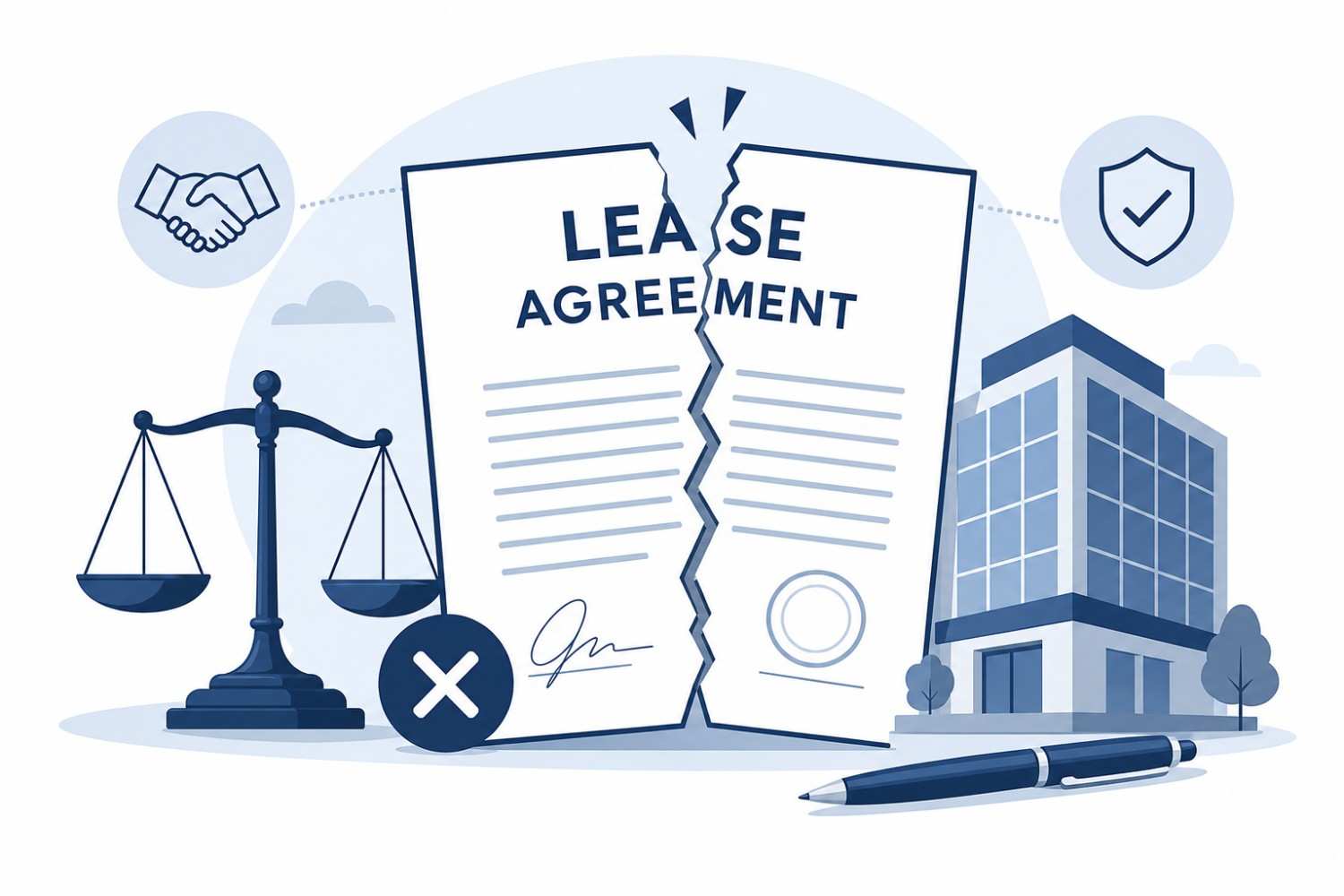
INTRODUCTION
Ending a lease agreement before its expiry is rarely a calm decision. It is usually driven by urgency business losses, relocation, restructuring, unexpected financial pressure, or disputes between parties. For landlords, early termination may arise from tenant default, misuse of premises, or persistent breach.
The question that brings most people here is simple but legally complex: Can you terminate a lease agreement early?
The answer depends entirely on the lease terms, the governing law, and the manner in which termination is attempted. A lease is not merely an informal arrangement. It is a binding legal contract creating enforceable rights and obligations. Exiting it prematurely without understanding the consequences can lead to substantial financial exposure.
This guide explains early lease termination in clear, practical language, while covering the key legal doctrines and contractual principles that determine whether you can exit and at what cost.
THE LEGAL NATURE OF A LEASE
Under Indian law, a lease is governed primarily by the Transfer of Property Act, 1882 and the Indian Contract Act, 1872. Unlike a simple service contract, a lease creates an interest in immovable property. Once possession is granted and consideration (rent) is agreed, both parties are legally bound for the duration of the term.
This means that early termination is not a matter of preference. It must either be contractually permitted or legally justified. If not, termination may amount to breach of contract, exposing the defaulting party to damages.
Understanding this distinction is critical. Many disputes arise because tenants assume that vacating the premises ends liability. Legally, it does not.
BREAK CLAUSES: THE MOST STRUCTURED EXIT MECHANISM
A break clause is the cleanest and safest way to terminate a lease early. It is a contractual provision allowing one or both parties to end the lease before the fixed term expires, provided certain conditions are satisfied.
Typically, a break clause becomes exercisable after a specified period for example, after completion of twelve months in a three-year lease. The clause usually requires advance written notice, often ranging from thirty to ninety days. Some agreements also require the tenant to clear all dues and ensure no subsisting breach exists at the time of exercising the clause.
However, courts interpret break clauses strictly. Even minor technical non-compliance such as incorrect notice calculation or failure to pay a small outstanding amount can invalidate termination. Therefore, precision in drafting and execution is essential.
Where a break clause exists and is properly invoked, termination becomes procedural rather than adversarial. Without it, the situation becomes significantly more complex.
LOCK-IN PERIODS AND THEIR ENFORCEABILITY
Many commercial leases contain a lock-in period, during which neither party may terminate the agreement. This clause is designed to provide stability and protect investments such as interior fit-outs, brokerage, or rent concessions.
Lock-in periods are generally enforceable, particularly in commercial arrangements where parties are presumed to have equal bargaining power. However, enforcement typically results in financial consequences rather than forced occupation. In other words, a tenant cannot be compelled to physically occupy the premises, but they may be liable to compensate the landlord for breach.
The crucial issue becomes whether the landlord can claim the entire remaining rent for the lock-in period. Courts examine whether the amount claimed represents genuine loss or an excessive penalty. The landlord’s duty to mitigate loss discussed later also plays a significant role in determining recoverable damages.
Thus, a lock-in clause does not make termination impossible, but it makes it financially consequential.
TERMINATION BY MUTUAL CONSENT: THE PRACTICAL SOLUTION
In real-world scenarios, termination by mutual consent often referred to as surrender of lease is the most pragmatic route. Surrender occurs when the tenant gives up possession and the landlord accepts termination.
This can be done through a formal surrender agreement, recording settlement terms and closure of obligations. It may involve payment of a negotiated amount, forfeiture of security deposit, or a limited compensation figure instead of full remaining rent.
Mutual termination reduces litigation risk, preserves professional relationships, and provides commercial certainty. Particularly in high-value commercial leases, parties often prefer negotiated exits over protracted disputes.
Where financial distress is involved, structured negotiation is often more effective than abrupt termination.
NOTICE REQUIREMENTS: THE TECHNICAL BACKBONE OF TERMINATION
Even where termination is permitted, compliance with notice requirements is essential. Lease agreements usually specify the manner of giving notice, the notice period, and the effective date of termination.
Errors commonly occur in calculating notice timelines or failing to follow the specified mode of delivery. For instance, if the agreement requires notice by registered post and acknowledgment due, an email may not suffice unless expressly permitted.
Additionally, some leases require notice to align with the rental cycle. Failure to comply with such procedural requirements can render termination defective, leading to continuing rent liability.
In lease disputes, notice defects are among the most litigated issues. A carefully drafted and properly served notice often determines whether termination succeeds or fails.
FRUSTRATION OF CONTRACT: A RARELY SUCCESSFUL ARGUMENT
Section 56 of the Indian Contract Act, 1872 incorporates the doctrine of frustration, which provides that a contract becomes void if performance becomes impossible due to unforeseen events.
However, Indian courts have consistently held that the doctrine of frustration rarely applies to completed leases. Once a lease is executed and possession is transferred, the arrangement is considered more than a mere contract it creates proprietary rights.
Temporary hardship, business losses, or reduced profitability do not amount to legal impossibility. Even severe economic downturns generally do not qualify as frustration.
Only in exceptional cases such as permanent destruction of the property or government acquisition rendering it unusable may frustration be invoked successfully.
Therefore, frustration is not a practical exit strategy in most lease situations.
It is important to distinguish the doctrine of frustration from statutory rights under Section 108(B)(e) of the Transfer of Property Act, 1882. This provision allows a lessee to treat the lease as void where the property is substantially and permanently destroyed by fire, flood, or other irresistible force.
FORCE MAJEURE IN LEASE AGREEMENTS
Force majeure clauses gained significant attention during the COVID-19 pandemic. These clauses excuse or suspend performance when extraordinary events beyond the parties’ control occur.
Whether force majeure can justify early termination depends entirely on the wording of the lease. Some clauses only suspend obligations temporarily. Others may excuse performance altogether.
Indian courts have generally held that force majeure does not automatically waive rent obligations unless the clause explicitly provides so. Financial inability to pay rent, even due to external events, is not automatically protected.
Thus, force majeure must be carefully examined within the context of the specific lease. It is not a universal remedy.
CONSEQUENCES OF WRONGFUL TERMINATION
Wrongful termination can result in substantial legal and financial consequences.
Consequences may include:
- Liability for remaining rent
- Forfeiture or adjustment of security deposit
- Legal costs and litigation risk
- Commercial and reputational exposure
The landlord may claim damages for:
- Unexpired lease period
- Lock-in period obligations
- Loss of business opportunity
However, such claims remain subject to mitigation principles and judicial scrutiny.
Importantly, vacating the premises alone does not extinguish liability.
Legal termination requires compliance with:
- Contractual obligations
- Statutory provisions
- Procedural requirements
LIQUIDATED DAMAGES VS PENALTY CLAUSES
Lease agreements frequently contain clauses specifying compensation payable upon early termination.
Under Section 74 of the Indian Contract Act, 1872, courts distinguish between:
- Genuine liquidated damages
- Penal clauses
Liquidated damages represent a reasonable pre-estimate of probable loss.
Penalty clauses, however, impose excessive amounts intended primarily to deter breach.
Courts generally award compensation linked to actual loss rather than mechanically enforcing excessive contractual sums.
For example, if the landlord re-lets the premises shortly after termination, claiming the entire remaining lease rent may be considered unreasonable.
This distinction significantly affects financial exposure in early termination disputes.
MITIGATION OF LOSS: THE LANDLORD’S DUTY
An important principle in contract law is mitigation of loss. The aggrieved party must take reasonable steps to reduce damages arising from breach.
In the context of leases, a landlord cannot deliberately leave the premises vacant and claim full rent for the remaining term. If the property is re-let, damages may be reduced accordingly.
Mitigation ensures that termination does not become a tool for unjust enrichment. It balances the interests of both parties and often determines the outcome of litigation.
SURRENDER VS ASSIGNMENT: CHOOSING THE RIGHT EXIT STRATEGY
Two distinct exit mechanisms often create confusion: surrender and assignment.
Surrender ends the lease entirely by mutual agreement. Assignment, on the other hand, transfers the tenant’s interest to a third party. Assignment typically requires landlord consent and may not release the original tenant from liability unless expressly agreed.
For commercial tenants seeking continuity without ongoing exposure, structured surrender is often safer than assignment. However, in thriving locations, assignment can provide a practical alternative.
The choice depends on negotiation leverage and contractual restrictions.
RESIDENTIAL AND COMMERCIAL LEASES: PRACTICAL DISTINCTIONS
While the legal principles remain broadly similar, commercial leases are generally enforced more strictly. Courts assume commercial parties possess greater bargaining power and business awareness. Residential tenants may sometimes receive more equitable consideration, but contractual terms still govern rights and obligations.
Therefore, businesses contemplating early termination must conduct careful risk assessment.
CHECKLIST BEFORE TERMINATING A LEASE
Before initiating early termination of a lease agreement in India, parties should assess:
- Availability of a break clause
- Lock-in period obligations
- Notice compliance requirements
- Potential financial liability
- Security deposit implications
- Likelihood of re-letting
- Existing defaults or outstanding dues
- Force majeure applicability, if any
A structured review at the initial stage can significantly reduce litigation risk.
POSSESSION AND HANDOVER: THE FINAL STEP
Termination is not complete merely upon issuance of notice. It is completed upon delivery of vacant possession. Parties should document the handover through a possession letter or surrender memo to avoid future disputes regarding occupation, damages, or pending dues.
RECENT JUDICIAL POSITION ON EARLY TERMINATION OF LEASE AGREEMENTS
Recent Indian jurisprudence reflects a clear and consistent approach:
Lease disputes are resolved primarily on contractual interpretation rather than broad equitable grounds. In Ramanand & Ors. v. Dr. Girish Soni & Anr. (2020), the Delhi High Court examined whether tenants could claim suspension or waiver of rent during the COVID-19 lockdown. The Court held that force majeure does not automatically excuse rent payment unless the lease expressly provides for it, and that financial hardship alone does not trigger Section 56 of the Indian Contract Act, 1872 in concluded lease transactions.
In Energy Watchdog v. CERC (2017), the Supreme Court of India clarified that force majeure clauses must be interpreted strictly in accordance with contractual language. Mere commercial difficulty or economic unviability does not amount to force majeure unless explicitly covered. Although the case arose outside the lease context, its reasoning has significantly influenced lease termination disputes involving force majeure claims.
Further, in Kailash Nath Associates v. DDA (2015), the Supreme Court of India reaffirmed that under Section 74 of the Indian Contract Act, 1872, compensation for breach must be reasonable and linked to actual loss. Courts have applied this principle in lease matters to distinguish enforceable liquidated damages from penal clauses, particularly where landlords claim rent for the unexpired term despite re-letting the premises.
These decisions collectively demonstrate that early termination of leases is judged through a strict contractual lens, break clauses are enforced as drafted, force majeure claims are narrowly construed, and damages are awarded based on reasonableness and mitigation rather than punitive recovery.
CONCLUSION: STRATEGIC TERMINATION IS LAWFUL TERMINATION
Early termination of a lease agreement is legally possible but only within defined frameworks. The safest routes are invoking a valid break clause or negotiating surrender. Lock-in clauses, notice requirements, and damage provisions significantly affect financial outcomes. Doctrines such as frustration and force majeure offer limited relief and are highly fact-specific. Wrongful termination, by contrast, can result in substantial liability.
The key takeaway is this: termination is not merely about vacating property. It is about exiting legally, strategically, and with controlled financial exposure. If you are considering terminating a lease, review the agreement carefully, assess your contractual position, calculate potential liability, and parties may consider obtaining independent legal advice before issuing notice.
In lease disputes, the difference between a costly mistake and a controlled exit often lies in the approach taken at the very beginning.
FREQUENTLY ASKED QUESTIONS (FAQS)
Can a tenant legally terminate a lease agreement before its expiry?
Yes, but only in specific circumstances. A tenant can terminate early if the lease agreement contains a valid break clause, if the landlord agrees to a mutual surrender, or if a legally recognized ground applies. Simply vacating the premises does not automatically end legal liability. The termination must comply with the lease terms and applicable law, including principles under the Transfer of Property Act, 1882 and the Indian Contract Act, 1872.
What is a break clause and how does it work?
A break clause is a contractual provision that allows either party to terminate the lease before the fixed term ends. Courts interpret break clauses strictly, so even minor procedural errors in notice or timing can invalidate the termination.
Is a lock-in period legally enforceable?
In most commercial leases, lock-in periods are enforceable. If a tenant exits during the lock-in period, the landlord may claim compensation. However, courts assess whether the claimed amount reflects actual loss or constitutes a penalty.
What happens if a tenant terminates a lease without legal justification?
Wrongful termination can lead to significant liability. The landlord may claim unpaid rent, damages for the unexpired period, adjustment or forfeiture of the security deposit, and legal costs. The extent of liability depends on contractual terms and whether the landlord mitigates loss by re-letting the premises.
Can financial hardship or business losses justify early termination?
Generally, no. financial difficulty does not amount to legal impossibility. Courts have consistently held that commercial hardship alone does not trigger the doctrine of frustration under Section 56 of the Indian Contract Act, 1872.
Does force majeure allow suspension or termination of rent obligations?
Only if the lease agreement expressly provides for it. Force majeure clauses must specifically cover the relevant event and clearly excuse or suspend rent obligations. In the absence of explicit wording, rent usually remains payable even during extraordinary events.
What is the difference between surrender and assignment of a lease?
Surrender ends the lease entirely by mutual agreement between landlord and tenant. Assignment transfers the tenant’s interest to a third party, typically with landlord consent. In assignment, the original tenant may remain liable unless expressly released. Surrender is often cleaner and reduces future risk exposure.
Is the landlord required to mitigate losses if a tenant leaves early?
Yes. Under general contract law principles, an aggrieved party must take reasonable steps to mitigate loss. A landlord cannot deliberately keep the property vacant and claim full rent for the remaining term. If the premises are re-let, the damages claim may be reduced accordingly.
ABOUT THE AUTHOR
Adv. Sanjana Mishra is a corporate lawyer with experience in contract drafting and regulatory compliance. She simplifies legal concepts to help businesses make informed, compliant, and growth-driven decisions.
DISCLAIMER
The information provided in this article is for general educational purposes and does not constitute a legal advice. Readers are encouraged to seek professional counsel before acting on any information herein. SolvLegal and the author disclaim any liability arising from reliance on this content.

Related Articles

Leave a Comment