Software Development Delays and Refund Claims in India: What the Law Actually Says
Read More
DPDP Act Consent Management: APIs, Consent Managers, and What Indian Businesses Must Actually Build
By the SolvLegal Team
Published on: May 26, 2026, 1:26 p.m.
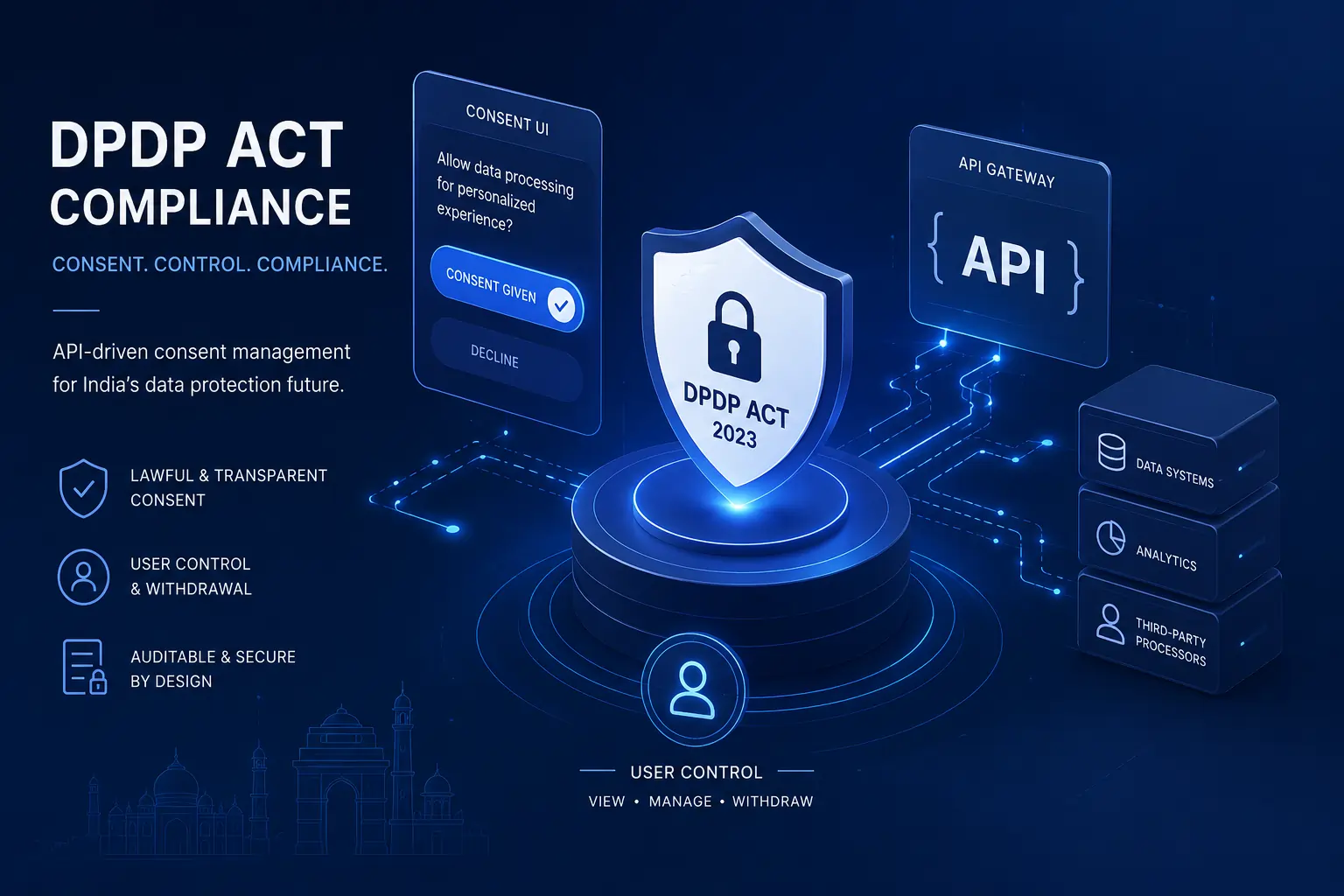
DPDP Act Consent Management: APIs, Consent Managers, and What Indian Businesses Must Actually Build
Legal and Technology Analysis | Privacy Engineering, API Governance, and DPDP Compliance
Quick Answer: The Digital Personal Data Protection Act, 2023 (DPDP Act) converts consent from a one-time checkbox into a continuously validated, technically enforceable obligation. Businesses must now deploy API-driven consent management platforms that verify user permissions in real time before any data processing occurs, maintain tamper-evident audit logs, and propagate consent withdrawals automatically across all integrated systems and third-party processors. Consent Managers, a new class of regulated intermediaries under the DPDP framework, provide an interoperable, data-blind layer for users to manage their consent across multiple platforms. Non-compliance carries penalties of up to INR 250 crores.
Why DPDP Compliance Is Now a Technology Problem
There is a particular kind of corporate confidence that comes from a forty-page privacy policy. For years, India's digital platforms, fintechs, SaaS providers, and financial institutions relied on precisely that instrument. Broad lawyer-drafted language buried inside terms of service agreements served as the legal foundation upon which entire data economies were built. Users clicked "I Accept" without reading, businesses processed data without restraint, and the regulatory framework was insufficiently equipped to intervene. That era is over.
The Digital Personal Data Protection Act, 2023 and the DPDP Rules, 2025 have changed the terms of engagement irrevocably. The legislation does not merely impose new rules on data collection. It demands a fundamental re-engineering of how businesses interact with user data at every point in the technology stack. This is not a compliance exercise that a skilled legal drafter can resolve over a long weekend. It is a software engineering challenge with severe legal consequences for failure.
The financial stakes clarify the urgency. Data breaches and systemic consent failures now carry penalties of up to INR 250 crores. Dark pattern UX designs that manipulate users into granting consent face dual enforcement from the Data Protection Board of India and the Central Consumer Protection Authority. The Act's most commercially consequential innovation, the Consent Manager, introduces a regulated intermediary layer that will reshape how data flows between businesses and their users across India's digital economy.
Privacy compliance has graduated from a legal drafting exercise to a challenge of enterprise architecture and privacy engineering.
For boards and technology leadership teams, the question is no longer whether to invest in API consent management infrastructure. That decision has been made by statute. The operative questions are how to architect that infrastructure correctly, how to govern third-party integrations under the new liability regime, and how to avoid the deceptive UX patterns that will invite regulatory scrutiny.
APIs as the Enforcement Mechanism for Consent
A Note for Non-Technical Readers
Before examining how APIs function within a DPDP-compliant consent architecture, it is worth establishing what they are for readers whose primary expertise lies in law, strategy, or business operations.
An Application Programming Interface is a defined communication channel between two software systems. When a user's banking application on their smartphone retrieves their account balance from the bank's central database, it does not connect directly to that database. Instead, it sends a request through an API, which validates the request, retrieves the relevant data, and returns a response. APIs are the invisible plumbing of every modern digital product, enabling dozens of internal and external systems to communicate securely.
Under the DPDP Act, APIs take on a different significance altogether. They cease to be merely a technical convenience and become the primary enforcement mechanism for user consent. Every time a user grants, modifies, or withdraws consent, an API transmits that decision to a secure backend consent repository. Every time an internal system or third-party processor attempts to access personal data, an API call to that repository determines whether access is legally permitted or must be blocked at the infrastructure level.
The Consent Artifact
When a user grants consent, the API transaction generates a "consent artifact": a machine-readable, cryptographically secured record of the user's specific choice, the version of the notice they saw, the timestamp, and the exact purposes they authorized. This artifact is the legal proof of compliance. Without it, a business cannot defend itself before the Data Protection Board.
The Check-Before-Processing Mechanism
The most operationally consequential requirement emerging from the DPDP Act is what privacy engineers call the "check-before-processing" mechanism. Under a legally compliant architecture, no internal microservice, analytics engine, marketing platform, or external data processor is permitted to access personal data by default.
Instead, every data access event must be preceded by a synchronous API call to the organization's central Consent Management System (CMS). That call queries the current, real-time status of the specific user's consent for the specific purpose for which data access is being requested. If the CMS returns an "active" or "valid" status, processing proceeds. If it returns "denied," "expired," or "withdrawn," the API gateway blocks access entirely at the system level, without human intervention.
This is a categorical departure from the legacy model, where consent was verified once during onboarding and assumed to persist indefinitely. Under the DPDP Act, consent is a living state that must be validated at the moment of every processing event. Processing data based on stale consent is unlawful, regardless of what the original privacy notice said.
The Legal Standard: Section 6 and the FISU-UW Framework
To build a technically sound consent architecture, enterprise leadership must understand the specific legal standard that architecture must satisfy. Section 6 of the DPDP Act establishes what practitioners have termed the FISU-UW standard: six characteristics that must simultaneously and demonstrably be present for consent to be legally valid.
PillarLegal RequirementCompliant ExampleNon-Compliant ExampleFreeNo coercion, bundling, or manipulationSeparate toggle for location data in a food delivery appRefusing to process a transaction unless the user accepts behavioral trackingInformedUser fully understands what data is collected and whyItemized notice specifying "transaction data for fraud detection"Vague statement: "we use your data to improve services"SpecificOne purpose equals one consentSeparate toggles for marketing emails and analyticsA single "I agree to Terms and Privacy Policy" checkboxUnconditionalNo lopsided terms that undermine legal rightsOptional consent for cross-sell offersConsent bundled with mandatory service termsUnambiguousClear affirmative action requiredUser actively clicks an unchecked "I Agree" boxPre-ticked boxes or consent assumed from continued scrollingWithdrawableRight to revoke must be as easy as grantingOne-click "Revoke Consent" on user dashboardRequiring users to call customer support to opt out
What makes the FISU-UW standard particularly demanding is the word "simultaneously." All six conditions must be present at the same time, in relation to every distinct processing purpose. A consent that satisfies five of the six pillars is not partially compliant. It is unlawful.
Rule 3: The End of Buried Terms
Rule 3 of the DPDP Rules, 2025 operationalizes the notice requirement with a level of specificity that eliminates all ambiguity. The consent notice must be a standalone document. It cannot be embedded within a general Terms of Service agreement or referenced through a hyperlink to a separate privacy policy. It must be written in plain language accessible to an ordinary person without legal assistance, and it must be available in English as well as the languages listed in the Eighth Schedule of the Constitution.
Every category of personal data being collected must be itemized and mapped explicitly to the specific purpose it serves and the service it enables. A notice that states "we collect your email address to provide our services" is non-compliant. A compliant notice would specify: "We collect your email address to send you transaction confirmation receipts, and separately to send you promotional communications if you consent to marketing." The notice must also include actionable links enabling withdrawal of consent and access to grievance redressal mechanisms.
Rule 4: The Engineering Mandate
Rule 4 translates the high-level consent principles into strict operational mechanics. Consent must be sought separately for each distinct purpose, without pre-ticked boxes and without bundling with any other acceptance. For technology teams, Rule 4 mandates meticulous per-user consent logging: every consent event must capture the exact timestamp, the specific version of the notice displayed, the mechanism through which consent was captured, and the precise purpose authorized. This logging requirement is not aspirational. It is the evidentiary foundation upon which legal defensibility rests.
Consent Managers: India's Regulated Privacy Intermediaries
Among the most structurally novel provisions of the DPDP Act is the creation of Consent Managers as a formal, regulated category of intermediary. Drawing on the architecture of India's Account Aggregator framework under the Data Empowerment and Protection Architecture (DEPA), the Consent Manager concept scales the principle of user-controlled data sharing from the financial sector to the entire digital economy.
What a Consent Manager Actually Does
A Consent Manager is a company registered with the Data Protection Board of India that operates as a single point of control for a user's consent across multiple, disparate data fiduciaries. Instead of a user logging into ten different platforms to understand what data each holds and to exercise their rights, a Consent Manager provides a unified, interoperable dashboard through which the user can view all active consents, review the notices they agreed to, and withdraw consent from any or all platforms in one place.
The Consent Manager's platform must be accessible through multilingual websites and mobile applications, reflecting the constitutional and statutory commitment to linguistic diversity. The interoperability requirement is central to the design: a Consent Manager's platform must be able to communicate with the technical systems of any registered data fiduciary, creating a standardized layer of consent orchestration across the Indian digital economy.
The Data-Blind Conduit Principle
Perhaps the most important architectural constraint on Consent Managers is the data-blind conduit principle, which mirrors the Account Aggregator model's approach to financial data. A Consent Manager orchestrates the flow of consent and, where relevant, the routing of personal data between a user and a data fiduciary. The Consent Manager must use a blind transport layer during this process.
This means the Consent Manager technically cannot access, read, analyze, store, or monetize the underlying personal data payload it routes. It deals exclusively in cryptographic consent artifacts and routing protocols. This design prevents Consent Managers from becoming yet another class of entity that aggregates and commercially exploits user data. The architecture enforces the neutrality that the fiduciary duty legally requires.
Regulatory Requirements for Consent Managers
Consent Managers must be incorporated in India with a minimum net worth of INR 2 crore. They are prohibited from subcontracting their core statutory obligations. They must maintain tamper-evident records of all consent events for a minimum of seven years. Their platforms must undergo independent certification. Penalties for non-compliance reach up to INR 50 crores, with the additional risk of suspension or cancellation of registration.
A clarification worth flagging: data fiduciaries are not currently mandated to use Consent Managers. Organizations may continue to collect and manage consent directly through their own systems, provided those systems independently satisfy all DPDP Act requirements. Given the engineering complexity of building and maintaining a fully compliant in-house consent management platform, however, integration with a registered Consent Manager will become the pragmatic default for all but the largest technology organizations.
How API-Based Consent Flows Work in Practice
The complete lifecycle of a consent event, from the moment a user first interacts with a platform to the downstream enforcement of their choices across integrated systems, is worth examining in detail.
Phase 1: Dynamic Notice and Consent Collection
The user initiates an onboarding or service request that requires personal data processing, such as opening a digital banking account. The frontend application fires an API call to the backend CMS, requesting the appropriate, purpose-specific notice configuration relevant to the service being requested. The CMS serves a dynamically generated, Rule 3-compliant consent notice to the user interface, with separate, clearly labeled toggles for each distinct processing purpose: mandatory data required for account opening, optional data for personalized product recommendations, and a separate opt-in for third-party marketing. The user reviews each item individually, makes deliberate choices on each toggle, and actively submits their selections.
Phase 2: Generating the Immutable Consent Artifact
The user's choices are transmitted to the CMS via a structured API payload containing the user's unique ID, the timestamp of each consent action, the specific purpose IDs authorized or denied, the exact version identifier of the notice displayed, and the initiating IP address. The CMS generates a cryptographic hash of the entire event record. This hash is the integrity seal. Any subsequent alteration to the underlying record will produce a different hash, immediately signaling tampering. The CMS then dispatches real-time webhook notifications to all relevant internal backend systems and registered third-party integrations, updating each system's view of the user's current consent status for each specific purpose ID.
Phase 3: Check-Before-Processing Enforcement
A downstream system, such as a marketing automation engine preparing to include the user in a promotional campaign, initiates a data access request. Before accessing any personal data repository, the system fires a synchronous API validation call to the CMS:
The CMS evaluates the current consent artifact and returns a boolean response. True permits processing. False blocks access at the infrastructure layer, before the data is ever retrieved, preventing the compliance breach from occurring at all. The system logs the result of the validation call, creating an audit trail that connects every data access event to the consent status at the exact moment of that access.
Enterprise Implementation: The FinLend Scenario
Abstract technical frameworks are best understood through concrete scenarios. Consider FinLend, a hypothetical fintech platform offering micro-loans through a mobile application. FinLend's underwriting process requires access to bank transaction history, a credit bureau check, and an AI-driven behavioral risk scoring model. It also has a commercial interest in cross-selling insurance products to loan applicants.
Under the previous legal regime, FinLend's legal team would draft a single Terms of Service agreement authorizing all of the above, and users would click "Accept" during onboarding without meaningful understanding of what they were authorizing.
Under the DPDP Act, FinLend must present a granular, itemized consent notice at onboarding. The credit bureau check is framed as mandatory for loan provision and linked explicitly to that service. The AI behavioral risk scoring is presented as a separate, optional purpose, with a clear explanation of what it involves. The insurance cross-selling is presented as a third, entirely independent purpose with its own toggle. The user cannot be refused a loan for declining the optional purposes, because that would constitute impermissible bundling under Section 6.
The user consents to the credit bureau check and declines both the AI scoring and the insurance cross-sell. FinLend's CMS generates a consent artifact recording these choices with cryptographic precision. The credit bureau, acting as a data processor under a DPDP-compliant Data Processing Agreement, receives the user's identity data via a secure API. The API gateway for FinLend's AI analytics engine and its insurance marketing platform, however, automatically returns a "Denied" status when those systems attempt a check-before-processing validation call for this specific user.
A month later, FinLend onboards a new debt collection partner. It cannot rely on the original consent artifact for data sharing with this new entity. The purpose is new. The entity is new. A fresh consent workflow must be triggered.
This is the operational reality that every fintech, bank, SaaS provider, and digital platform in India must now engineer into its core architecture.
Consent Withdrawal: The UX Symmetry Principle and Automated Propagation
Section 6(4) of the DPDP Act establishes a deceptively simple but technically demanding legal principle: the ease with which a user can withdraw consent must be equivalent to the ease with which they originally granted it. Privacy practitioners call this the UX Symmetry Principle, and it has direct, non-negotiable implications for both product design and backend architecture.
What UX Symmetry Demands in Practice
If a user granted consent with a single toggle and a single click during onboarding, the withdrawal mechanism must also be a single toggle and a single click, accessible from the user's account dashboard without requiring re-authentication, navigating through nested menus, or calling customer support.
The regulatory prohibitions are unambiguous. Requiring users to send a written request, hiding the revocation option under multiple layers of navigation, making the "Accept" button visually prominent while rendering the "Decline" or "Revoke" option in light gray small print, adding unnecessary friction steps such as multiple "Are you sure?" confirmation screens: all of these constitute structural non-compliance. They fail the "Unconditional" and "Free" pillars of the FISU-UW standard, and they are precisely the kind of dark patterns that both the Data Protection Board and the CCPA are actively looking to enforce.
Engineered Downstream Propagation
The frontend withdrawal experience is the visible face of a far more complex backend requirement. Section 6(6) mandates that upon withdrawal of consent, the data fiduciary must, within a reasonable time, cease all processing of the personal data in question, and must cause its data processors to also cease processing. This statutory obligation cannot be satisfied through manual ticketing systems, periodic batch reconciliation jobs, or next-business-day processing queues.
A technically compliant withdrawal propagation architecture works as follows. When the user clicks "Revoke" on their privacy dashboard, the CMS immediately updates the master consent artifact to record the withdrawal event, generating a new cryptographic hash that seals the updated record. The CMS then fires API webhooks simultaneously to every integrated system in the data fiduciary's ecosystem: its CRM platform, its data lake, its email marketing engine, its programmatic advertising integration, and every external third-party processor's API endpoint. These webhooks must trigger automated scripts at each receiving system that immediately halt any ongoing processing pipelines involving that user's data, and initiate data deletion, anonymization, or masking workflows aligned with the organization's data retention policies. The entire propagation chain must be logged and timestamped.
A data fiduciary that cannot demonstrate, through API call logs, that withdrawal propagation occurred promptly and completely will face the full weight of regulatory liability. If a user withdraws marketing consent but a siloed third-party ad-tech vendor continues to receive and process that user's behavioral data because the withdrawal webhook was not properly integrated, the data fiduciary bears full regulatory liability for the unlawful processing, regardless of the vendor's independent failure. This is the vicarious strict liability regime of Section 8, and it has no equivalent in the GDPR.
Data Fiduciaries vs. Data Processors: The Section 8 Liability Regime
The DPDP Act's liability framework for third-party integrations represents one of the sharpest departures from the GDPR model, and one that has material commercial implications for any business that relies on external vendors, SaaS tools, cloud providers, or analytics platforms.
Vicarious Strict Liability: India's Approach
Under the GDPR, data processors carry independent statutory obligations and can be investigated and penalized directly by regulatory authorities for failures in their own sphere of operations. The DPDP Act takes a different approach. Section 8(1) places absolute, vicarious liability on the data fiduciary for all processing undertaken on its behalf by data processors, irrespective of any contractual arrangement to the contrary.
In practice, if a cloud analytics vendor suffers a security breach, fails to honor a withdrawal webhook, or continues processing data beyond the authorized purpose, it is the platform or bank that faces penalties from the Data Protection Board, up to INR 250 crores. There is no mechanism under the DPDP Act for the fiduciary to redirect regulatory enforcement to the processor. The fiduciary owns the risk, entirely.
Liability DimensionDPDP Act (India)GDPR (European Union)Processor AccountabilityFiduciary is vicariously liable for all processor actions; no direct penalty on processorsProcessors have independent statutory obligations; can be fined directlyContract RequirementMandatory under Section 8(2); must include safeguards and breach notification provisionsMandatory under Article 28; highly prescriptive contractual requirementsWithdrawal ObligationFiduciary must ensure instant API-driven propagation to all processors upon withdrawalControllers must ensure processors respect all data subject rightsPrivate Right of ActionNone; enforcement flows exclusively through the Data Protection BoardData subjects can bring civil claims against processors for damagesMaximum PenaltyUp to INR 250 crores, levied entirely on the data fiduciaryUp to EUR 20 million or 4% of global annual turnover
Data Processing Agreements and API Governance
Section 8(2) mandates that data processors may only be engaged under a valid written contract, commonly referred to as a Data Processing Agreement or DPA. Under the DPDP Act, however, a DPA is not merely a legal formality that allocates contractual risk between commercial parties. It is the mechanism through which a data fiduciary enforces technical compliance obligations on every vendor in its ecosystem.
A DPDP-compliant DPA must contractually require the processor to integrate with the fiduciary's check-before-processing API architecture, to respect withdrawal webhooks in real time without batching or delay, to implement documented security safeguards including endpoint encryption and access controls, and to provide full audit log access in the event of a regulatory inquiry. Data fiduciaries that maintain loose, boilerplate vendor contracts that do not address these API governance requirements are not merely commercially exposed. They are operating in material breach of the statute.
Immutable Audit Logs and the Evidentiary Standard
When a consumer complaint reaches the Data Protection Board, or when the Board initiates a suo motu inquiry into alleged unlawful processing, the burden of proof rests entirely with the data fiduciary. The fiduciary must demonstrate, affirmatively and forensically, that every processing event it undertook was covered by valid, active, specific consent at the exact moment it occurred.
A conventional relational database, in which a system administrator can modify a consent_status = TRUE flag after the fact, is not a legally defensible consent record. It is precisely the kind of mutable, untrustworthy record that regulatory proceedings will scrutinize and dismiss.
ISO/IEC TS 27560 and Privacy Engineering Standards
ISO/IEC TS 27560, the international standard for consent record information structure, defines an interoperable, open framework for creating machine-readable consent receipts that can be securely exchanged between entities and verified by regulators.
Under a DPDP-compliant privacy engineering approach, every consent event, whether a grant, modification, or withdrawal, must generate an immutable log entry capturing: the specific purpose ID authorized or denied, the exact text and version identifier of the notice displayed to the user, the precise timestamp, the user's IP address, and a cryptographic hash of the entire data package. That hash is the integrity seal. If any element of the record is altered, the hash changes, and the tampering is immediately detectable.
Role-Based Access Control must be implemented to restrict unauthorized internal personnel from accessing or modifying consent logs. The logs themselves should be stored in infrastructure designed for immutability, such as append-only databases or blockchain-anchored record systems, depending on the organization's scale and risk profile. This is not optional privacy engineering sophistication. It is the technical infrastructure upon which legal survival depends.
Dark Patterns, Deceptive UX, and the Dual Regulatory Threat
The most technically sophisticated consent management system in India is legally worthless if the frontend experience through which consent is obtained employs psychological manipulation to produce that consent. Section 6(1)(a) of the DPDP Act explicitly prohibits deceptive or manipulative practices in the consent collection process. The requirement that consent be "free" is not merely about avoiding overt coercion. It encompasses the full range of interface design techniques that exploit cognitive biases to inflate opt-in rates.
The regulatory landscape is doubly threatening for businesses that rely on dark patterns. The Data Protection Board has authority under the DPDP Act. The Central Consumer Protection Authority has issued its own Guidelines for Prevention and Regulation of Dark Patterns, 2023, which independently targets the same behaviors under consumer protection law. An organization found to have used basket sneaking, false urgency, confirm shaming, or interface interference to obtain consent faces parallel enforcement actions from two separate regulatory bodies.
Dark PatternDescriptionDPDP Act ViolationCCPA EnforcementBasket SneakingAdding optional data-sharing consents at the final step of a transaction without prior disclosureViolates "Free" and "Specific" requirements of Section 6CCPA levied INR 7,00,000 on a major quick-commerce platform for this practiceConfirm ShamingUsing manipulative language on decline options: "No thanks, I prefer my data to be unsafe"Violates "Free" requirement; consent obtained under psychological coercionExplicitly listed as a prohibited dark pattern in CCPA 2023 GuidelinesFalse UrgencyImplying that consent must be granted immediately or service access will be lostCoercive mechanism invalidates the "Free" pillarIdentified as impairing consumer autonomy under CCPA frameworkInterface InterferenceMaking "Accept All" visually dominant while hiding "Decline" in small gray text behind multiple clicksViolates "Unambiguous" and "Free" requirements of Section 6Constitutes unfair trade practice under Consumer Protection Act, Section 17
Data fiduciaries must subject their consent collection interfaces to formal UX audits against both the DPDP Act's statutory requirements and the CCPA's dark pattern guidelines before deployment, and at regular intervals thereafter. UX design decisions are now legal decisions with financial consequences.
Implementation Challenges: What the MeitY BRD Reveals
While the DPDP Act establishes clear legal principles, the path from statutory text to operational architecture involves genuine complexity. The Business Requirement Document for Consent Management Systems issued by the Ministry of Electronics and Information Technology through the National e-Governance Division in June 2025 offers a revealing window into the challenges facing Indian businesses.
The BRD proposes a highly prescriptive, one-size-fits-all architecture that may not accommodate the operational realities of modern digital platforms. It mandates extreme granularity in purpose separation, requiring distinct consent checkboxes for each conceivable processing activity. For platforms that use data across interdependent purposes, where diagnostic analytics simultaneously improves core functionality and generates personalized recommendations, this rigid separation creates genuine architectural friction without necessarily improving user privacy outcomes.
The BRD also introduces proactive consent renewal, requiring platforms to notify users and obtain fresh consent before existing consents expire. For financial institutions, insurance companies, and SaaS platforms managing millions of long-term user relationships across a linguistically diverse population, executing consent renewal at scale without triggering consent fatigue or mass operational disruption is a formidable engineering challenge.
Perhaps the most commercially concerning issue raised by practitioners is what has been described as the "ghost in the machine" scenario. The DPDP Act places absolute liability on the data fiduciary. The BRD relies heavily on a separate third-party CMS to handle real-time API synchronization, artifact generation, and dashboard operations. If a commercial CMS vendor fails to propagate a withdrawal webhook correctly, the data fiduciary remains fully liable for the resulting breach, despite having no direct control over the specific technical failure. This dynamic makes SLA governance with CMS vendors a legal imperative, not merely a commercial preference.
Future Implications: AI Systems, Data Lakes, and the Privacy Economy
The DPDP Act's enforcement will have consequences far beyond the immediate compliance obligations of individual businesses. It is reshaping the economics of data-driven innovation across India's digital economy.
The Starvation of Data Lakes and AI Training Sets
Artificial intelligence systems are built on historical data. For years, Indian digital platforms have repurposed customer data collected for one purpose, say processing payments, to train proprietary machine learning models for entirely different purposes, such as behavioral prediction or risk scoring. Under the DPDP Act, purpose limitation is strictly enforced. Data collected for payment processing cannot be ingested into an AI training pipeline without explicit, unbundled consent for the specific purpose of "AI Model Training."
Organizations with legacy consent architectures will find that their vast data repositories are legally compromised. The data exists, but processing it for new AI purposes without fresh, purpose-specific consent constitutes unlawful processing. India's AI ambitions at the enterprise level are now directly tied to the quality of consent management infrastructure.
The Rise of Privacy-Enhancing Technologies
As the legal liability of holding identifiable personal data without continuously validated consent increases, economically rational enterprises will accelerate adoption of Privacy-Enhancing Technologies. Differential privacy, federated learning, tokenization, and on-device processing techniques reduce or eliminate the need for centralized personal data repositories. If data is genuinely anonymized and stripped of personal identifiers, it falls outside the regulatory scope of the DPDP Act entirely, making sophisticated consent orchestration unnecessary for that data category.
This will drive investment in privacy engineering capabilities within Indian technology teams, and will create a new market for privacy technology vendors offering DPDP-compliant data transformation tools.
Consent as Competitive Differentiation
The most strategically interesting long-term implication of the DPDP framework is the commoditization of trust. In a market where interoperable Consent Managers give users unprecedented visibility into who holds their data and frictionless tools to revoke access, privacy transparency will become a frontline competitive differentiator rather than a back-office legal function.
Platforms that offer genuinely transparent, user-respectful consent experiences will cultivate measurably higher consent opt-in rates and lower consent withdrawal rates. Those that rely on dark patterns to manufacture artificial consent will face not only regulatory enforcement but accelerating user attrition as the market becomes more sophisticated about data rights.
Five Things Business Leaders Must Understand
Consent is dynamic infrastructure, not a static checkbox. The DPDP Act requires real-time API-based validation of user consent before every data processing event. Consent must be purpose-specific, granular, and continuously enforceable across all internal systems and third-party integrations.
Withdrawal parity is both a legal and an engineering mandate. Section 6(4) requires that revoking consent be as frictionless as granting it. This demands automated downstream propagation via API webhooks that instantly halt processing and initiate data lifecycle management across every connected system.
Data fiduciaries bear absolute, vicarious liability for their data processors. Unlike the GDPR, the DPDP Act places the entire regulatory risk on the data fiduciary. Poorly governed third-party API integrations and inadequate Data Processing Agreements are existential legal liabilities, not merely technical vulnerabilities.
Consent Managers are a regulated class of intermediary operating under strict fiduciary duties. They are designed to give users interoperable, data-blind control over their consent across India's digital economy. For most enterprises, integrating with a registered Consent Manager will be the most practical path to scalable DPDP compliance.
Auditability requires immutable privacy engineering. Manual tracking systems and conventional databases are legally indefensible before the Data Protection Board. Enterprises must implement cryptographically hashed, tamper-evident consent logs, aligned with ISO/IEC TS 27560, that can prove the validity of every consent artifact at the exact moment of every data processing event.
Frequently Asked Questions
Do we have to use a registered Consent Manager to collect user data?
No. The DPDP Rules do not currently mandate the use of a Consent Manager. You may collect and manage consent directly through your own digital platform, provided your internal architecture independently satisfies all statutory requirements for itemized notice, purpose granularity, withdrawal parity, and immutable audit logging. Given the engineering complexity of meeting these requirements at scale, most enterprises will find that integrating with a registered Consent Manager is the more commercially rational choice.
What happens if a user withdraws consent but their data is sitting with our third-party analytics vendor?
Under Section 6(6), you must cause your data processors to cease processing within a reasonable time. Operationally, this requires automated API webhooks that trigger immediate processing halts and data deletion or anonymization at the vendor's systems. If the vendor fails to comply, your organization, as the data fiduciary, bears full regulatory liability for the continued unlawful processing, with penalties up to INR 250 crores.
Can we require users to accept marketing terms as a condition of using our core product?
No. This constitutes impermissible bundling under Section 6(1)(a) and violates the requirement that consent be "Free" and "Unconditional." You cannot make optional data processing consent a precondition for accessing core services unless that specific data is technically necessary for the service to function. Bundling invalidates the consent obtained.
How granular does our consent notice actually need to be under Rule 3?
Exceptionally granular. Rule 3 requires a standalone notice, in plain language, available in multiple Eighth Schedule languages, that itemizes every category of personal data being collected and maps each category explicitly to the specific purpose it serves and the specific service it enables. Broad statements such as "we collect your data to improve our services" are non-compliant. Each data category and each purpose must be separately identified.
What are the real risks of using dark patterns to improve our consent opt-in rates?
The risks are severe and dual-layered. First, dark patterns legally invalidate the consent they produce, because consent obtained through manipulation does not satisfy the "Free" or "Unambiguous" pillars of Section 6. This means all subsequent data processing based on that consent is unlawful. Second, dark patterns expose the business to parallel enforcement from both the Data Protection Board under the DPDP Act and the Central Consumer Protection Authority under its 2023 Guidelines on Dark Patterns. The CCPA has already levied financial penalties on major platforms for practices such as basket sneaking and drip pricing.
ABOUT AUTHOR
Aman Patel is a corporate lawyer with a focused practice in commercial transactions, contract drafting, corporate advisory, and legal strategy. A graduate of Symbiosis Law School, Hyderabad, he works extensively on matters involving business structuring, regulatory compliance, and transactional documentation. Aman shares practical insights on corporate law, evolving legal developments, and the intersection of business and regulation in India. He also regularly shares insights on data privacy, including developments under the Digital Personal Data Protection Act (DPDP) and the General Data Protection Regulation (GDPR).
DISCLAIMER
The information provided in this article is for general educational purposes and does not constitute a legal advice. Readers are encouraged to seek professional counsel before acting on any information herein. SolvLegal and the author disclaim any liability arising from reliance on this content.

Related Articles

Leave a Comment