What Investors Must Protect in a Shareholders Agreement
Read More
Have EU Customers? Why GDPR Applies to Your Business and How to Comply Without Overcomplicating It (2026 Guide)
By the SolvLegal Team
Published on: Jan. 20, 2026, 12:43 p.m.
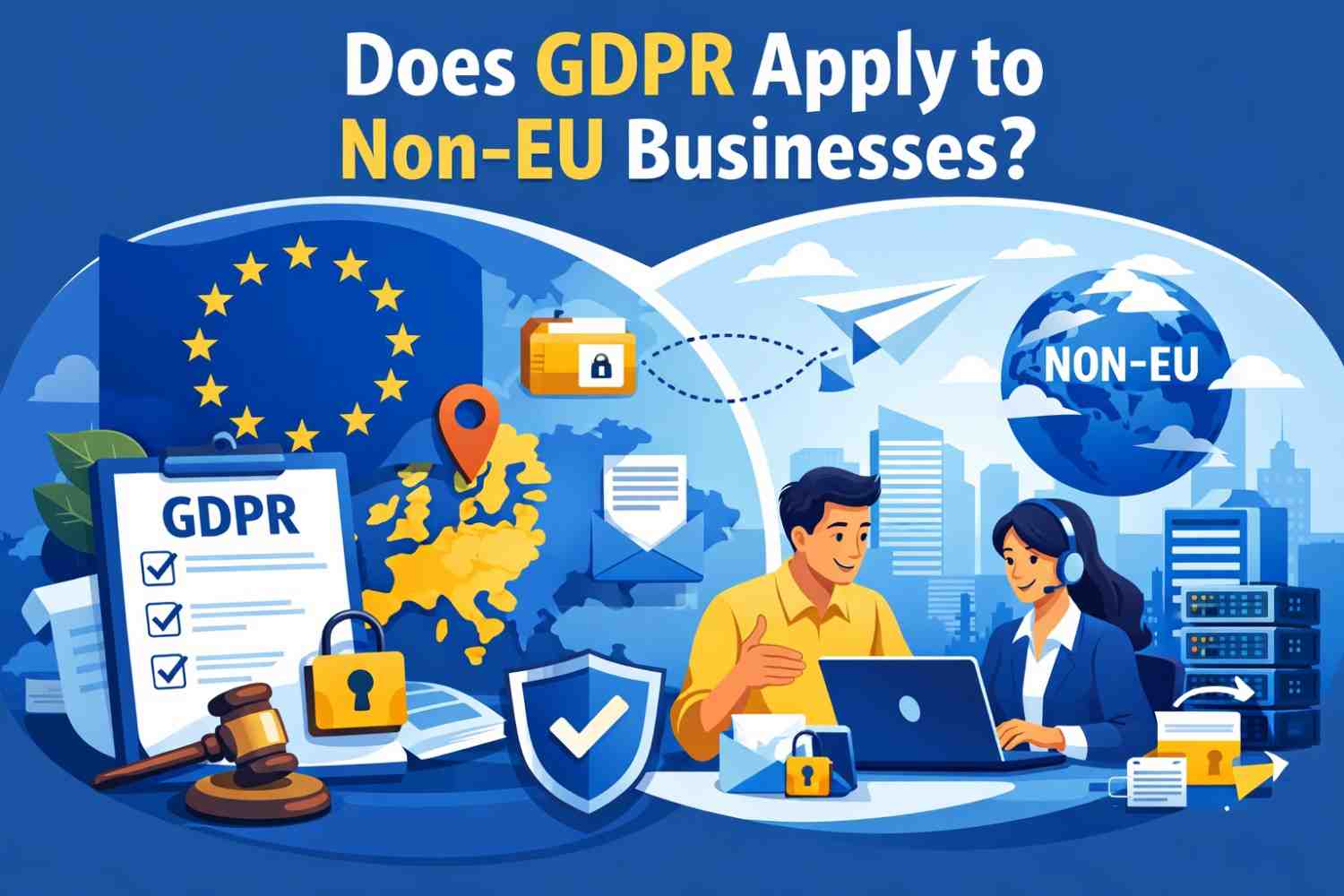
Quick Answer: What This Guide Covers
If your business has customers or users in the EU, GDPR likely applies to you even if you are based outside Europe. This guide explains why that is the case, when the law is triggered, and what you are actually required to do under GDPR in 2026.
It breaks down the core legal provisions that matter most, extraterritorial scope, lawful bases for processing, transparency duties, data subject rights, vendor obligations, international data transfers, and enforcement risks, without unnecessary theory or checkbox compliance. The focus is on what regulators enforce in practice and how businesses can comply in a structured, realistic way.
By the end of this article, you should be able to assess whether GDPR applies to your business, understand your key legal obligations, and implement compliance without overcomplicating operations or documentation.
The Legal Basis of GDPR’s Extraterritorial Reach
GDPR’s reach beyond the EU is not implied or interpretive. It is explicitly stated in Article 3. This provision is what brings non-EU businesses within scope, and regulators rely on it heavily in enforcement actions.
Under Article 3(1), GDPR applies where processing is carried out “in the context of the activities of an establishment” in the EU. This does not require a subsidiary or office. Even minimal operational presence linked to EU-facing activities can be enough. However, for most non-EU businesses, the real trigger lies in Article 3(2).
Article 3(2) extends GDPR to controllers or processors not established in the EU if their processing relates to either:
(a) the offering of goods or services to individuals in the EU, or
(b) the monitoring of their behaviour within the EU.
This is not about passive accessibility. Regulators look for intentional targeting. Factors such as EU-focused advertising, acceptance of EU currencies, EU delivery options, localisation of language, or onboarding EU users are all relevant indicators. On the monitoring side, activities like behavioural tracking, profiling, analytics, cookies, or location analysis involving EU users are sufficient to trigger applicability.
The legal test is simple but strict: if your processing is connected to EU individuals in a deliberate and structured way, GDPR applies, even if every part of your business infrastructure is located elsewhere. This extraterritorial design is deliberate and has been consistently upheld by supervisory authorities. Once Article 3 is triggered, the rest of GDPR follows in full.
What Qualifies as Personal Data and Processing
Once GDPR applies to your business, the next question is scope. What exactly is regulated? The answer is broader than most businesses expect, and it is defined precisely in Article 4 GDPR.
Under Article 4(1), personal data means any information relating to an identified or identifiable natural person. This is not limited to names or email addresses. Identifiers such as IP addresses, device IDs, location data, customer IDs, online usernames, and even combinations of data points that allow identification fall within scope. If data can reasonably be linked back to an individual, directly or indirectly, it is personal data.
Equally important is the definition of processing in Article 4(2). Processing covers almost every possible operation on personal data: collection, recording, storage, use, analysis, sharing, transfer, deletion, or even mere access. There is no threshold of scale or sophistication. Routine business activities such as running a website, using CRM software, sending marketing emails, providing customer support, processing payments, or analysing user behaviour all qualify as processing.
This is where many businesses misjudge their exposure. GDPR does not regulate only “sensitive” or “high-risk” activities. It regulates ordinary digital operations involving people in the EU. If your systems touch EU user data at any point, GDPR’s obligations are engaged. Understanding this scope is critical, because compliance failures often stem from underestimating what counts as personal data or assuming that limited processing falls outside the law.
Choosing the Correct Lawful Basis for Processing
This is the point at which GDPR compliance either builds correctly or collapses entirely. Article 6 GDPR does not give businesses flexibility to “pick what sounds convenient”. It requires you to identify, justify, and document the lawful basis that genuinely applies to each category of processing. Most enforcement actions trace back to mistakes made here.
Article 6 lists six lawful bases, but in practice, most businesses rely on only three: performance of a contract, consent, and legitimate interests. Each comes with strict conditions, and using the wrong one makes the processing unlawful from the outset.
Processing that is necessary for performing a contract applies only where the data is objectively required to deliver what the user has asked for. For example, collecting delivery details to ship a product or payment information to complete a transaction fits within this basis. What does not fit is using the same data for analytics, profiling, or marketing. Regulators consistently reject attempts to stretch “contract necessity” beyond its narrow purpose.
Consent, governed by Article 7, is the most misused lawful basis. Consent must be freely given, specific, informed, and revocable. It cannot be bundled, coerced, or assumed. If refusing consent results in denial of a core service, the consent is usually invalid. This is why relying on consent for routine business operations or mandatory tracking creates high enforcement risk. Once consent is withdrawn, processing must stop, and many businesses are operationally unprepared for that reality.
Legitimate interests, recognised under Article 6(1)(f) and Recital 47, are often the most appropriate basis for analytics, security, fraud prevention, and limited marketing. However, this basis is conditional. It requires a documented balancing test assessing whether the business interest outweighs the individual’s rights and expectations. Simply stating “legitimate interest” in a privacy policy is not enough. Regulators expect evidence that the test was actually carried out.
Special attention is required where special category data is involved, as Article 9 imposes additional prohibitions and exceptions. Many businesses unknowingly process such data through profiling, behavioural inference, or health-related services, without meeting the stricter thresholds required.
The key compliance mistake is treating lawful basis as a one-time label. In reality, it is a processing-by-processing decision. Each activity must be mapped to a lawful basis that can be defended during an investigation. If that foundation is weak, transparency notices, user rights handling, and international transfers all become legally unstable.
Transparency and Privacy Notice Obligations
Once you have identified the correct lawful basis for processing, GDPR requires you to tell individuals exactly what you are doing with their data. This obligation is not optional or cosmetic. It is a legal duty set out in Articles 12, 13, and 14, and it is one of the most commonly enforced parts of GDPR.
Article 12 lays down the standard: information must be provided in a concise, transparent, intelligible, and easily accessible form, using clear and plain language. Regulators regularly cite this provision when privacy policies are overly long, vague, copied from templates, or written in legal jargon that an average user cannot understand.
Article 13 applies when personal data is collected directly from the individual, such as through sign-ups, purchases, or contact forms. Article 14 applies when data is obtained indirectly, for example from third parties, data brokers, or public sources. The distinction matters because the timing and content of disclosures differ, and many businesses fail to comply with Article 14 entirely.
At a minimum, GDPR requires disclosure of the controller’s identity, purposes of processing, lawful basis relied upon, data retention periods, data subject rights, recipients of the data, and details of international transfers. Where legitimate interests are relied upon, those interests must be specifically explained, not stated in abstract terms. Where consent is used, individuals must be informed of their right to withdraw it at any time.
Timing is as important as content. Information must be provided at the time of data collection under Article 13, and within a reasonable period under Article 14, usually no later than one month. Providing disclosures only after processing has begun is a clear violation.
Regulators also look at how information is presented. Layered privacy notices, contextual disclosures, and just-in-time explanations are accepted and often encouraged, but burying key information behind multiple links or generic statements is not. A privacy notice must reflect actual data practices, not aspirational compliance.
In practice, transparency failures often reveal deeper compliance gaps. If a business cannot clearly explain what data it collects, why it collects it, and on what legal basis, it is unlikely that the underlying processing is compliant. This is why privacy notices are treated as evidentiary documents during investigations.
Data Subject Rights and Mandatory Response Duties
GDPR gives individuals enforceable control over their personal data, and regulators take these rights seriously. Articles 15 to 22, read with Article 12, impose clear obligations on businesses once a request is received. Failure here is not theoretical risk; it is one of the most common triggers for complaints and enforcement action.
Individuals have the right to access their data, correct inaccuracies, request erasure, restrict processing, object to certain uses, receive a copy of their data in a portable format, and not be subject to certain forms of automated decision-making. These are not abstract rights. Each one carries an operational duty that businesses must be able to perform on demand.
The most critical requirement is time. Under Article 12(3), responses must be provided within one month of receiving a request. Extensions are permitted only in limited circumstances and must be justified and communicated. Ignoring a request, delaying without explanation, or providing partial responses is treated as a violation in itself, regardless of whether the underlying processing was lawful.
GDPR also limits when requests can be refused. Requests may be denied only if they are manifestly unfounded or excessive, and even then, the burden of proof lies with the business. Regulators expect documentation explaining why a refusal was justified. Simply stating that a request is “unreasonable” is not sufficient.
Another frequent compliance failure is poor internal coordination. Data subject requests often touch multiple systems: customer databases, marketing tools, support platforms, and third-party vendors. GDPR expects controllers to have processes in place to locate, assess, and respond to requests across all relevant systems. Lack of internal visibility is not accepted as an excuse.
Importantly, how you respond matters as much as whether you respond. Information must be provided in a clear and accessible form, free of legal jargon. Where data cannot be erased or access cannot be granted, the reasons must be explained transparently, along with information about the individual’s right to complain to a supervisory authority.
In practice, data subject rights are where GDPR becomes real for most businesses. They turn compliance from policy into action.
Accountability, Records, and Internal Controls
GDPR does not operate on trust. It operates on accountability. This principle, set out in Article 5(2), requires businesses not only to comply with the law, but to be able to demonstrate that compliance at any time. In enforcement practice, this distinction is crucial. Regulators rarely ask whether you intended to comply. They ask what evidence you have.
One of the clearest expressions of this principle is the requirement to maintain records of processing activities under Article 30. These records are not optional paperwork. They are the first document regulators request during investigations. They must accurately describe what data is processed, for what purposes, on what lawful basis, how long it is retained, and with whom it is shared. Generic or outdated records signal weak governance.
GDPR also embeds accountability through privacy by design and by default under Article 25. This requires data protection considerations to be built into systems and workflows from the start, not added later as a policy layer. Collecting more data than necessary, retaining it indefinitely, or enabling unrestricted access internally are all viewed as failures of design, not operational accidents.
Security measures form another core control. Article 32 requires appropriate technical and organisational safeguards based on risk. This does not mandate specific technologies, but it does require evidence of risk assessment, access controls, encryption where appropriate, incident response planning, and regular review. Saying “we are secure” is not compliance; showing how security decisions were made is.
What regulators look for, in practice, is coherence. Lawful bases should align with privacy notices. Records should reflect actual systems. Security controls should match the sensitivity of the data processed. Where these elements contradict each other, enforcement risk rises sharply.
Accountability is not about perfection. It is about structure, documentation, and consistency. Businesses that can show deliberate decision-making, even where trade-offs exist, are treated very differently from those that cannot explain how compliance was approached at all.
Processor Relationships and Mandatory Contractual Clauses
One of the most underestimated GDPR risks sits outside your organisation: third-party processors. Cloud providers, SaaS tools, marketing platforms, payment processors, customer-support software, and analytics services all process personal data on your behalf. GDPR does not allow controllers to outsource responsibility along with operations.
Article 28 GDPR is explicit. Whenever a processor processes personal data on your behalf, there must be a binding written contract governing that relationship. Using a vendor without a compliant data processing agreement is itself a violation, even if no data breach ever occurs.
The regulation specifies what these contracts must contain. At a minimum, they must define the subject matter and duration of processing, the nature and purpose of processing, the types of personal data involved, and the obligations of both parties. They must also impose clear duties on processors to act only on documented instructions, maintain confidentiality, implement security measures, assist with data subject requests, support breach notification obligations, and delete or return data at the end of the relationship.
A common compliance failure is assuming that standard vendor terms are sufficient. Many SaaS providers offer generic privacy clauses that do not meet Article 28 requirements or shift responsibility back to the controller in subtle ways. Regulators have repeatedly made clear that controllers remain accountable for their choice of processors and the adequacy of contractual safeguards.
Vendor risk is not limited to paperwork. Controllers must also ensure that processors provide sufficient guarantees of compliance in practice. This includes assessing security measures, sub-processing arrangements, and cross-border data flows. Blind reliance on reputational trust or market popularity does not satisfy GDPR’s due diligence expectations.
From an enforcement perspective, processor contracts are easy targets. They are binary: either the required clauses exist or they do not. During audits, missing or deficient agreements are treated as structural compliance failures, not technical oversights.
For businesses aiming to comply without overengineering, the lesson is straightforward. Maintain a clear inventory of vendors, identify which ones act as processors, and ensure every such relationship is backed by an Article-28-compliant agreement. This single step eliminates a large portion of avoidable GDPR exposure.
International Data Transfers and Transfer Risk
Transferring personal data outside the EU is one of the highest-risk GDPR activities, and it is also one of the most misunderstood. Once GDPR applies to your business, Chapter V (Articles 44–49) becomes unavoidable if EU data is accessed, stored, or processed outside the EU, even temporarily.
The starting rule under Article 44 is strict: personal data may be transferred outside the EU only if the level of protection guaranteed by GDPR is not undermined. This means that transfers are not prohibited, but they are conditional. Many businesses fail here by assuming that using foreign servers or global SaaS tools is automatically permitted.
The safest route is an adequacy decision under Article 45, where the European Commission has recognised a country as providing essentially equivalent protection. Where adequacy applies, transfers can occur without additional safeguards. However, adequacy is limited and jurisdiction-specific, and it does not cover many commonly used destinations.
Where adequacy does not exist, businesses usually rely on Standard Contractual Clauses (SCCs) under Article 46. Since the Schrems II decision, SCCs are no longer a box-ticking exercise. Controllers must assess whether the laws and practices of the destination country could interfere with data protection, and whether supplementary measures are required. Regulators now expect a documented transfer risk assessment, not blind reliance on templates.
Derogations under Article 49 exist, but they are narrow and exceptional. They are not meant for regular, large-scale, or systematic transfers. Over-reliance on derogations is frequently cited as a compliance failure in enforcement actions.
What makes this area particularly risky is that international transfers often occur indirectly. Using cloud hosting, customer support tools, analytics platforms, or remote teams outside the EU can all trigger Chapter V obligations. Businesses often discover transfer issues only during audits or investigations.
From an enforcement perspective, regulators treat unlawful transfers as serious violations because they undermine the core protections of GDPR. For compliance in 2026, the focus is no longer on whether contracts exist, but whether the transfer decision was reasoned, assessed, and documented.
Enforcement, Penalties, and What Regulators Actually Act On
GDPR enforcement is not abstract, and it is not evenly distributed across all obligations. Regulators focus on clear, provable failures, not on whether a business has perfect policies. Understanding this enforcement logic is essential if you want to comply without overengineering.
Under Article 58, supervisory authorities have wide investigative and corrective powers. They can demand documents, order audits, require changes to processing, suspend data flows, and impose bans on certain activities. These powers are frequently used before fines are even considered. Many businesses underestimate this and assume enforcement begins and ends with monetary penalties.
Fines are governed by Article 83, which sets two tiers: up to €10 million or 2% of global annual turnover, and up to €20 million or 4% of global annual turnover, depending on the nature of the violation. However, regulators do not fine randomly. They assess factors such as the seriousness of the breach, duration, intent or negligence, cooperation with authorities, prior violations, and whether basic GDPR principles were ignored.
In practice, enforcement is most often triggered by complaints and breaches, not by routine audits. Data subject complaints about ignored access requests, unlawful marketing, or lack of transparency are common entry points. Security incidents that expose personal data and are poorly handled or reported late also attract immediate attention.
What regulators consistently act on are foundational failures: processing without a lawful basis, misleading or missing privacy notices, ignoring data subject rights, unlawful international transfers, and absence of processor contracts. Technical perfection does not compensate for these gaps. A business with modest but well-documented compliance is treated more favourably than one with extensive policies that cannot be operationally defended.
For businesses worried about complexity, the key takeaway is this: regulators reward clarity and accountability, not volume. Demonstrating that decisions were consciously made, documented, and reviewed matters more than having exhaustive paperwork.
How SolvLegal Supports GDPR Compliance in Practice
SolvLegal helps businesses translate GDPR obligations into workable compliance structures rather than abstract policies. The focus is on identifying where GDPR applies, mapping data flows, and aligning lawful bases, privacy notices, and internal processes with actual business operations. This approach avoids overcompliance while addressing the areas regulators scrutinise most closely.
For businesses operating outside the EU, SolvLegal also assists with cross-border compliance, including Article 27 EU representative obligations, processor contracts under Article 28, and international data transfer frameworks under Chapter V. The objective is not just formal compliance, but building documentation and decision-making trails that stand up to regulatory and commercial scrutiny.
Conclusion
If your business has EU customers, GDPR is not a theoretical risk or a future problem. It is a current legal framework that applies based on what you do, not where you are based. Article 3 makes that clear, and everything else in GDPR flows from that starting point.
What this guide shows is that GDPR compliance is not about chasing every possible requirement or drowning your business in paperwork. It is about getting the fundamentals right. Choosing the correct lawful basis under Article 6, being transparent under Articles 12 to 14, respecting data subject rights, maintaining accountability records, controlling vendors, and handling international transfers lawfully. These are not optional extras. They are the core of the Regulation.
Most enforcement actions do not arise because businesses tried and failed. They arise because businesses never structured compliance at all, relied on assumptions, or treated GDPR as a checkbox exercise. Regulators consistently reward clarity, documentation, and conscious decision-making, even where compliance is imperfect. What they penalise is silence, inconsistency, and avoidance.
In 2026, GDPR compliance is best understood as a risk-management exercise. When done correctly, it integrates into normal business operations instead of sitting on top of them. Businesses that approach GDPR this way reduce enforcement risk, respond better to user complaints, and avoid disruption when regulators or partners ask questions.
If you have EU customers, GDPR is already part of your legal environment. The choice is not whether to comply, but whether to do so deliberately and efficiently, rather than reactively and under pressure.
Frequently Asked Questions (FAQs)
Does GDPR apply if I have only a few EU customers?
Yes. GDPR does not have a minimum threshold based on the number of EU customers. If you intentionally offer goods or services to even a small number of people in the EU, or monitor their behaviour, Article 3 is triggered. Scale may affect enforcement priority, but it does not remove legal applicability.
Does GDPR apply to companies based in India, the US, or the UAE?
Yes. GDPR applies based on the location of the data subjects, not the location of the business. Companies incorporated in India, the US, the UAE, or elsewhere fall under GDPR if they target or track individuals in the EU. Regulators have repeatedly confirmed that non-EU status is not a defence.
Can I rely on consent for all my data processing?
No, and this is a common mistake. Consent under Article 7 must be freely given, specific, informed, and revocable. It is often inappropriate for core business operations or mandatory processing. Many activities are better justified under contract necessity or legitimate interests, provided the legal conditions are met.
Do I need to appoint an EU representative?
In many cases, yes. Under Article 27, non-EU controllers or processors subject to GDPR must appoint an EU representative unless a narrow exception applies. This requirement is frequently overlooked and can itself become a compliance issue during enforcement.
What happens if I ignore a data subject request?
Ignoring or delaying a request is a direct violation of GDPR. Under Article 12(3), you must respond within one month. Failure to do so often leads to complaints and enforcement action, even where the underlying processing might otherwise be lawful.
Are small businesses or startups exempt from GDPR?
No. GDPR does not exempt small businesses or startups. While certain documentation obligations may be lighter in limited cases, the core principles, lawful basis, transparency, data subject rights, and security, apply to all businesses equally.
Is GDPR compliance a one-time exercise?
No. GDPR requires ongoing compliance. Lawful bases, privacy notices, vendor relationships, and security measures must be reviewed as business models, technologies, and data flows change. Treating GDPR as a one-time checklist is one of the fastest ways to fall out of compliance.
Related articles:
1. CROSS BORDER CONTRACTS IN INDIA
3. Global Data Privacy Laws Compared: GDPR, CCPA, PDPL, PIPEDA & India’s DPDP Act – 2025 Guide
About the author: Kunal Singh is a second-year B.Sc. LL.B. (Hons.) student at National Forensic Sciences University, Gandhinagar.
Reviewed by
This blog was reviewed by Yashvardhan Singh, a legal professional focusing on legal research, contract analysis, and regulatory compliance. He works closely with corporate and technology-driven legal frameworks, with particular exposure to data protection, commercial documentation, and legal process optimisation. His work supports businesses in strengthening compliance structures and ensuring legally sound operations.
Disclaimer
The information provided in this article is for general educational purposes and does not constitute a legal advice. Readers are encouraged to seek professional counsel before acting on any information herein. SolvLegal and the author disclaim any liability arising from reliance on this content.

Related Articles

.jpeg "How to Protect an App Idea: Copyright, Design and Patent Explained")

Leave a Comment